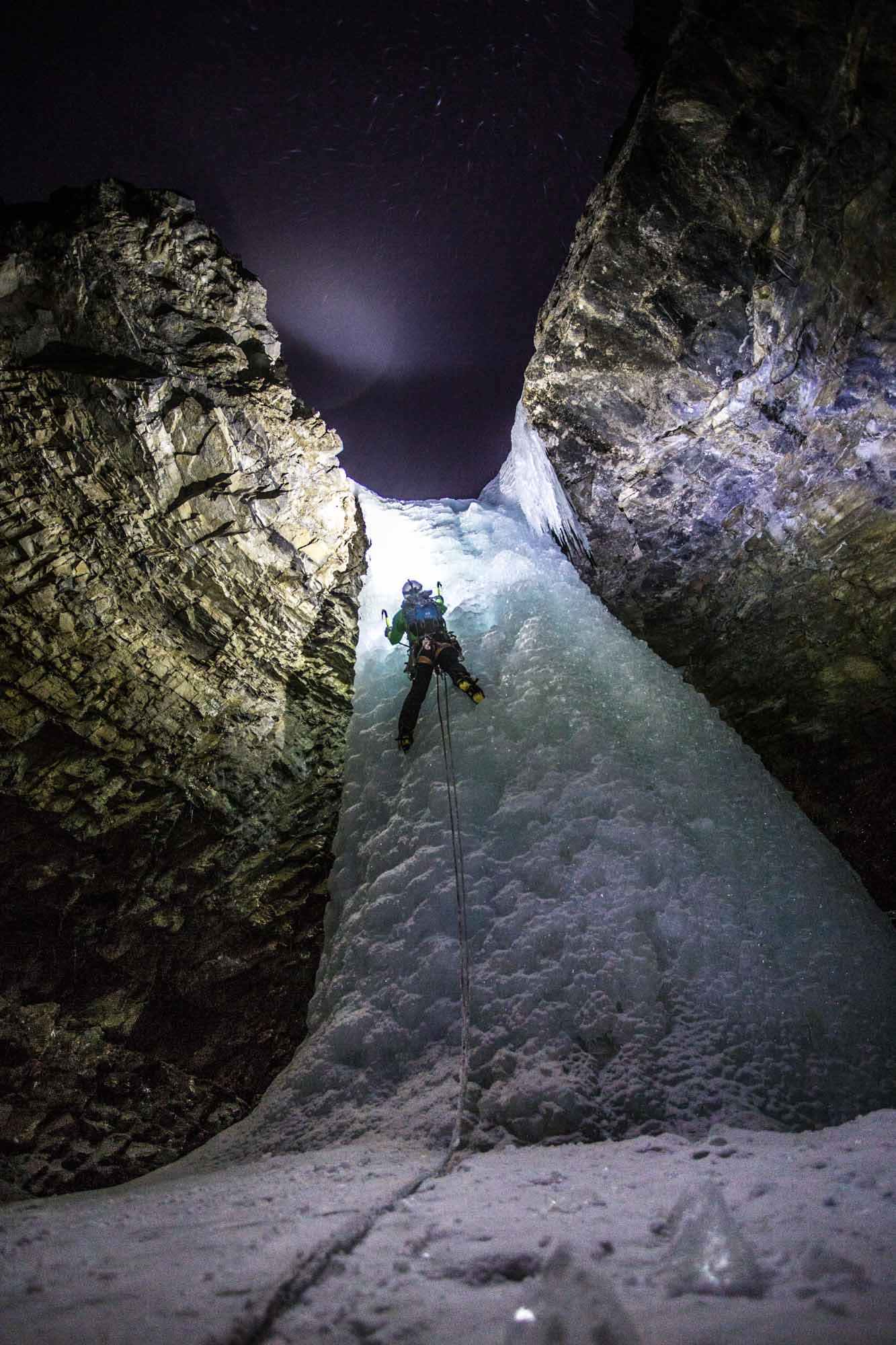
Classic multi-pitch ice on Mount Rundle above Banff; stepped tiers of short pillars/curtains with a steeper crux final pitch; ~280–300 m overall, typically 6–8 short pitches depending on how you group steps.
Top 100 But It's Probably More Like Top 136
Ice and Mixed Classics
Ranked by community rating. Tap any route to dive deeper into the latest description and pitches.
Rating first100 entriesCommunity picks
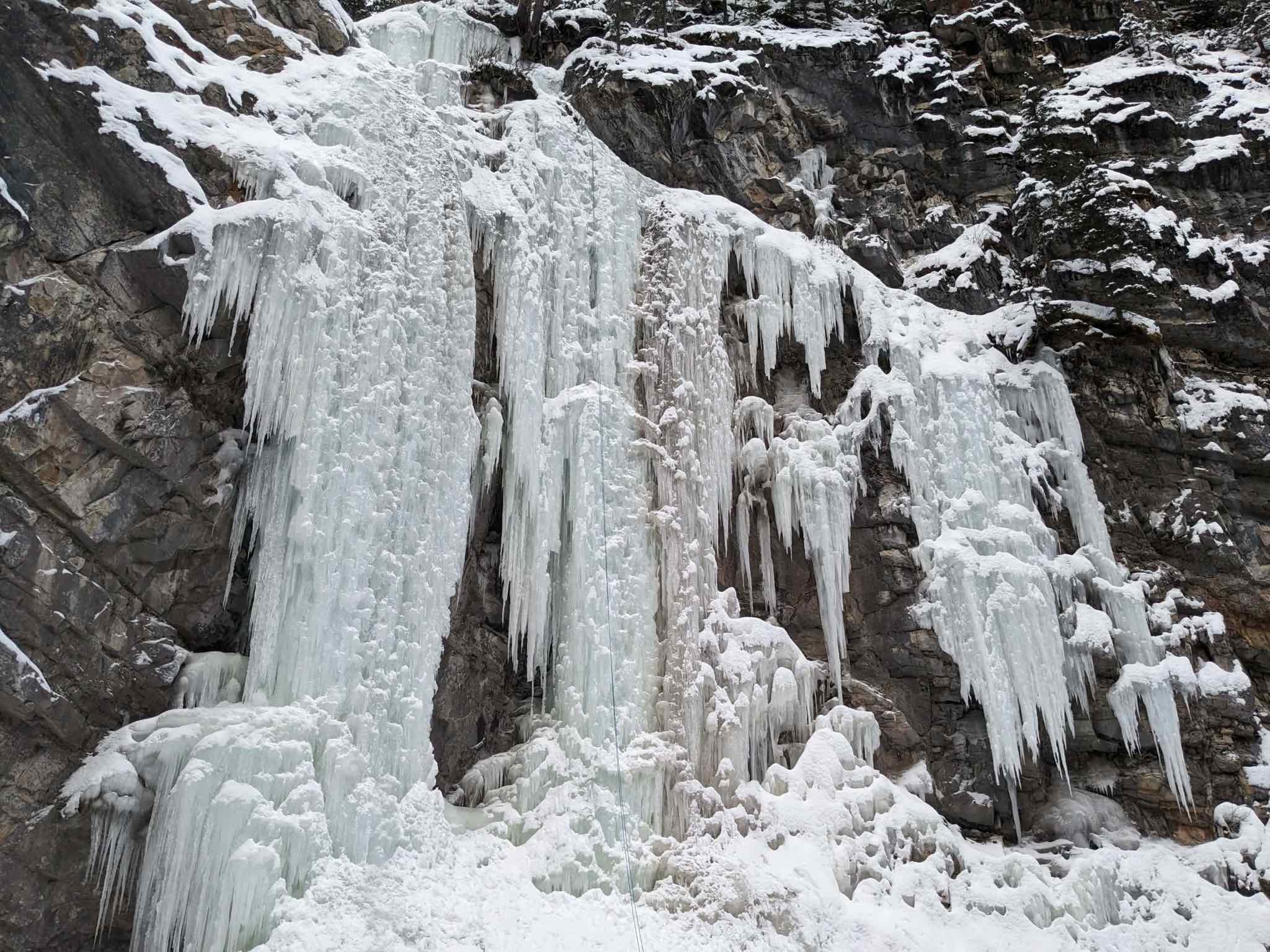
WI4+ - II - 30m Class 1 This curtain provides likes with varying difficulty from W4 to 4+. It is a great area if the moonlight area is busy, albeit quite a bit further from moonlight.
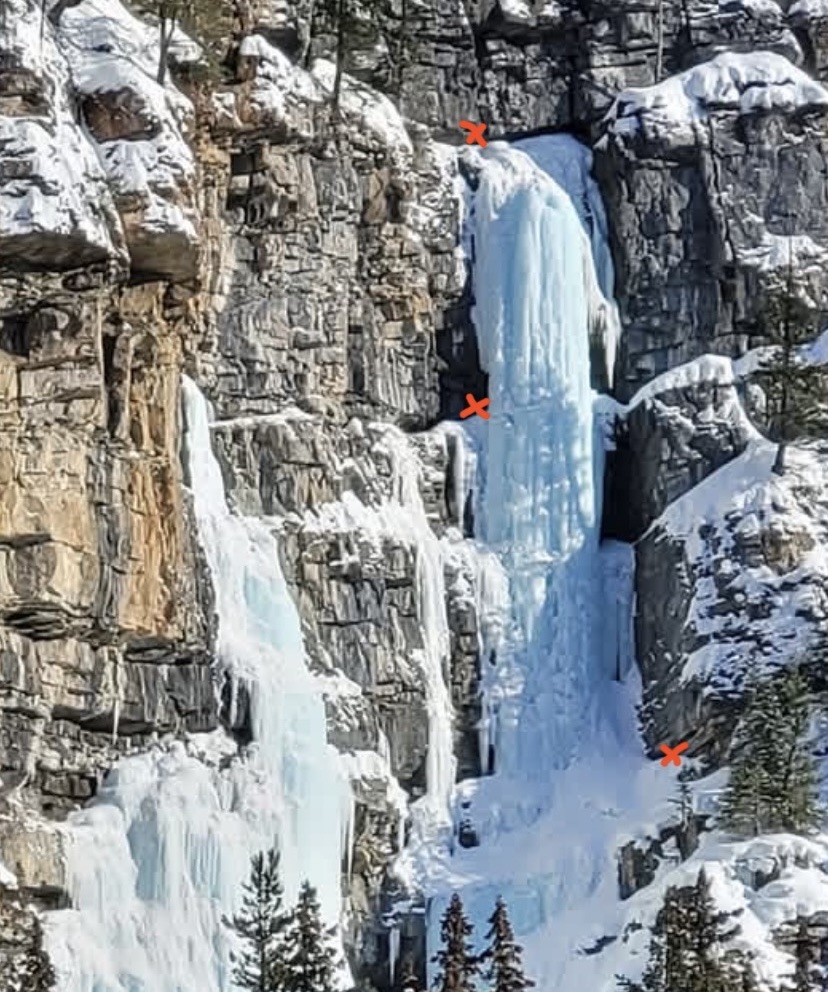
A classic WI5 for the Field area. A great back-up plan is climbing “The Pillars” located left of F.O.D. Be aware of changing conditions; there is sluff and rockfall hazard from overhead.
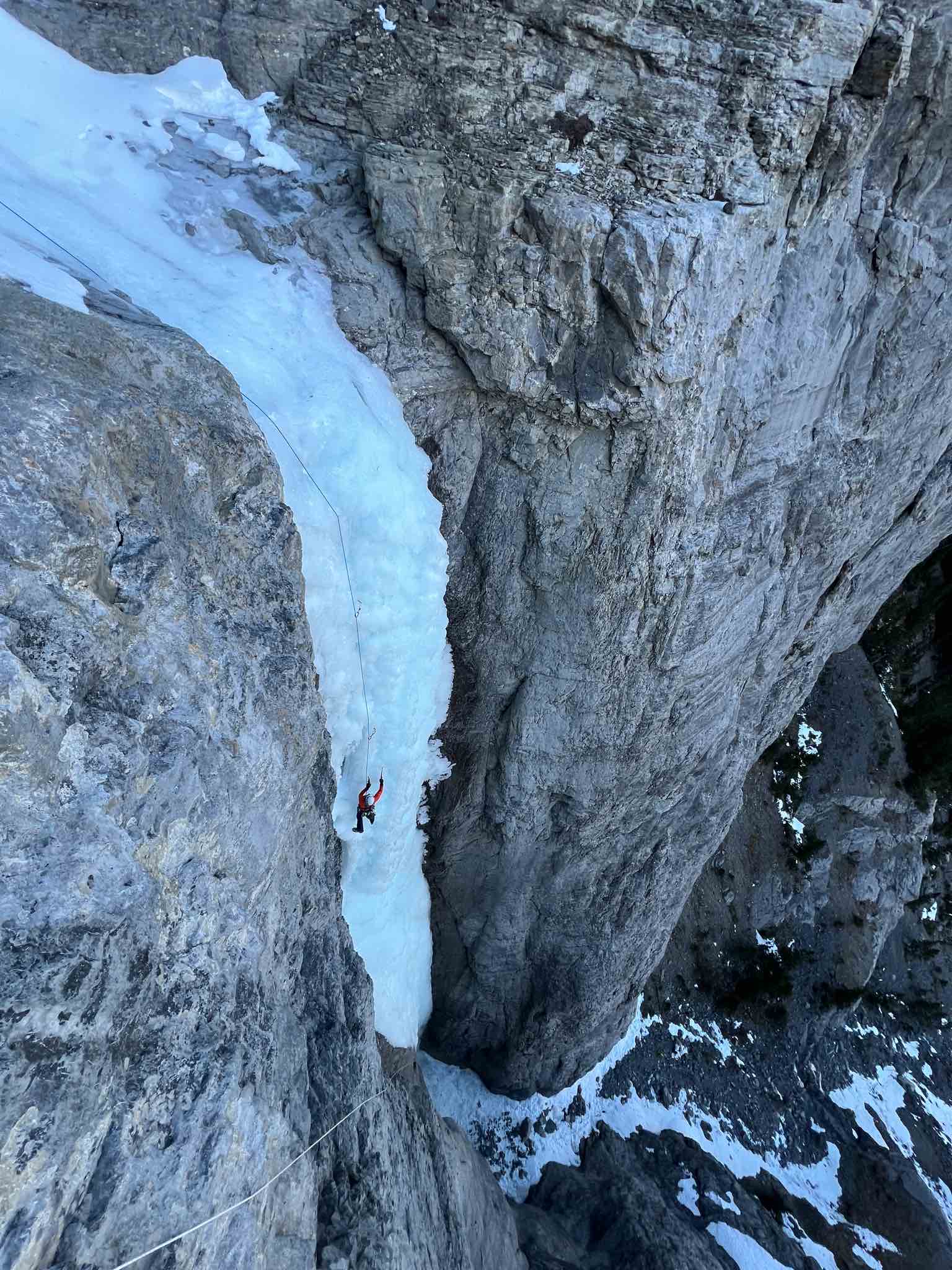
Classic two-pitch Ghost ice that changes character year to year: anything from straightforward grade 4 to a more engaging outing with wind-sculpted features on the second pitch. North-facing and reliably formed relative to its neighbors.
A full-length 60 m WI4 pitch forming the gateway into the Ghost’s Recital Hall—sustained but with short benches, commonly climbed as one long rope-stretcher to the bolted station on the right. As the season progresses, the top receives sun and can thin, sometimes warranting a large cam on the left wall. The Recital Hall above gives access to Fearful Symmetry and Rainbow Serpent.
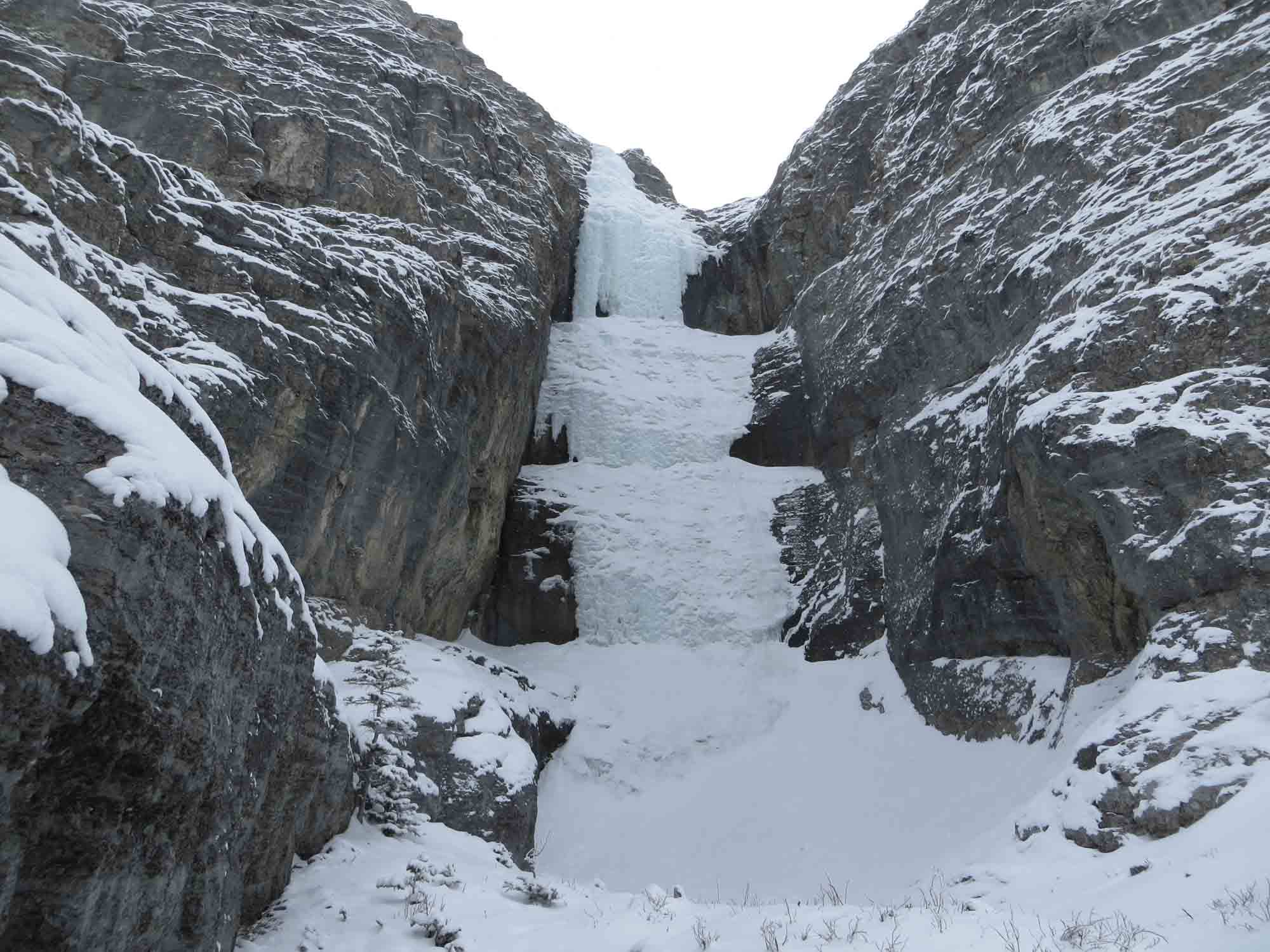
No overview yet.
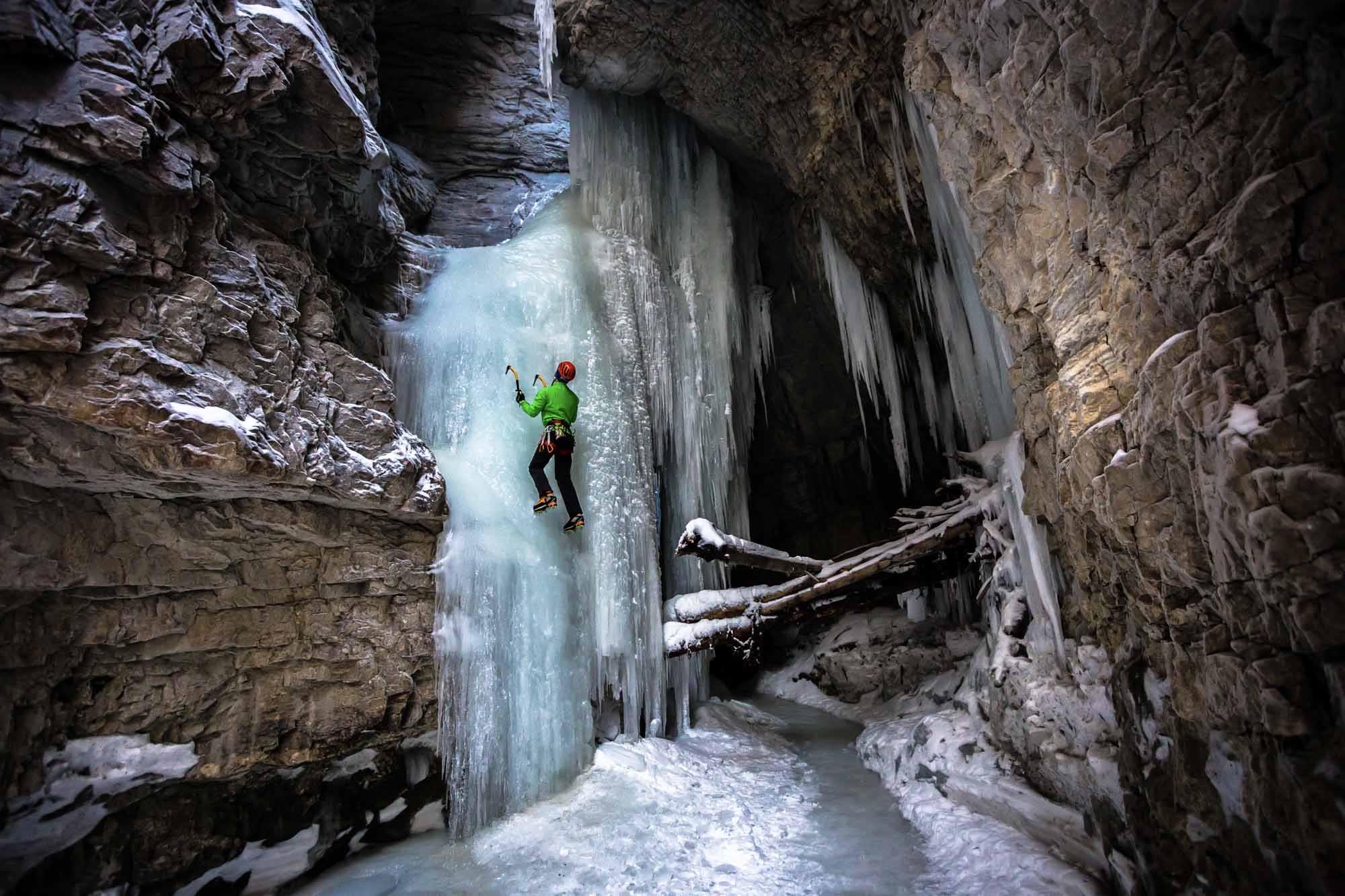
The signature pillar in Marble Canyon between the 5th and 6th bridges over Tokkum Creek, Tokumm Pole is a steep single pitch that often starts thin and overhanging before easing up high—excellent for hard leading or top-roping with minimal commitment. The route sits on the east wall of the canyon (faces west) and typically stays shaded and very cold. Avalanche exposure is minimal compared to most Rockies ice venues.
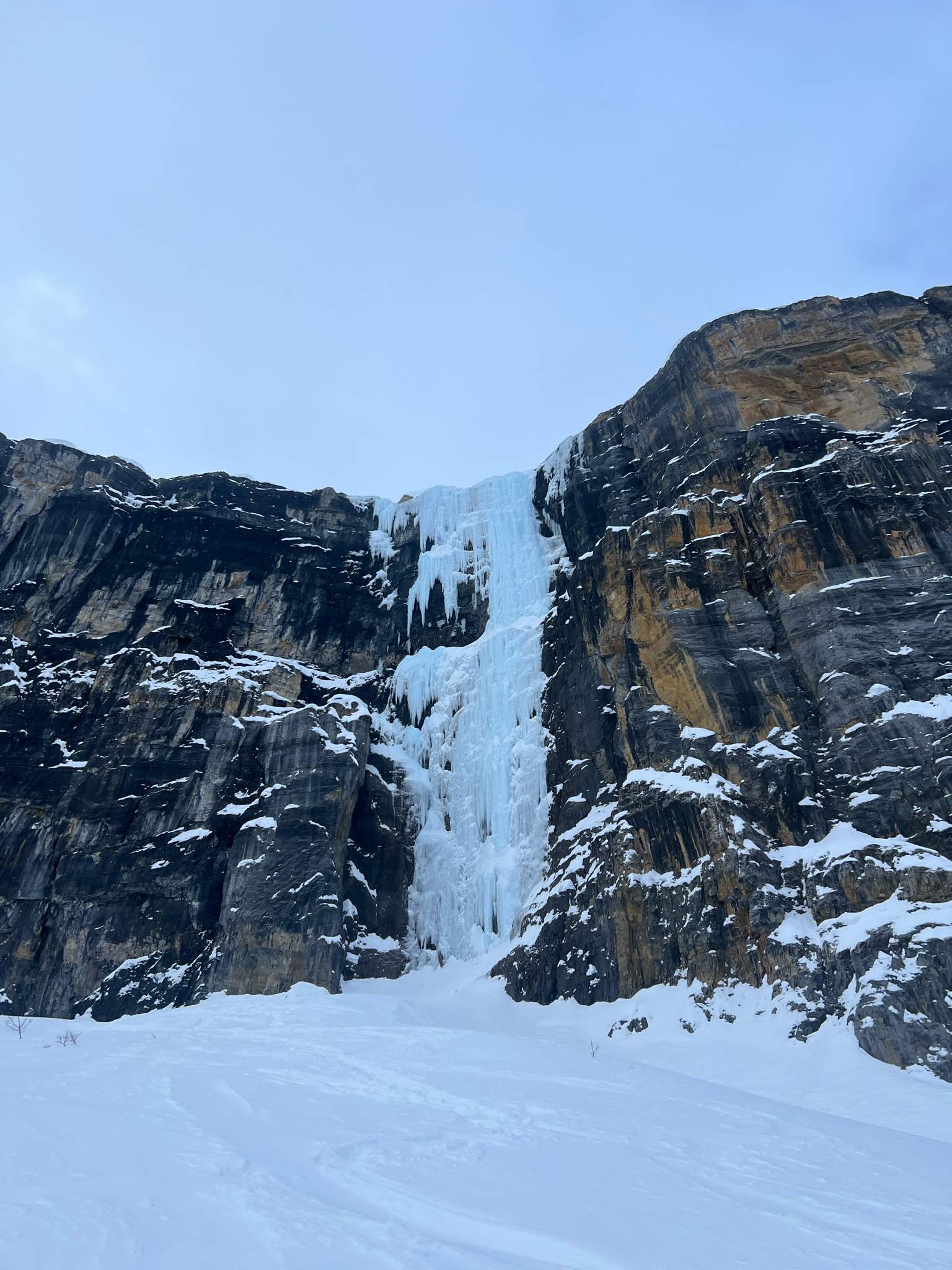
A landmark blue ribbon on the northeast-facing Stanley Headwall, Nemesis remains a sustained four-pitch testpiece at WI6/160 m that forms most seasons. First climbed in 1974 by Bugs McKeith (with aid tactics typical of the era) and freed on the second ascent in 1980 by James Blench, John Lauchlan and Albi Sole, it has retained its reputation as one of the Rockies’ definitive steep ice routes.
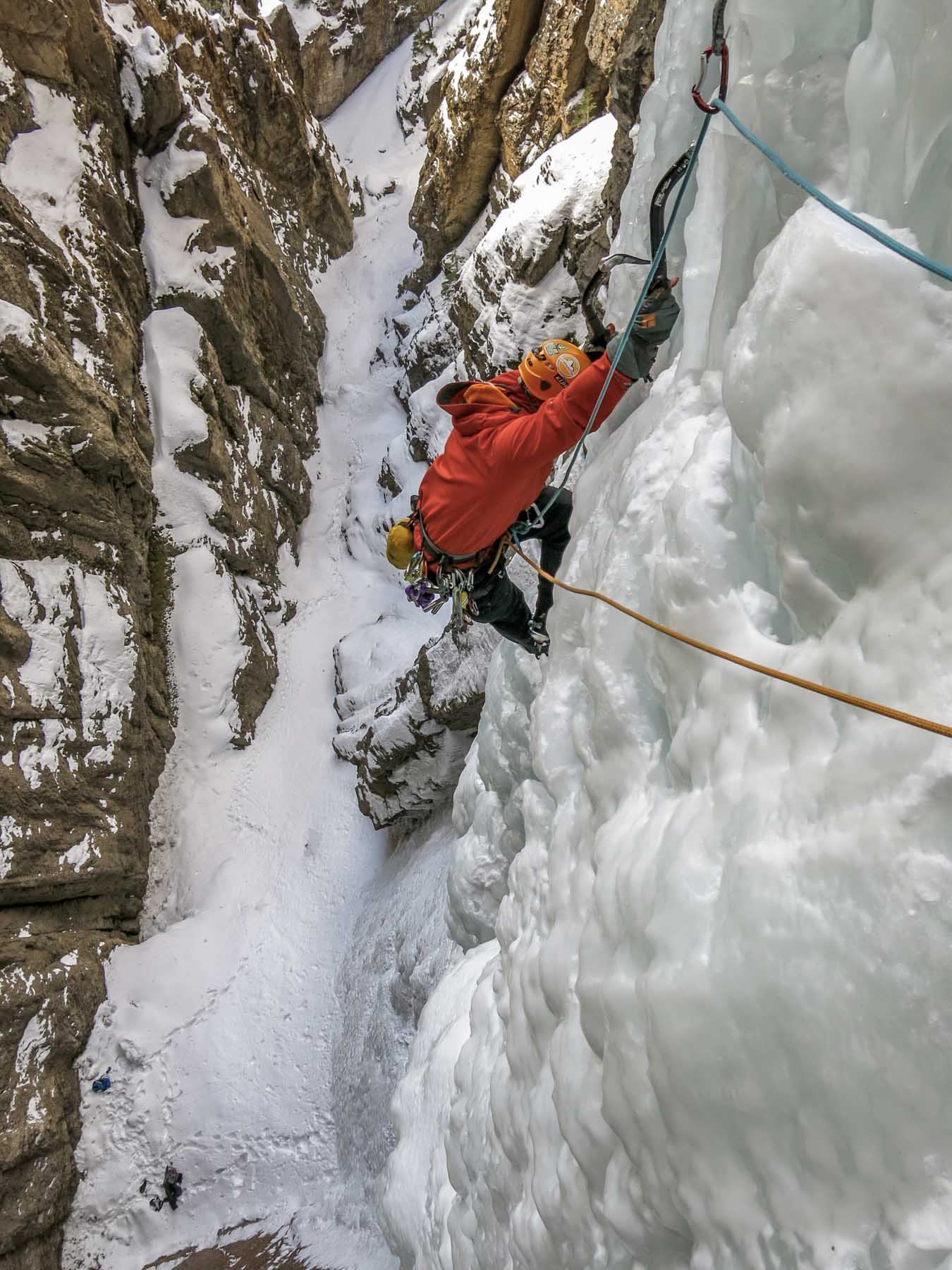
A short approach canyon reveals one of the Rockies’ benchmark steep ice climbs: two pitches featuring a mushroomed first pitch to a cave and a suspended, often hollow upper tube. In lean phases the second pitch can feel among the hardest pure ice in the range; when fat it’s still sustained and spectacular. P1 and P2 can be linked into one strenuous rope stretcher pitch. A full 70m rap will then get you back to the snow cone at the base of the route
A long, low-angled gully on Mount Kidd offering enjoyable moderate ice with short steps up to about 80°. Length varies with snow cover; expect several pitches of easy ice interspersed with snow ledges. Widely regarded as the Canadian Rockies’ most "claimed" first ascent; historical sources note it was probably climbed in the late 1970s, with no definitive party recorded. Significant overhead avalanche terrain exists above and between pitches; best climbed early season in a cold, dry spell. 350 m, Grade III, WI2. Climb descriptions on Mountain Project echo the variable pitch count (4–6+), lack of fixed gear, and the need for short screws and v-threads. Avalanche Canada’s Ice Climbing Atlas also documents a mid-2000s human-triggered wind slab between pitches here, reinforcing the need for conservative timing and travel techniques.
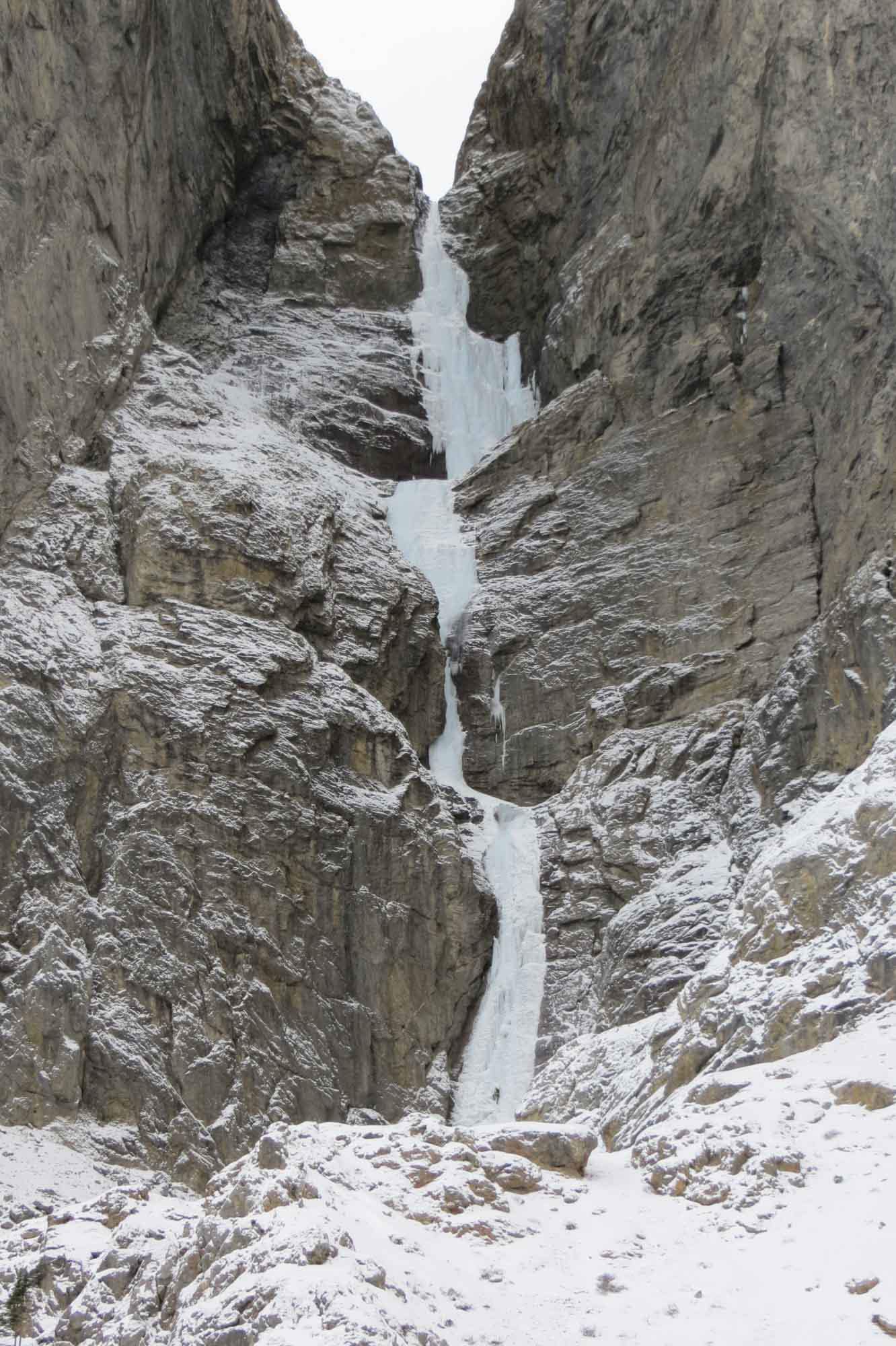
The showpiece multi-pitch ice route of the Canadian Rockies: ~700 m total with ~500 m of waterfall ice, nine main pitches of generally moderate climbing that steepen to a sustained WI5 crux finale. The famous WI6 “Pencil” is an optional, rarely-formed freestanding icicle at mid-height; most parties bypass it.
One of the top routes in the Canadian Rockies and high on most folks hit list when the avalanche and route conditions align. The approach and route are heavily threatened from the slopes above.
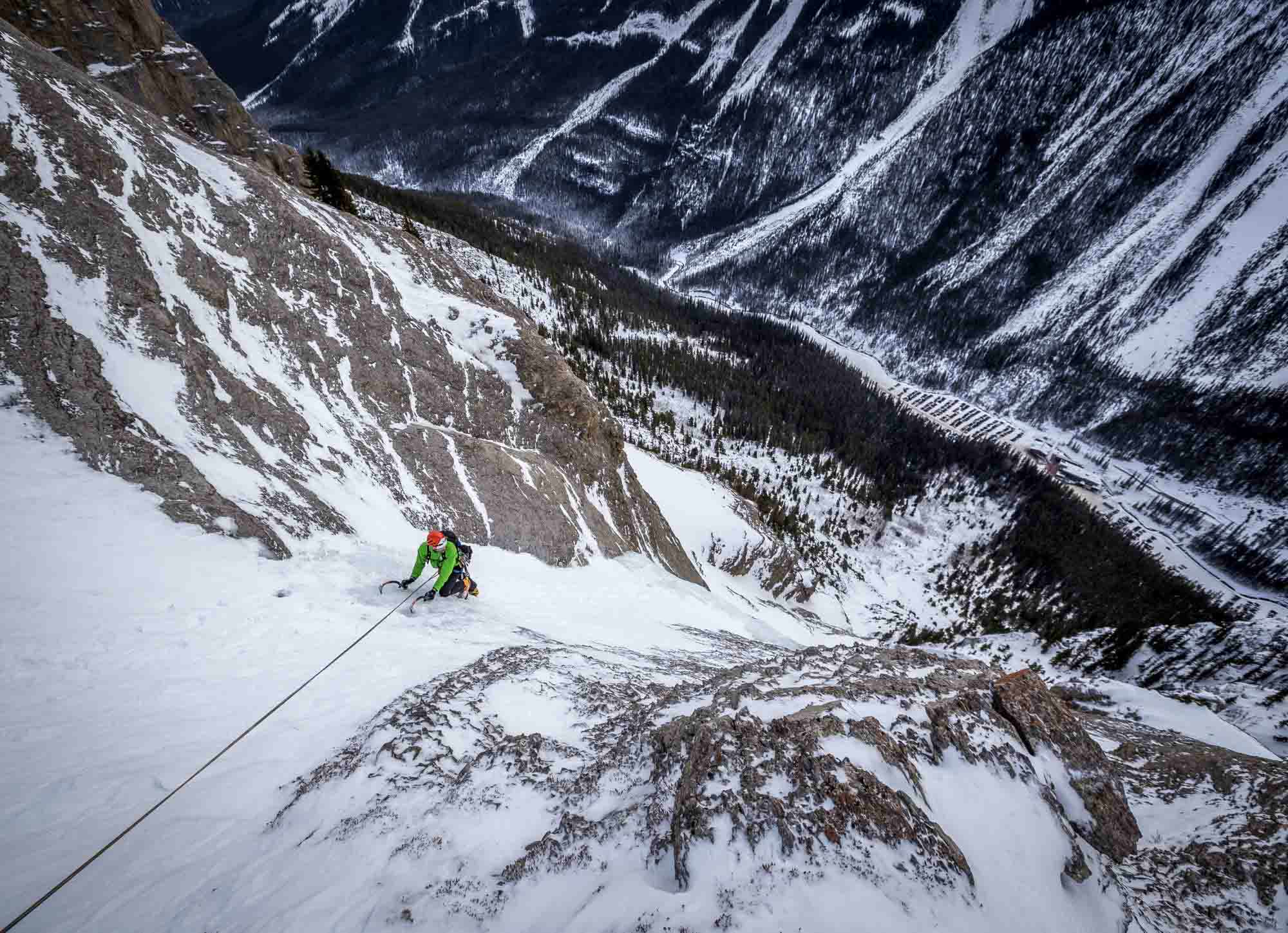
A long, classic Sunshine-area ice climb above the Sunshine Village parking lot. The first two pitches are the business—often thin, steep, and sometimes hard to protect—followed by broken terrain with several steps and a final long wall of moderate-angle ice. Significant overhead hazard exists; treat it as a full alpine outing.
A genuine one-pitch wonder below the huge walls of Phantom Crag: 55 m of steep, continuous ice that sees lots of sun, so it forms reliably but deteriorates as the season progresses. Despite variable ice quality late season, it remains one of the best of the grade in the Ghost.
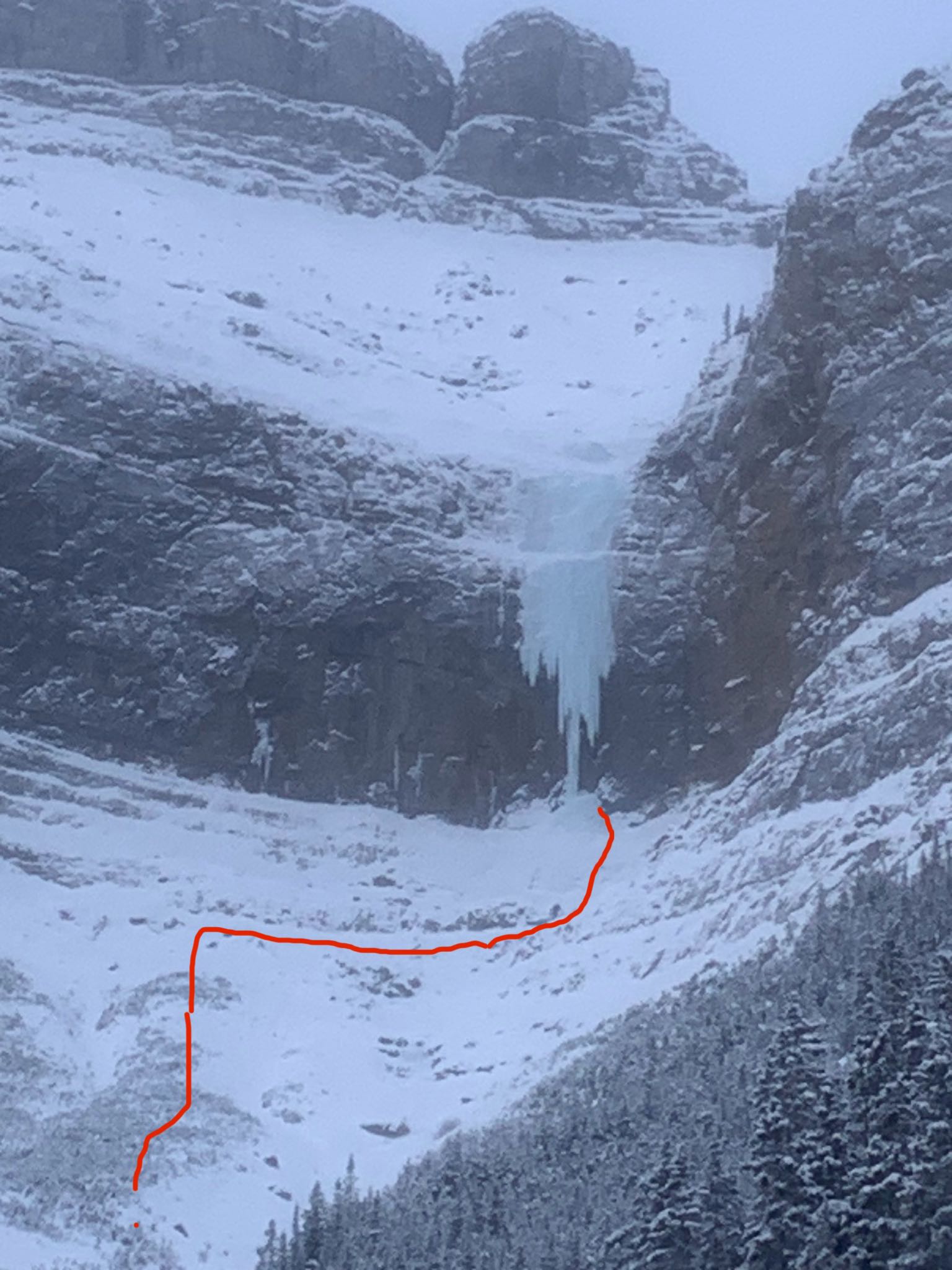
WI6 - IV - 100m Class 3 3 pitches. The first being a steep and serious free-standing pillar. A king ling, visible on Pilot Mountain from the trans-canada highway. Only know to have formed completely a few times. The pillar tends to snap off during cold snaps due to its weight and size. FA: 1983 FFA: unknown
A Valley of the Birds classic: a two-pitch, west-facing curtain high on the right (east) wall of the canyon. First ascent by Frank Campbell and Alan Kane in February 1985.
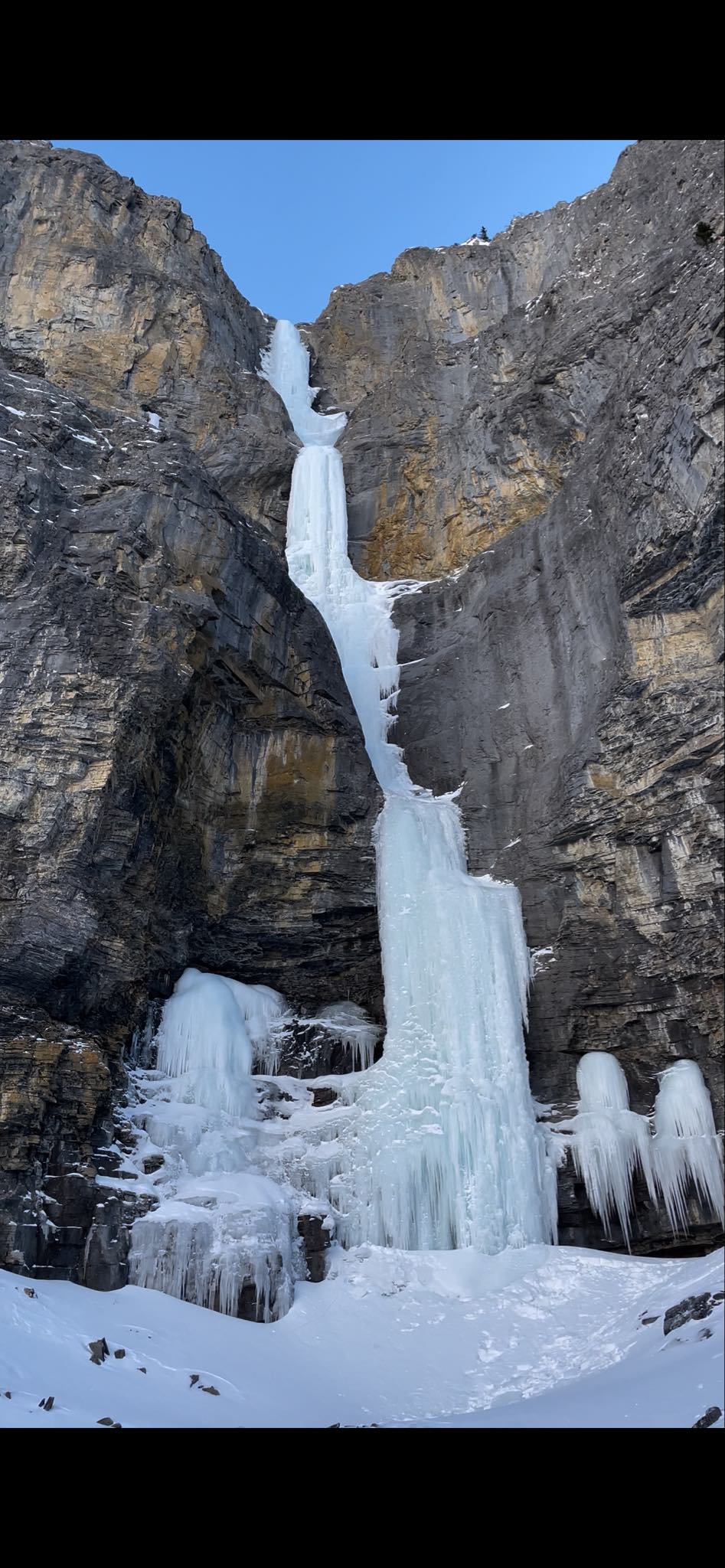
One of the Ghost’s finest, climbing three steep pillars linked by easier ice and then rambling steps higher up the canyon. Conditions can be variable and occasionally ephemeral (the second pillar famously collapsed soon after the FA), so treat it as an early‑season prize.
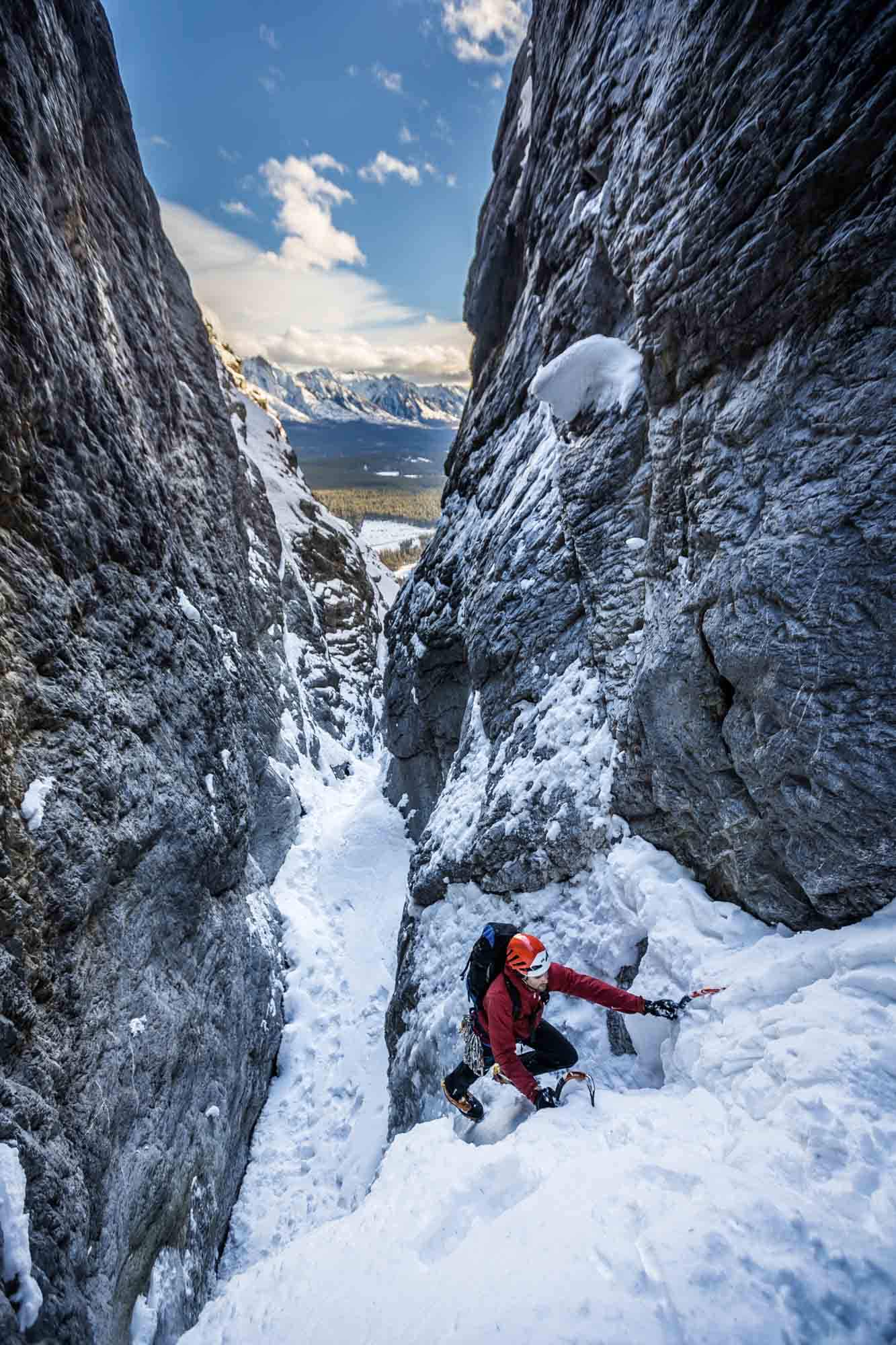
Right-most of the Cascade Mountain lower-tier gullies, directly beneath the main south face. A moderate outing of short WI2 steps culminating in the notorious pocket “glacier” plug; avoid it after the first significant snowfall due to extreme avalanche exposure (ATES Class 4). An optional Direct Finish forms above and can reach WI5. In recent years, very large avalanches have been observed running the line, underscoring the hazard. First climbed in 1969.
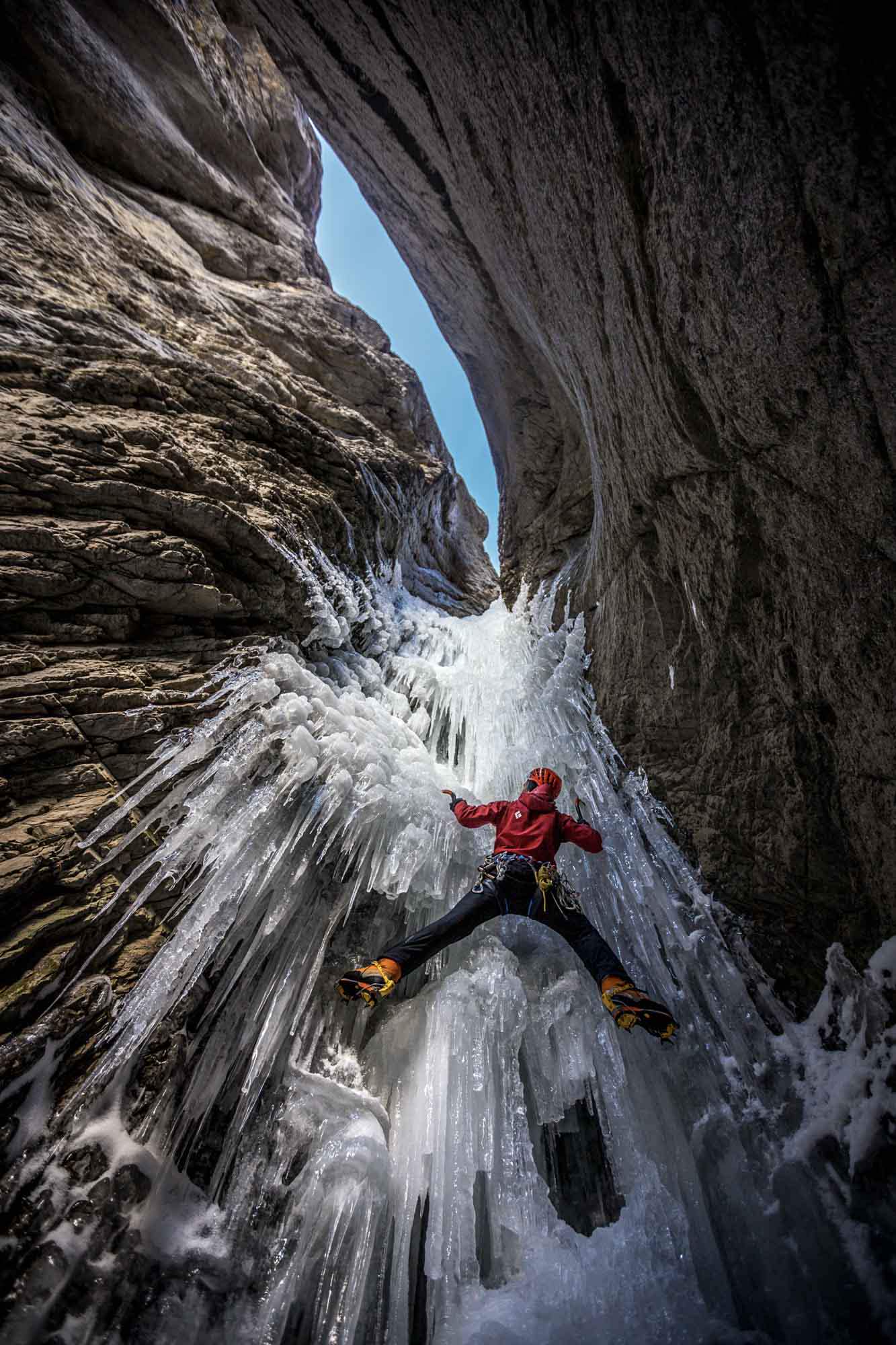
A single long, steep finish to The Urs Hole: beyond the pocket-glacier plug, a curtain of beautiful icicles and chandeliers forms in a smooth water chute for about 45 m of sustained WI5. Many parties treat this as an early-season testpiece because the line is often buried by avalanche debris later in winter. Urs Hole lies directly under the main south face of Cascade Mountain, with significant avalanche exposure; most climbers consider it only in low-snow periods (ATES Class 4). FA of the Direct Finish: December 1981 by Rusty Bailie and Murray Toft. Parties sometimes continue above on easier WI3 steps into the broad upper bowl.
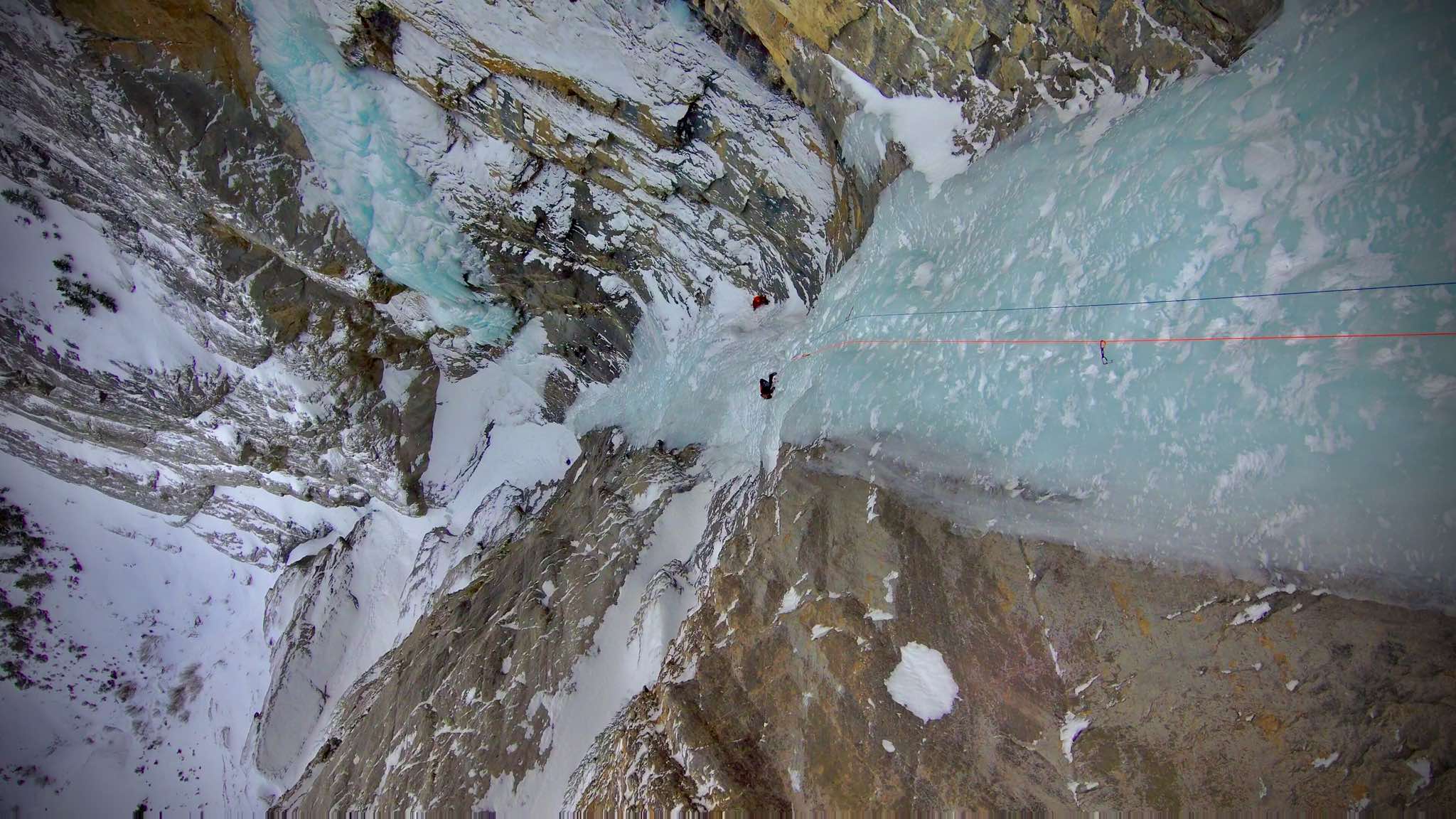
A premier David Thompson Highway classic on Elliot Peak, with big terrain and significant overhead avalanche exposure. Climb only in low hazard and cool/cloudy conditions; the overhead bowl frequently produces large avalanches that sweep the gully. Expect sustained ice with a crux pillar and scenic views over Abraham Lake.
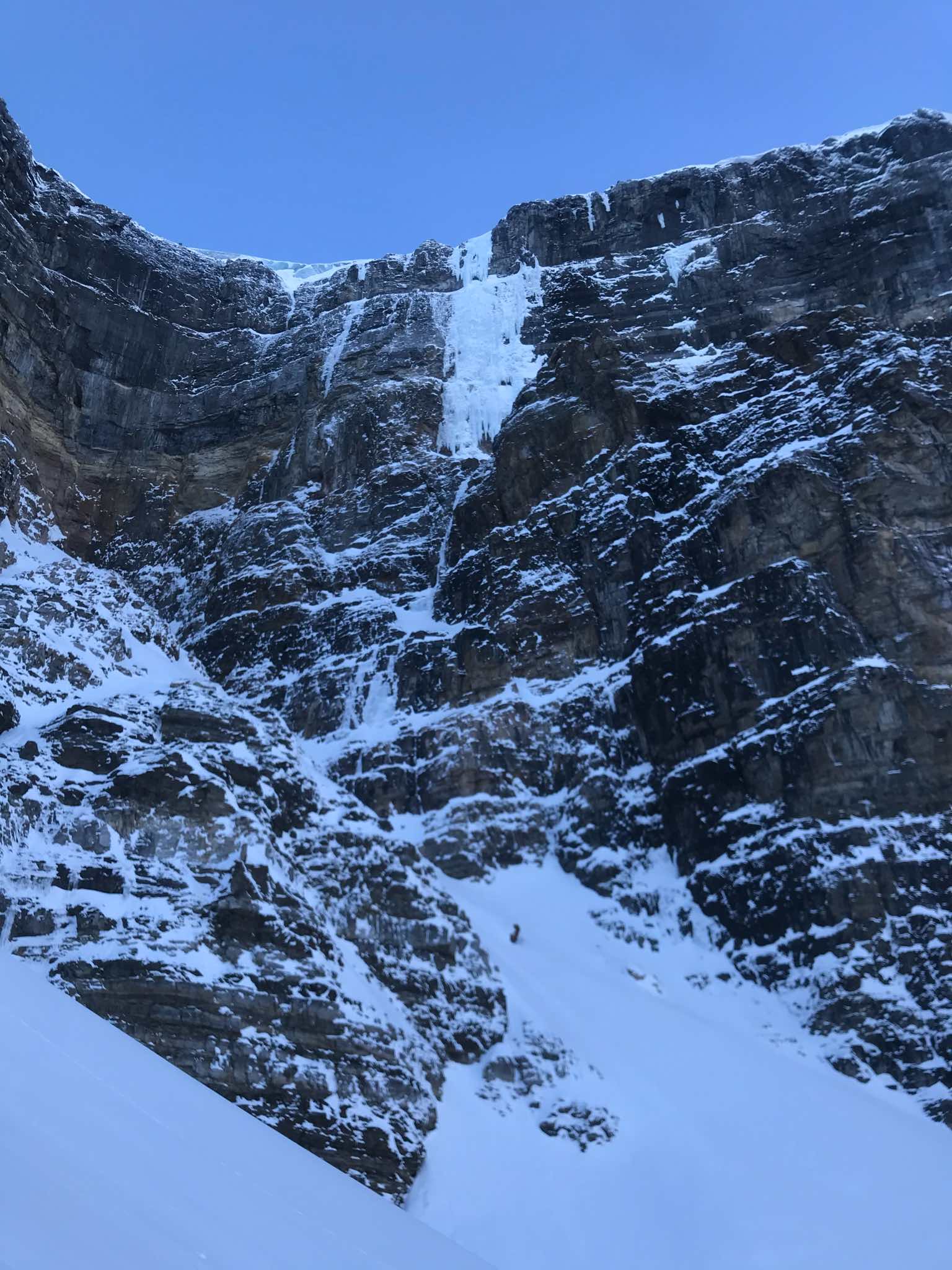
Long ski, long route, beautiful ice, remote setting. The route could be pretty closely approximated as climbing Buddha nature in a fat year, then hydro and finishing on cascade kronenberg. Full value. No avalanche hazard from above but class 2/3 on approach with some serac hazard.
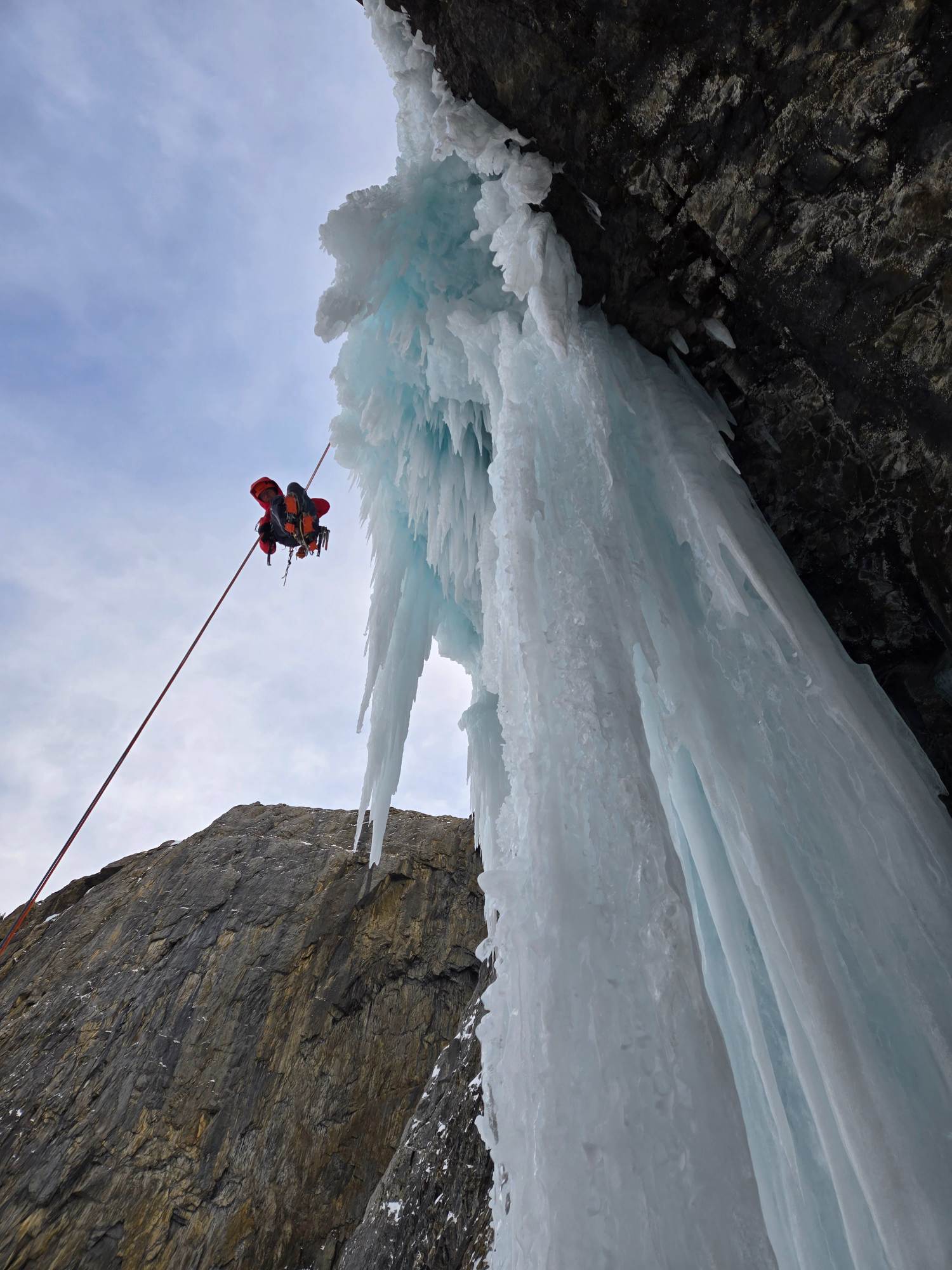
A superb 6+ testpiece near the trophy wall on Mount Rundle. The ice overhangs through the middle section, before returning to a vertical pillar to it's apex. Powerful and pumpy throughout. A long approach for this incredible climb which can be combined with approach ice in the Welcome to Canada gully. Avalanche terrain exists above the route (narrow gully draining into the route). Avalanche slopes exist on the approach trail (broad slope below Welcome to Canada & La Goutte draining into the Welcome to Canada drainage).
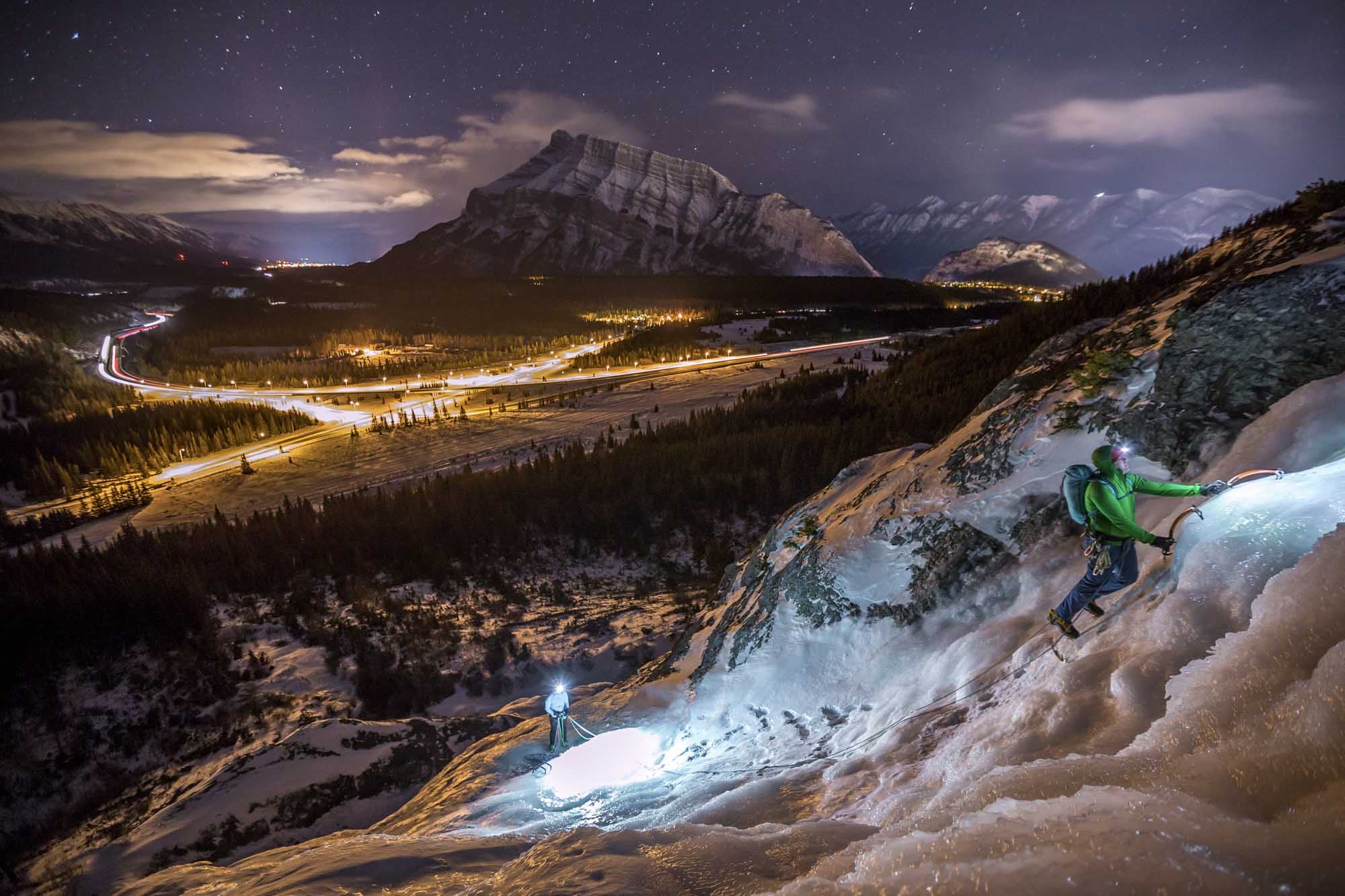
An awesome route for the grade, position and approach but don’t underestimate the avalanche terrain around the route. Cascade usually comes in and out of shape with warm and cold spells.
A three-pitch Yoho classic on Mt. Stephen: a short WI3 step through a picturesque rock arch leads to long, engaging ice and a steep WI5 finale. Routes on this face sit above significant avalanche terrain and face a bit north of west, staying cold and visible from the highway.
Right‑hand of the two upper flows above Guinness Gully on Mount Dennis (left is Guinness Stout). Typically climbed as a sustained 60 m pitch of steep, quality ice; commonly described as WI4+, slightly easier than Stout. High Test is noted in the classic Rockies guidebook as the right‑hand fall that “always forms,” with a short ledge stance low on the route before the main pitch.
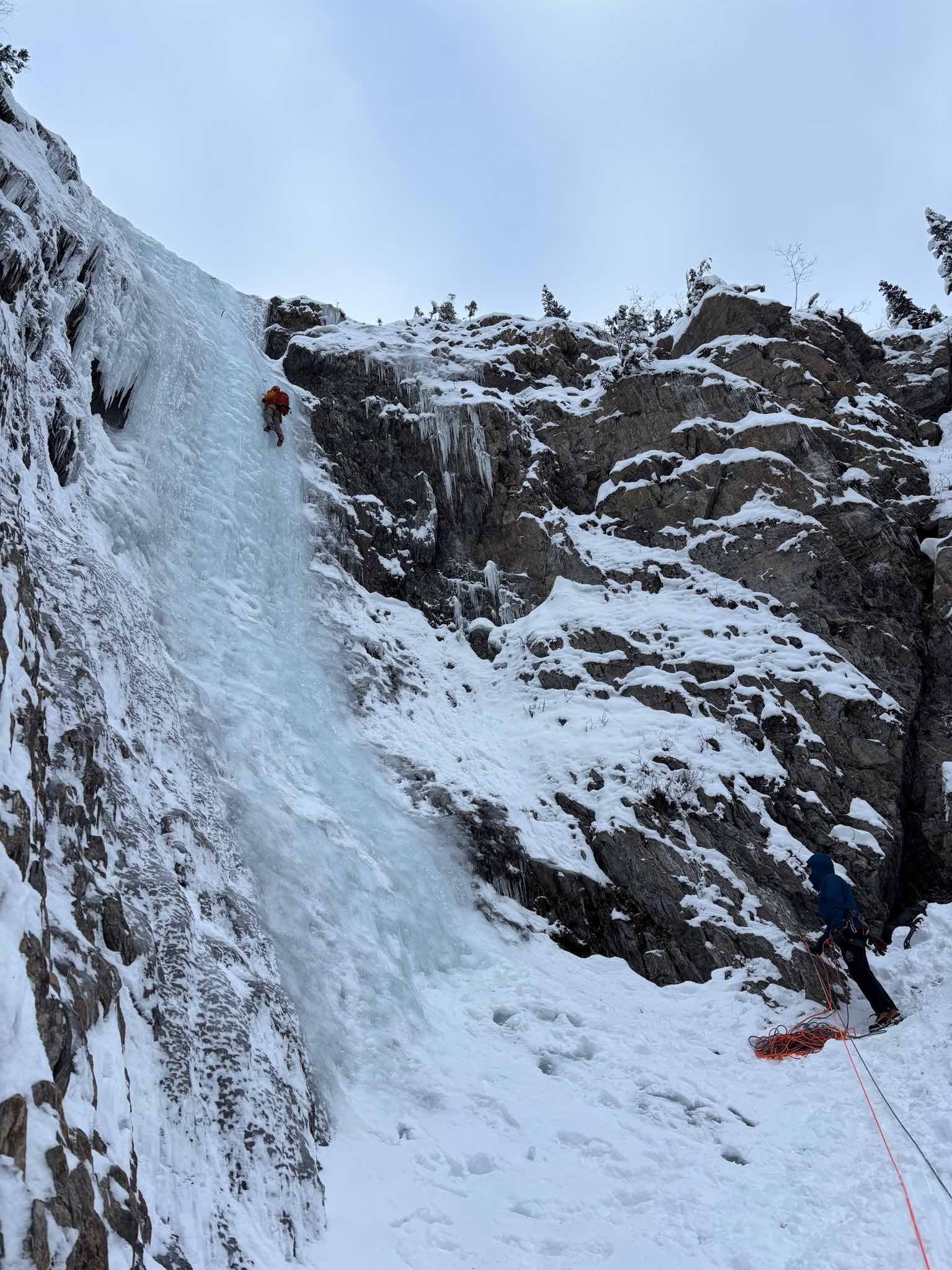
A Yoho classic on Mount Dennis and one of the Rockies’ best mid-grade gullies: three steep ice tiers separated by lower-angled snow/ice, with the climbing improving as you gain height. North-facing and typically reliable through the season; total length about 245 m.
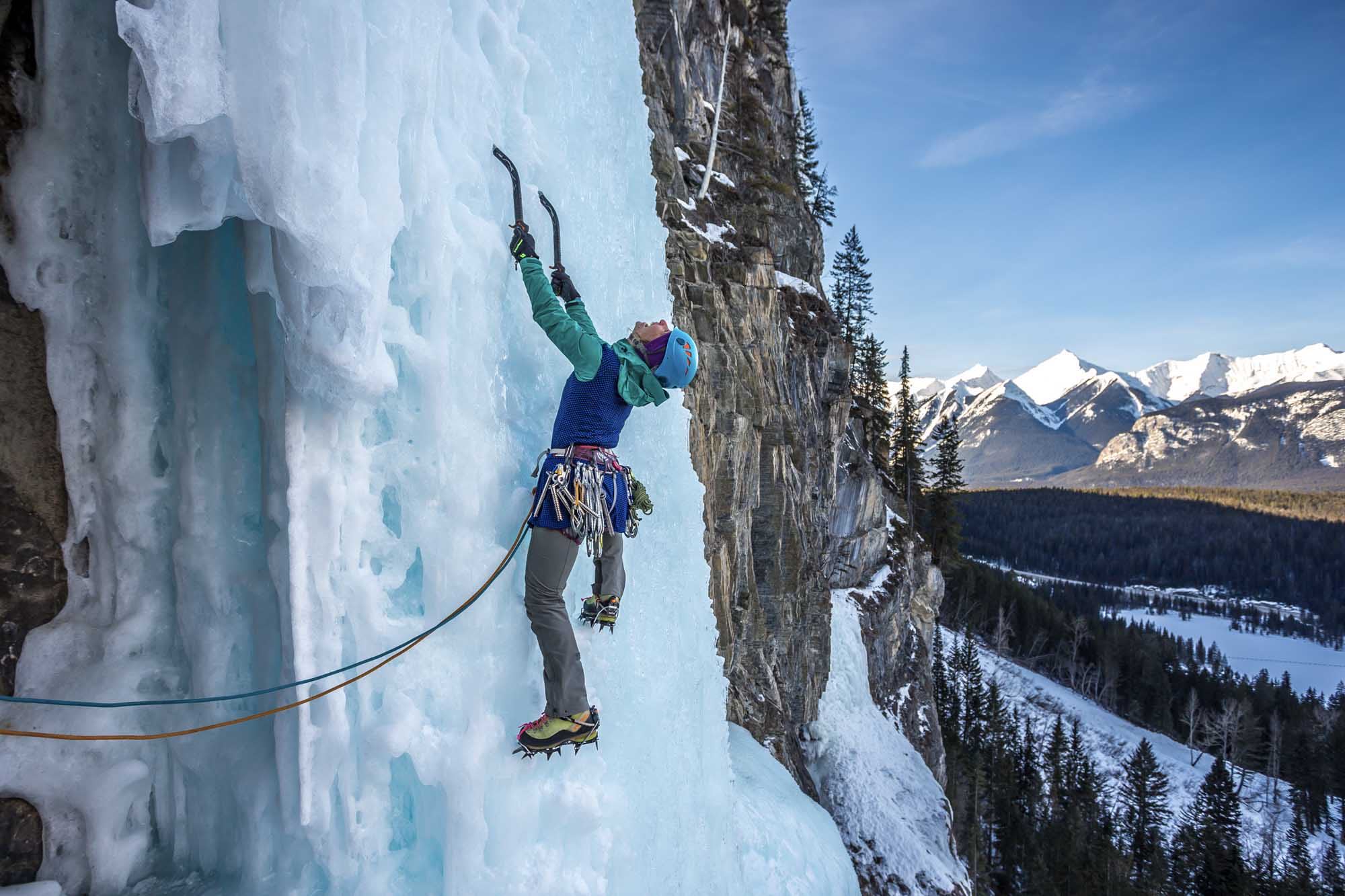
An area classic on Mount Dennis that forms reliably and offers multiple lines on the main curtain. Commonly climbed in two pitches (and occasionally in a single 60 m pitch) from bolted belays; difficulty varies with conditions and traffic. First ascent in March 1974 by Jack Firth and John Lauchlan; first free ascent by Duncan Ferguson and Dave Wright in February 1977.
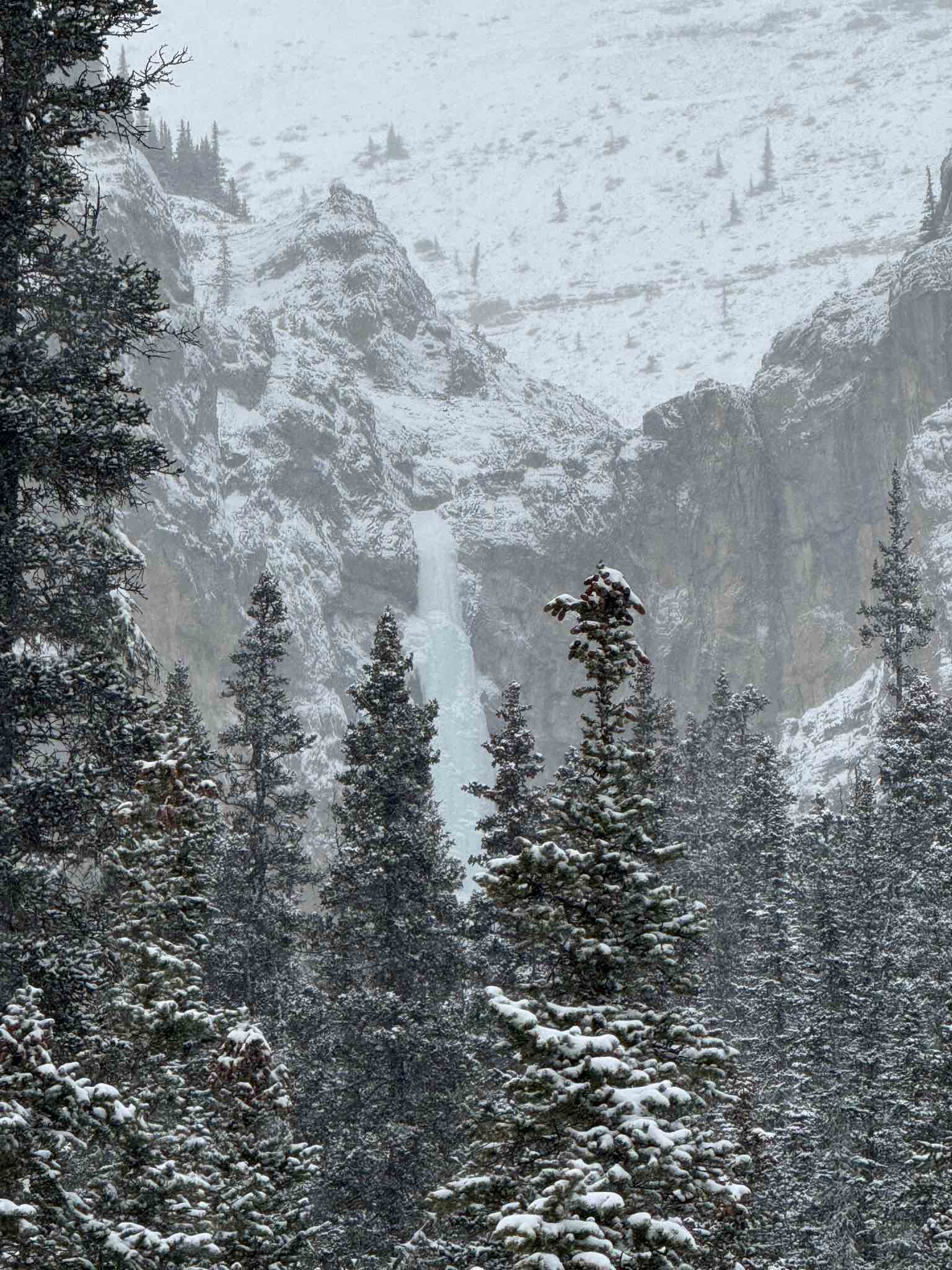
A remote Waiparous Creek classic: two pitches of waterfall ice in a tight cleft on the north side of the south fork, yielding a generally moderate first pitch and a long, sustained headwall to finish. First ascent by Frank Campbell and Dave Dancer in January 1987. Mountain Project lists it in the Waiparous Creek drainage alongside The Ice Funnel and notes its two-pitch character; Gripped has referenced the route and valley in recent coverage, reinforcing location and length.
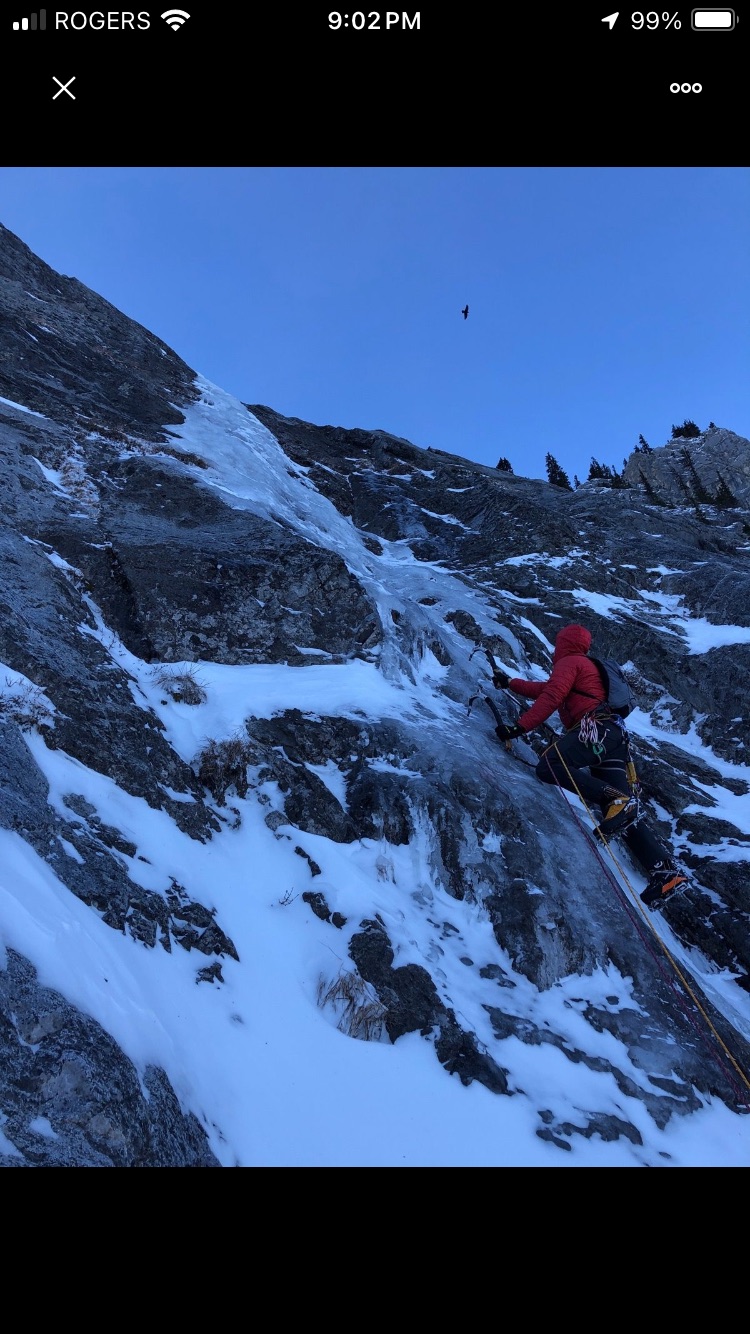
A rarely formed ribbon of thin ice on a smooth slab high in the bowl behind Mount McGillivray/Heart Mountain. Typically three pitches of WI3 with a seriousness rating due to thin ice and limited protection; avalanche hazard increases markedly after snowfall. A fine early-season objective when lean.
A 120 m WI3 at the back of the Ranger Creek cirque past R & D; when formed it’s one of the better grade-three ice routes in the area. Two pitches of technical, bulgy ice lead to easier ice and a snow slope. Both the route and the walk-off are exposed to significant avalanche hazard. Farther up the same drainage than R & D, Lone Ranger sits in the centre of the cirque alongside The Chalice and the Blade.
The rarely formed right-hand finish of the prominent central flow in the Ranger Creek cirque, about 30 m right of Lone Ranger. The line splits halfway; the right branch is The Blade (harder), while the left branch is The Spoon (easier). Rated IV, WI5 at ~70 m. Serious avalanche terrain affects both the approach and climb.
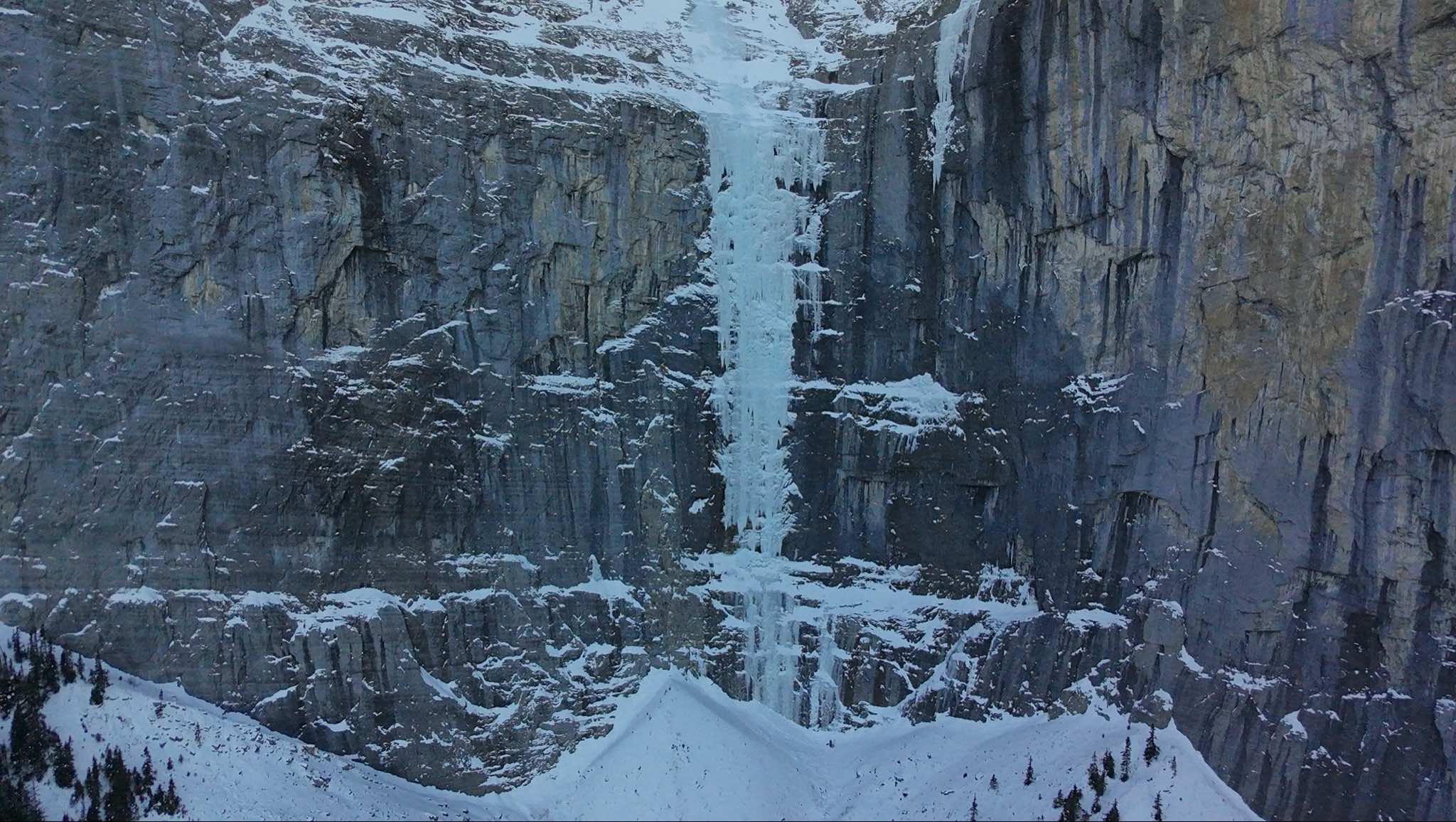
A remote Ghost classic: a continuous, steep waterfall plastered on the back wall of a large cirque in the South Fork of Johnson Creek. Typically climbed in three long pitches with the first being the crux; sustained, featureful ice rarely lets up and finishes with a sting-in-the-tail finale. Guidebooks and modern topos list it at roughly 150 m, Grade V, WI5/5+. First ascent: Frank Campbell and Karl Nagy, December 1986.
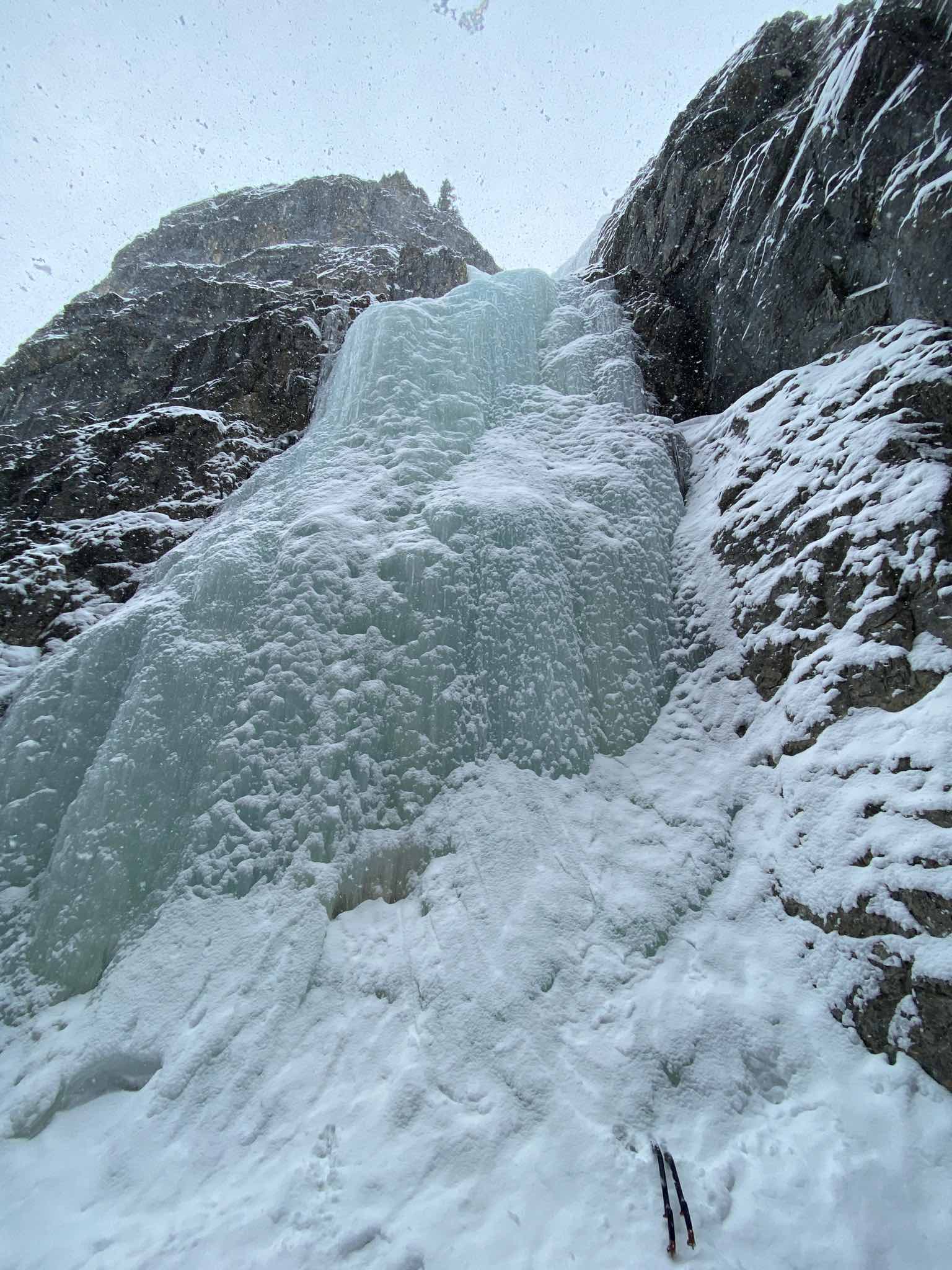
A long, rambling canyon climb of roughly 670 m in total line length that strings together short steps with three distinct crux pitches. The first steep curtain and the final two pitches provide the WI4 cruxes; the middle ground is mostly WI2–3 rambling in a tight, shaded slot. The 670 m figure comes from Josephson’s guide (measured from ~250 m vertical and ~625 m horizontal in the canyon).
A classic, crowd‑pleasing WI3 at the back of Grotto Canyon. Most parties climb it in one long pitch or break at the mid‑ledge bolts; in fatter conditions a left curtain can form around WI4. First ascent by Cyril Shokoples, Stuart Taylor, and Brian Thompson in the winter of 1975/76.
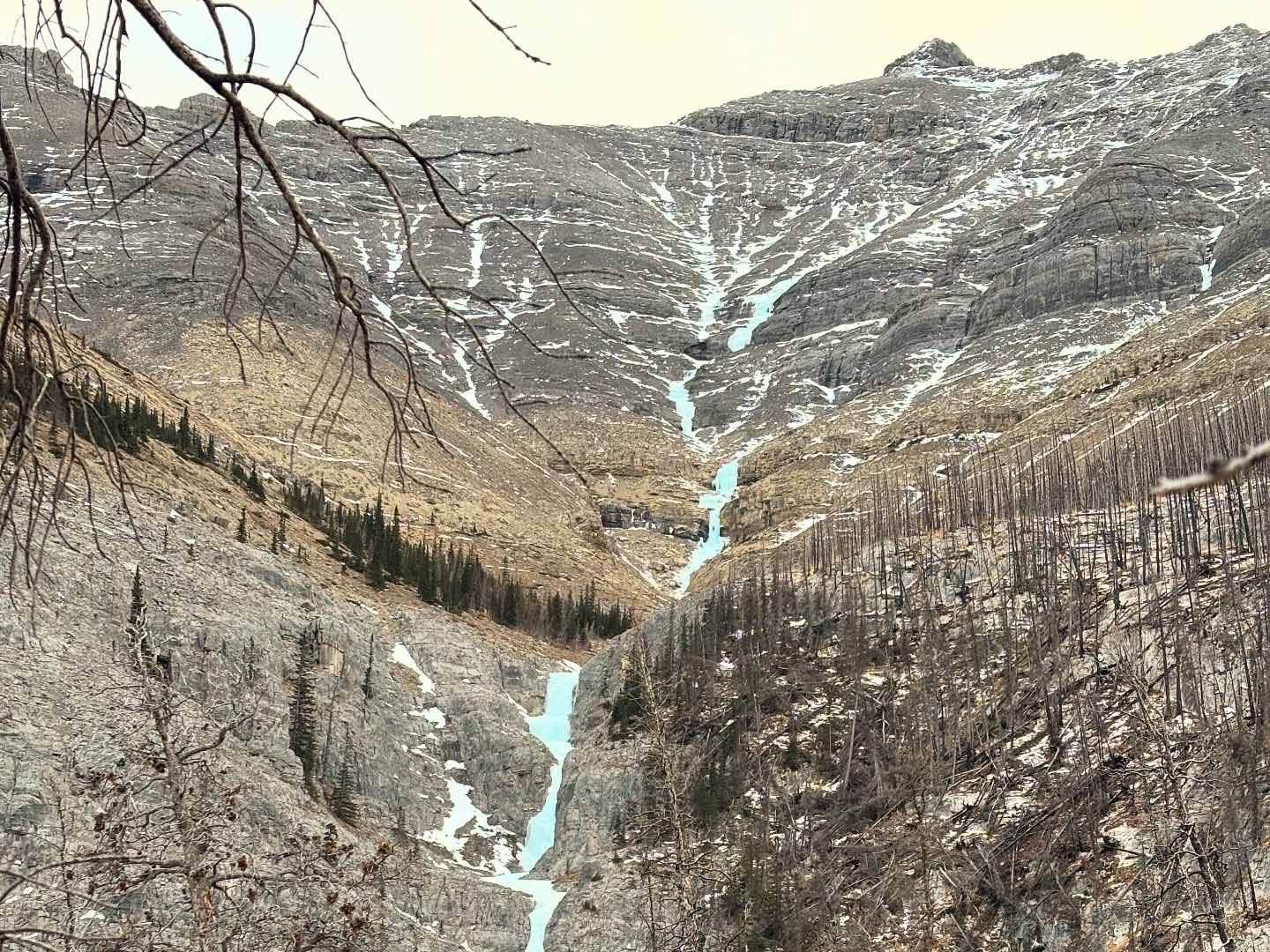
A classic, very long moderate in the North Ghost: an endless series of short steps up a tight canyon, with occasional steeper options near the top. Expect about 497 m of climbing in roughly 10 pitches at WI3, with short sections up to WI4 depending on conditions. All pitches now have bolted anchors, every single little step. All anchors are flagged with orange flagging tape and equipped for rappelling with chain and quicklinks
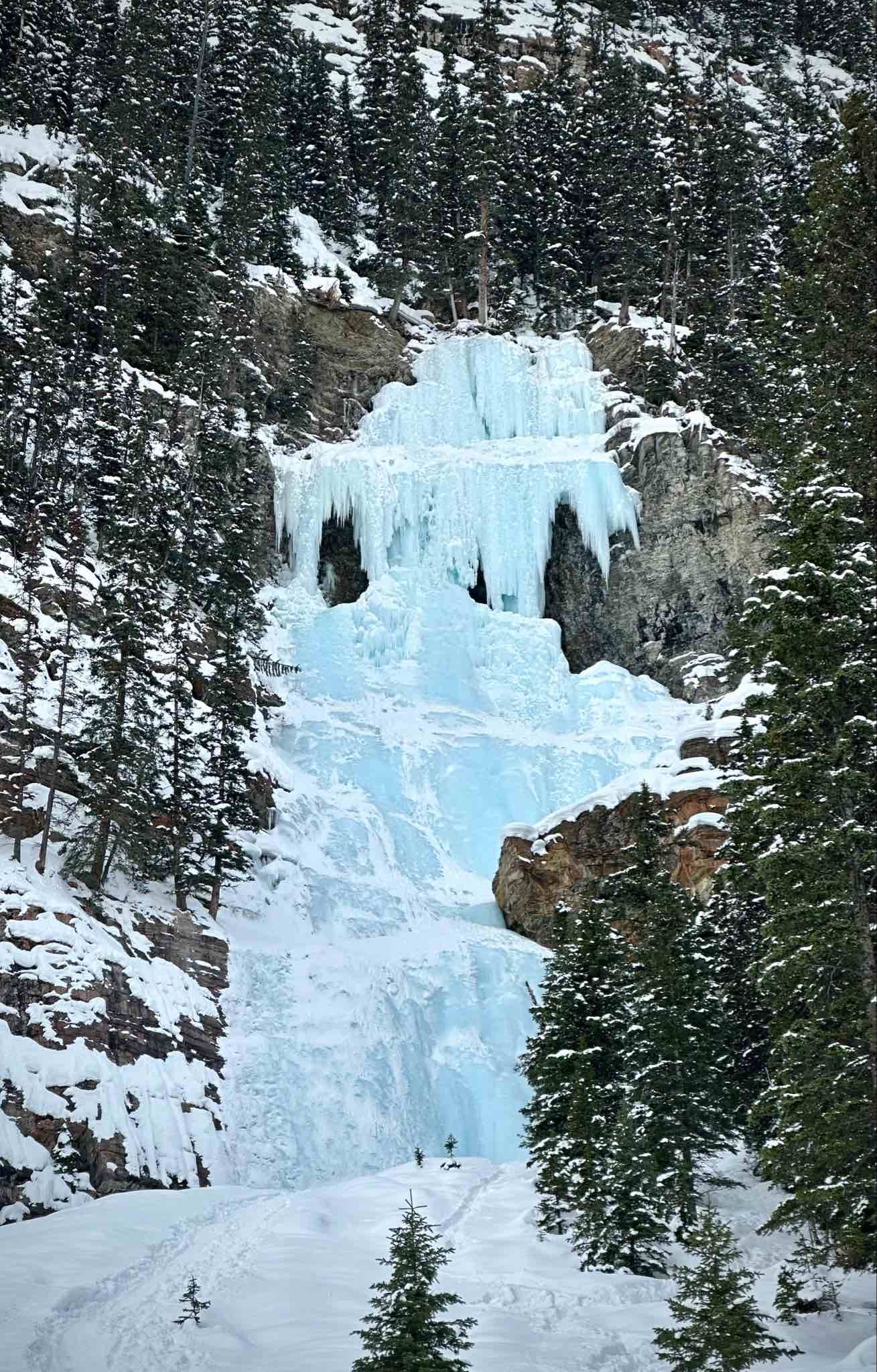
A celebrated Rockies classic above the west end of Lake Louise. Broad lower tiers lead to a large mid-height cave and a striking finishing pillar; difficulty varies with how the pillar forms (commonly WI4, but can feel WI5 when full and vertical). Expect crowds and manage overhead hazard from daggers. While avalanche exposure is relatively low for the area, it is not zero.
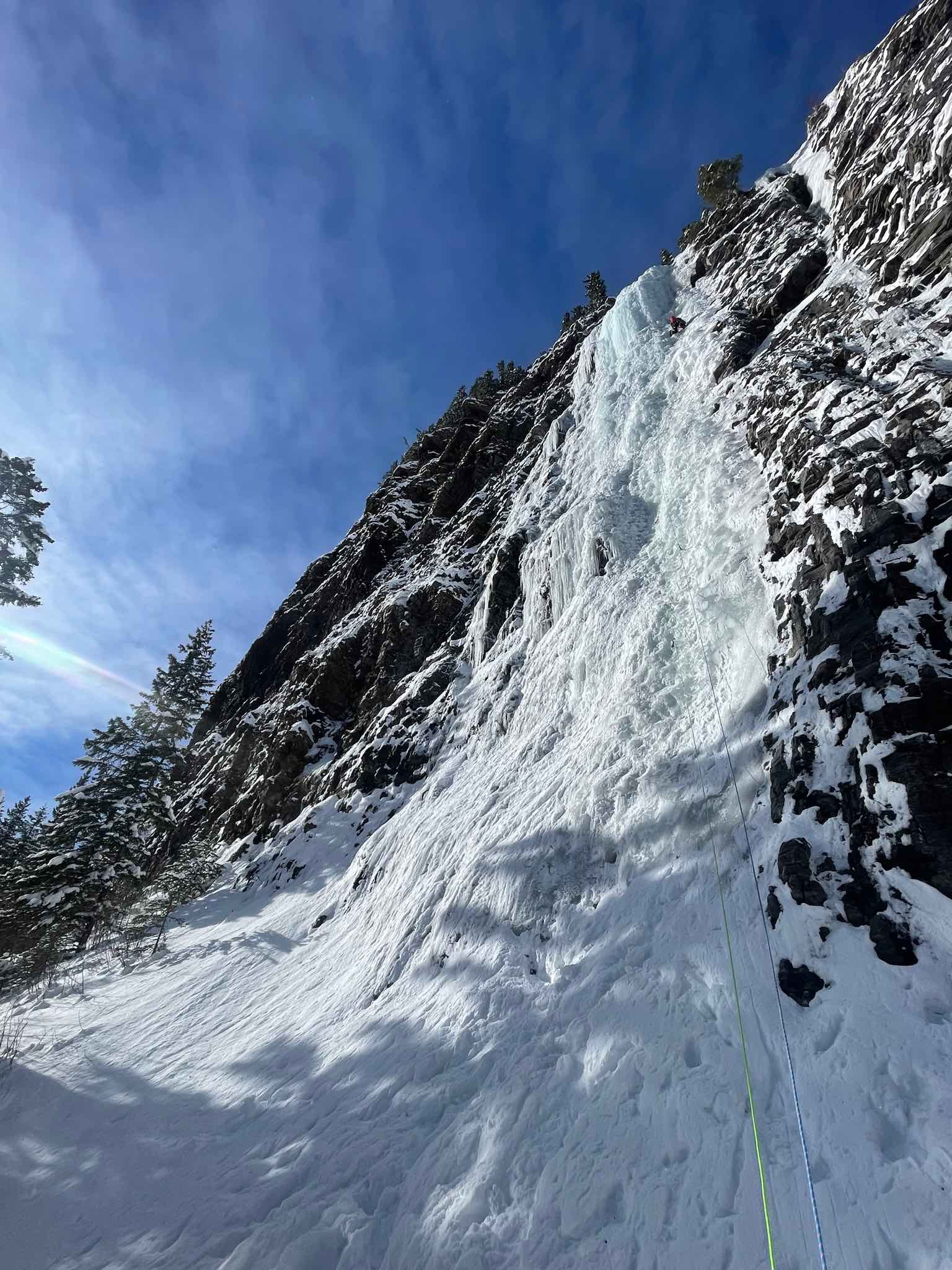
One of the most popular routes at the grade. It's a classic 2 pitch route with other options beside it, it's also wide enough that you can make it harder / easier depending on your line. Note that there have been many accidents here from falling ice. Do not climb with another party above you.
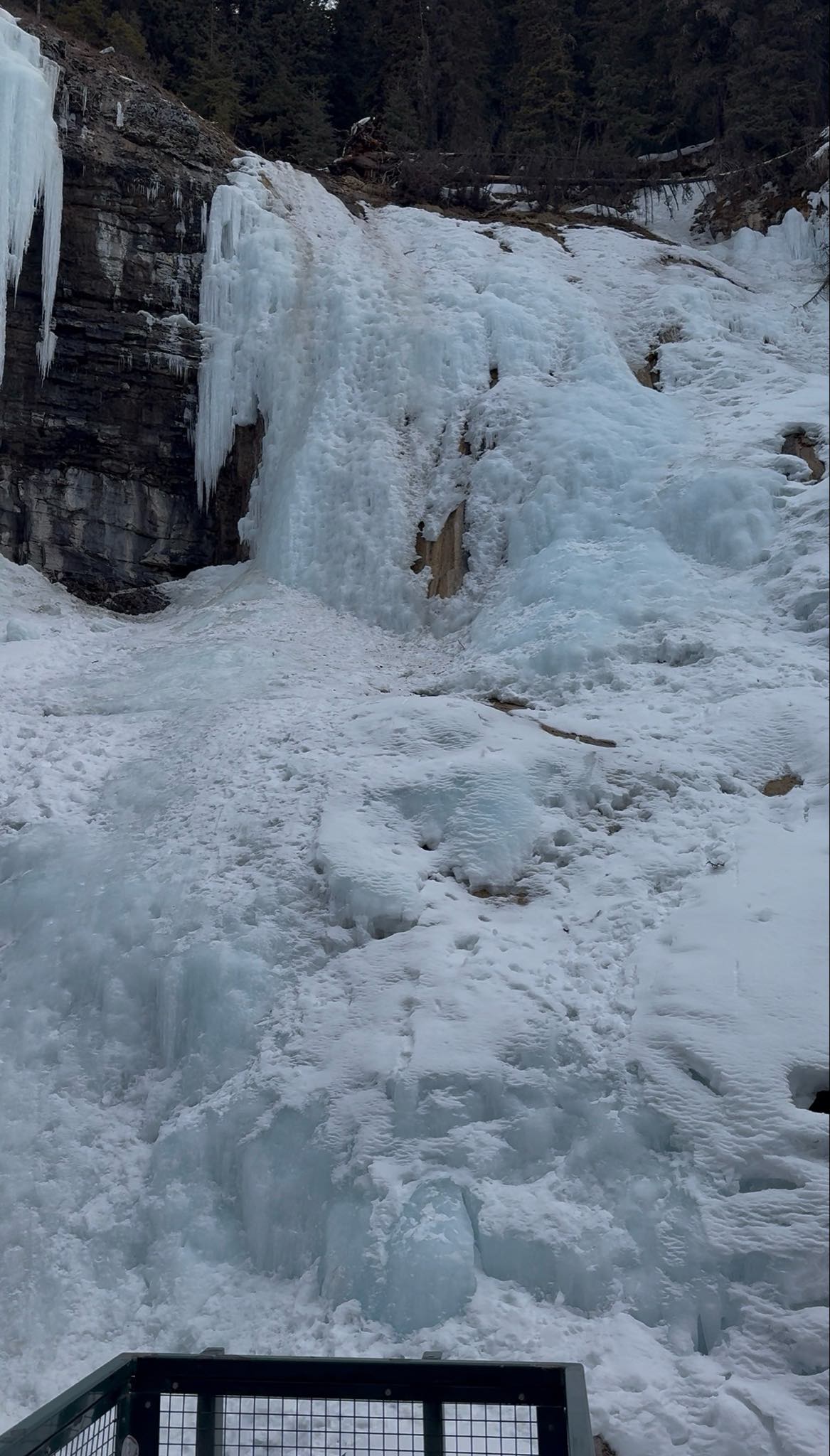
At the Upper Falls of Johnston Canyon, a 60 m–wide amphitheatre forms each winter with low-angled slabs on the right and progressively steeper free‑standing pillars to the left, offering lines from WI2 to WI5. The far‑left pillar above open water is widely known as Prism Falls (typically WI5).
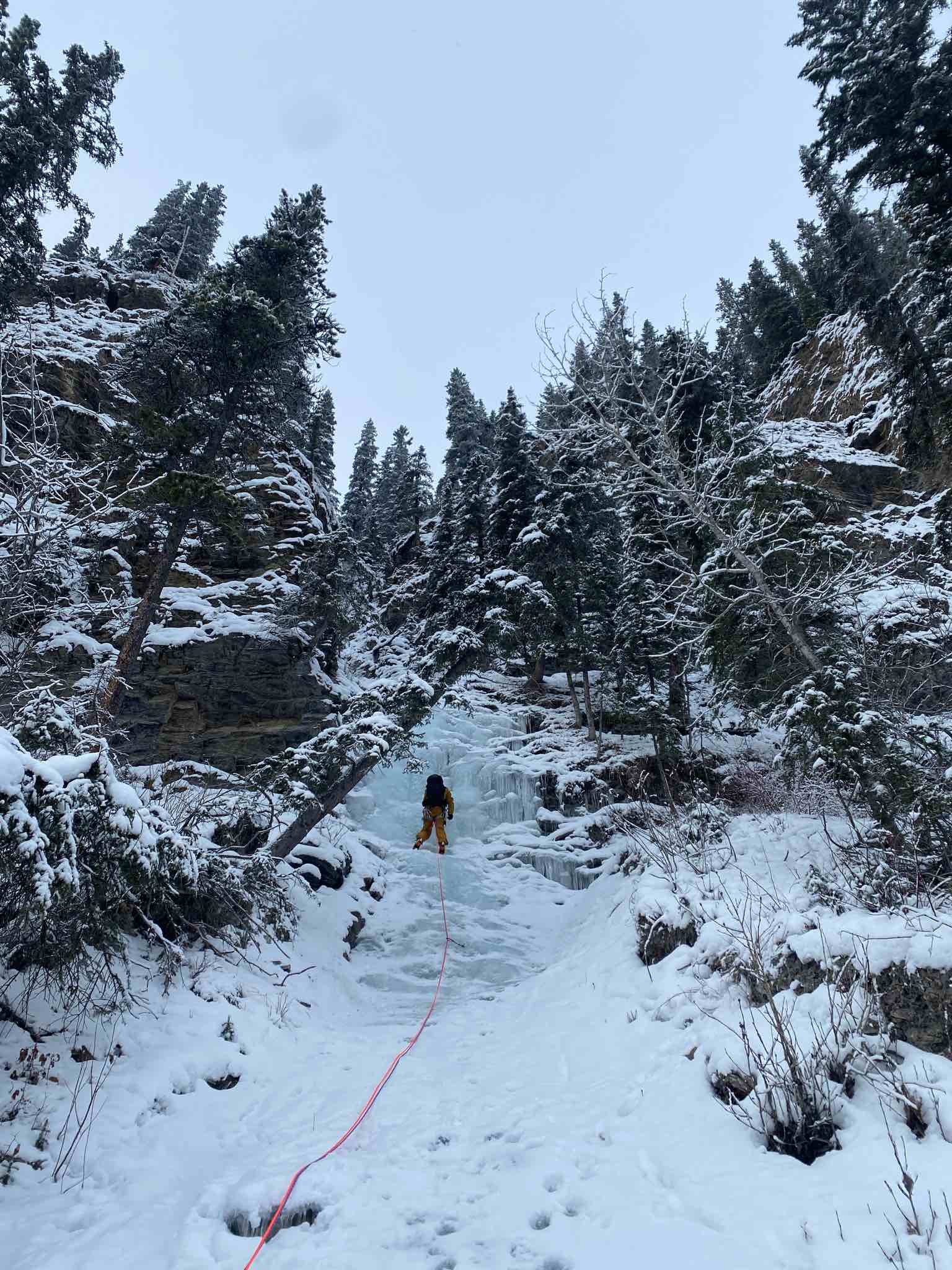
Beginner-friendly two-pitch ice fall in Evan-Thomas Creek with a characteristically lacy appearance; the first half is a lower-angled ice ramp to a ledge and the upper half is steeper but short. Total length about 100 m. FA attributed to John Calvert and Trudy Kamphuis in 1978.
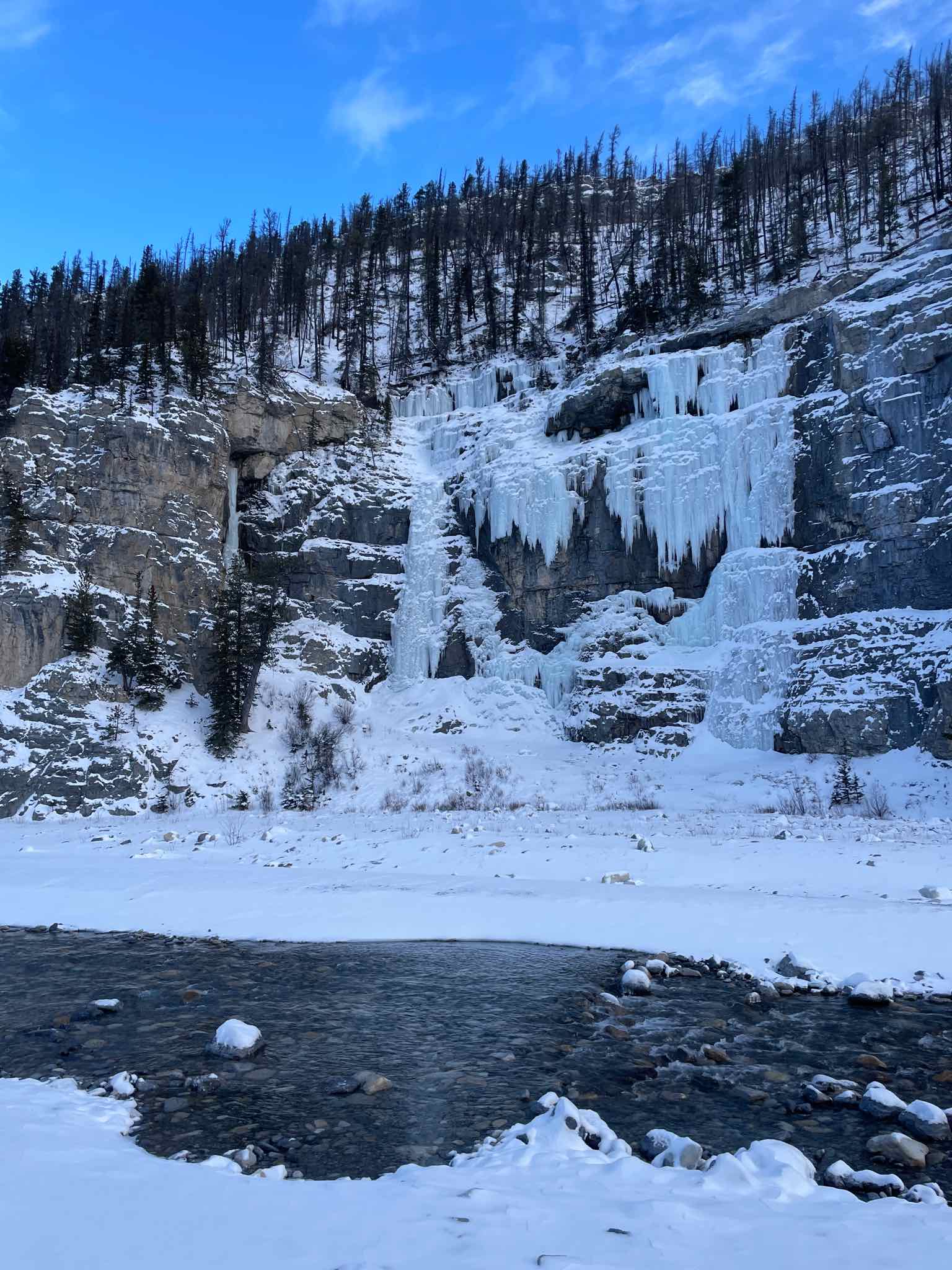
The sunshine slabs of ghost river. Dont bother packing a bag
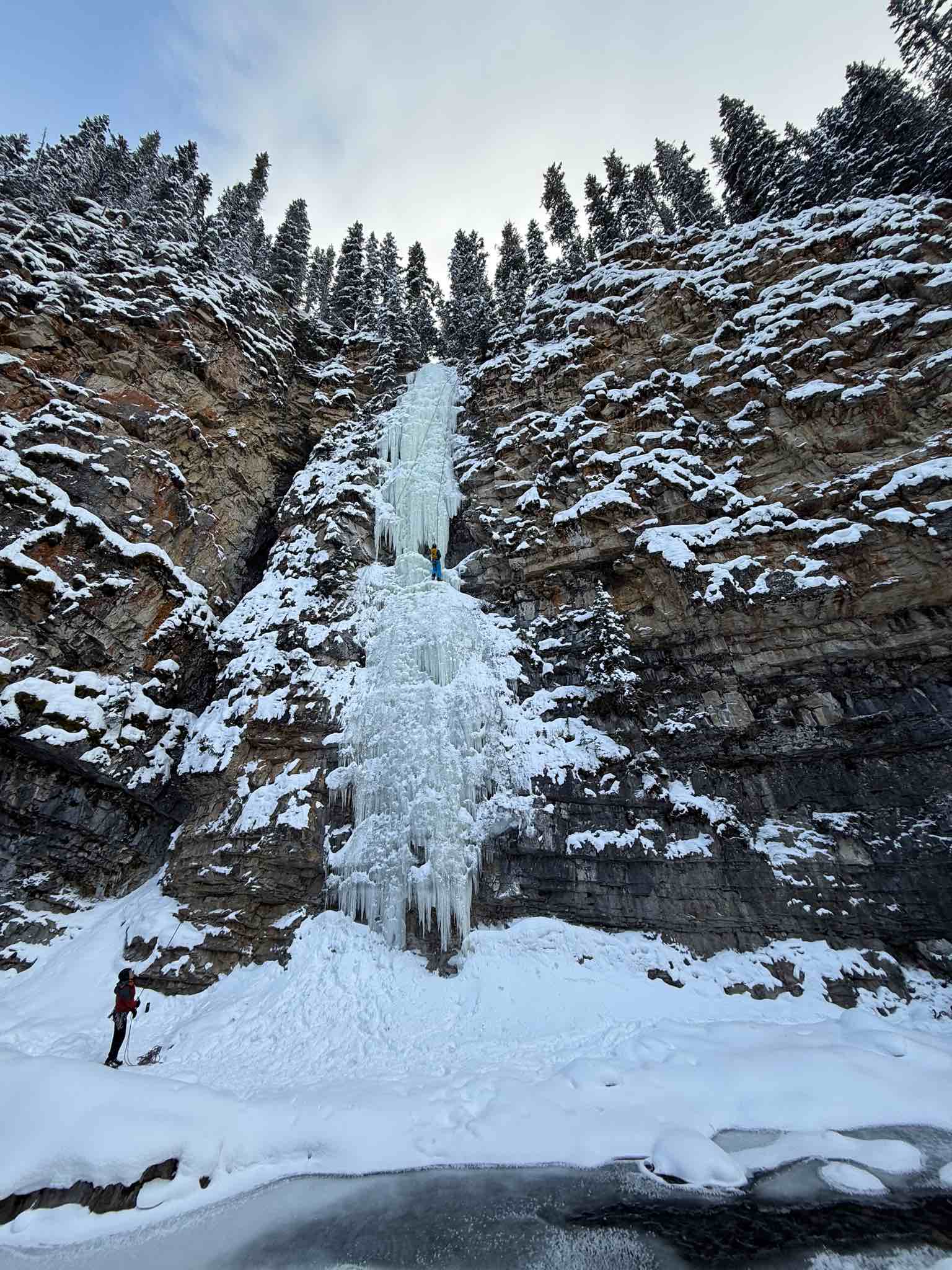
WI4 - II - 60m Class 1 WD40 has formed as a fat and blue long pitch. It also can be thin, with a fragile crux pillar in the middle. Some years it hasn’t formed at all. This climb is a great alternative to Moonlight and a great climb for the grade.
A Stanley Headwall classic that links an engaging mixed roof and slab into long, sustained ice above. The route was first climbed (aid + ice) by Jeff Everett and Glenn Reisenhofer in April 1991 and later freed by Jay Billings and Rob Owens in November 2001; the modern grade is M7 WI5. The line rarely forms to the ground as pure ice, but in exceptional seasons the icicle has touched down and been climbed as a very hard ice line. The wall faces northeast, so expect cold shade and significant avalanche exposure from above and on the approach.
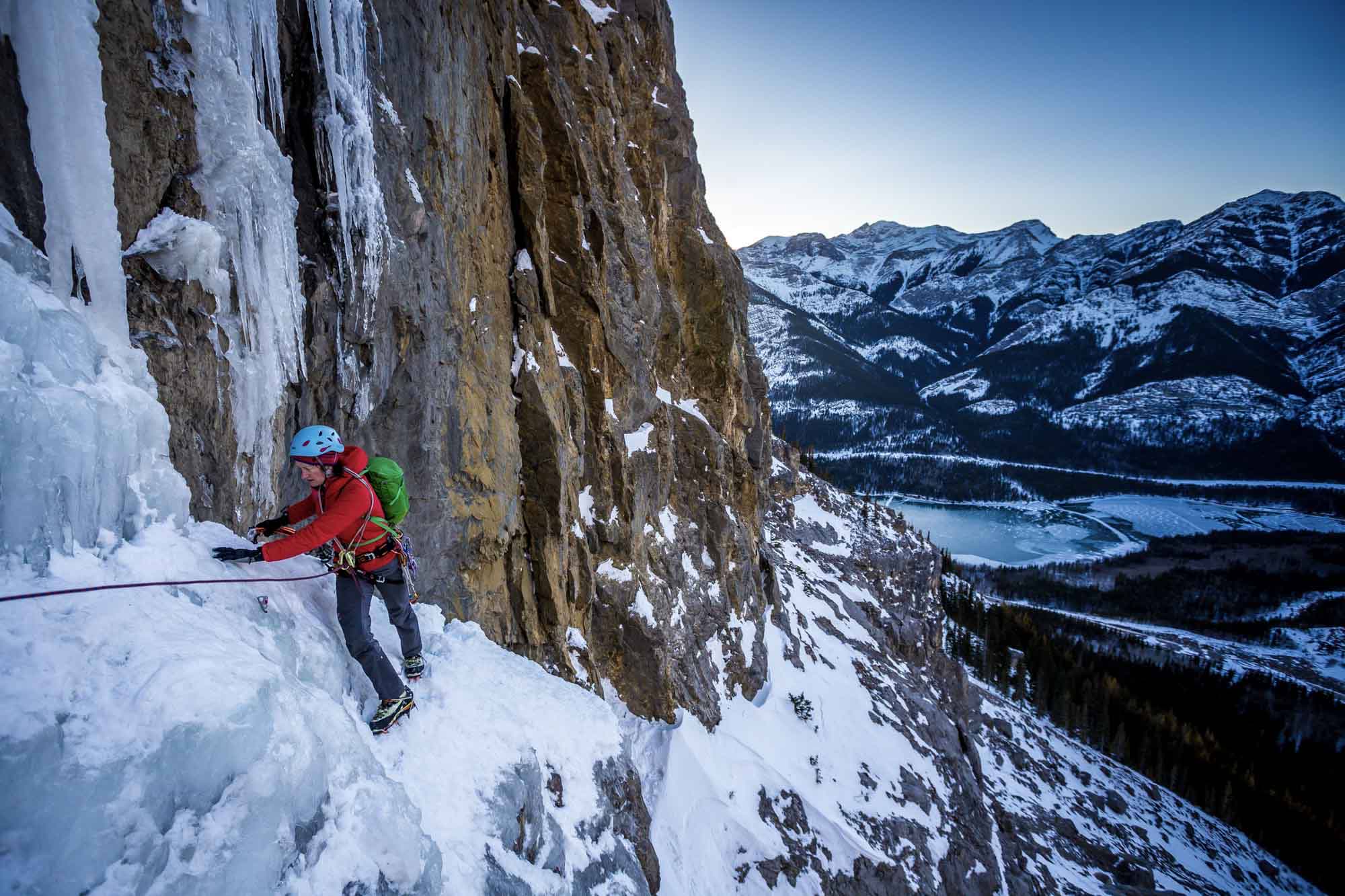
A reliable early-season mixed/ice line on the Upper Barrier headwall above Barrier Lake. It rarely forms as a pure ice route, so most parties use the mixed start on the right to gain the ramp and the ice above; in fat years it can form completely but often deteriorates quickly after the first Chinooks. First ascent in October 1984 by Dave Clay, Karl Nagy and Tim Friesen.
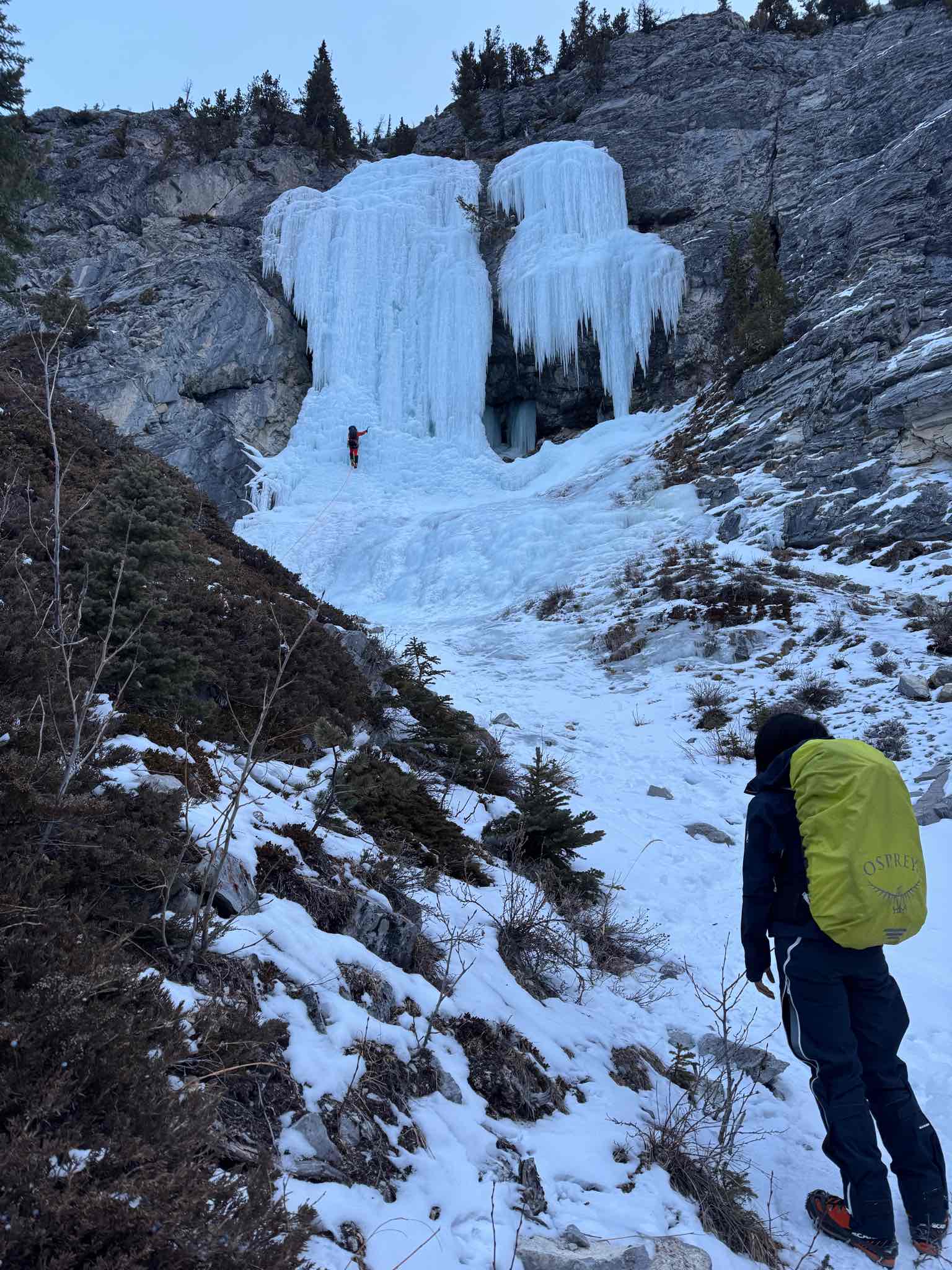
A classic south-facing Mt. Kidd ice line above Galatea Creek, best known for its crux first pitch: a freestanding pillar, with easier, rambling ice above. Modern sources list the climb at roughly 160 m and WI 4+, with notable avalanche exposure between and above the upper pitches; many parties only climb the first pitch. First ascent was in January 1982 by Mike Blenkarn, Iain Stewart-Patterson, and Murray Toft.
A short but very steep 35 m pillar tucked in a small canyon of Galatea Creek, offering excellent, concentrated WI5 climbing and convenient top‑rope options from sturdy trees above. Expect open water hazards in the creek bed below and significant avalanche exposure typical of the Mount Kidd/Galatea area. Tasting Fear is also included in Avalanche Canada’s Ice Climbing Atlas, underscoring the need for avalanche awareness on this approach. First ascent: Dec 1991 by Steve Chambers, Martin Lalonde and John Whiteman.
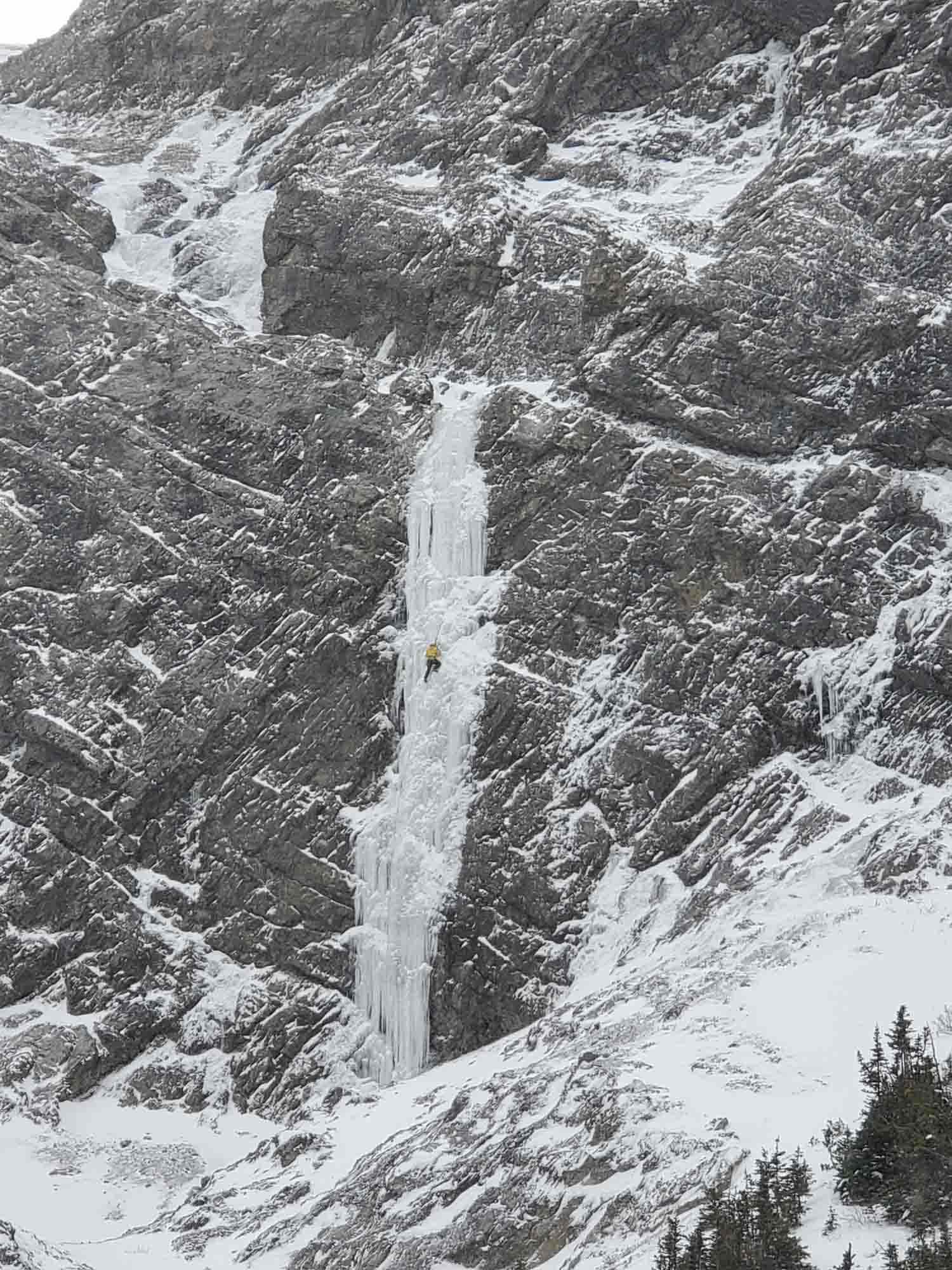
Early-season classic in Ranger Creek with very serious overhead avalanche terrain; most parties climb a single long pitch to a bolted anchor, with optional easy ice above when formed. Expect the first few metres to be a touch steeper/thinner early season. Avalanche Canada classifies the venue as Complex to Extreme avalanche terrain, and incidents have occurred even in October–November.
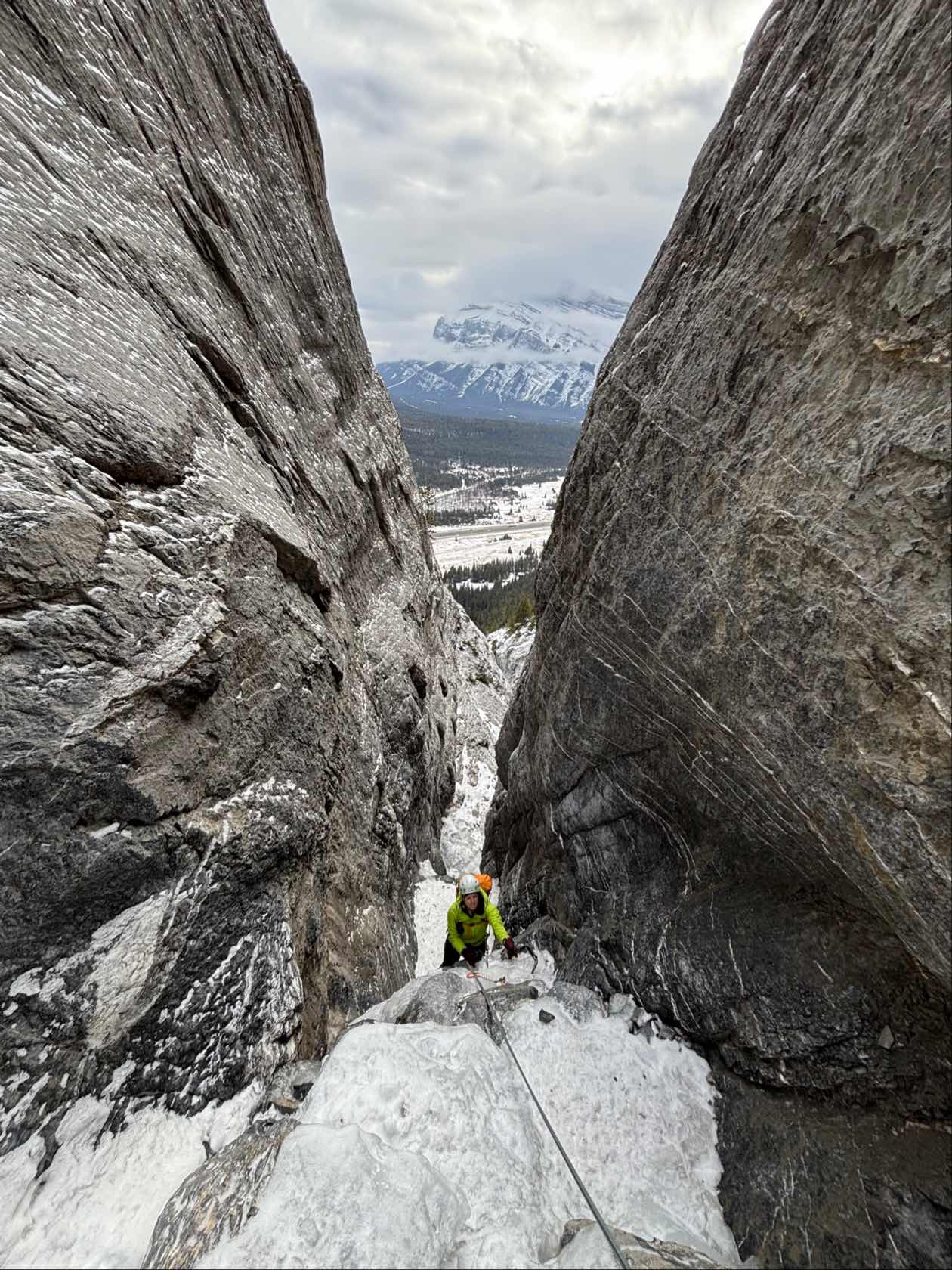
A long, rambling gully of steps and short walls left of Cascade Waterfall that gives enjoyable moderate ice with a final, longer stepped finish. The line and the avalanche slopes above face southeast and get plenty of sun, so timing and conditions assessment are important. Established in 1973, it remains a popular early-season objective when coverage in the gully is favourable.
A short, shaded roadside ice pitch above Goatview Pond—ideal when avalanche hazard is elevated. Expect a brief approach and a single steep step of blue ice with convenient trees up left for descent. Other short lines in the bowl include Jungle Warfare, which sits next to Public Enemas of the State.
A rare, early-season, north-facing smear on the west end of the McGillivray Slabs above Lac des Arcs. When it forms, expect variable thickness: the crux can be thin, technical ice low on the first step or a short, steeper pillar in the upper half. Typical length about 60 m, WI3; climbed most often when cold snaps arrive before the first big Chinooks. First ascent January 1989 by Allan Derbyshire and Choc Quinn. Very obscure and often doesn’t form.
A short, popular curtain on Grotto Canyon’s Headwall, immediately beside His. Expect plastic steps down low with a slightly steeper and often thinner finish; overall difficulty typically ranges from WI3+ to WI4 depending on build and traffic.
A rarely formed 100 m IV, WI5 icefall on the south-facing wall of the Mount Kidd Bowl, sharing the same sunny aspect as nearby Kidd Falls. Typically climbed in two pitches: a moderate opening pitch leads to a steep, chandeliered crux pillar above. Extreme avalanche exposure characterizes both the approach and the climb. The wall is known for frequent avalanche activity, with debris often reaching the approach and below the route.
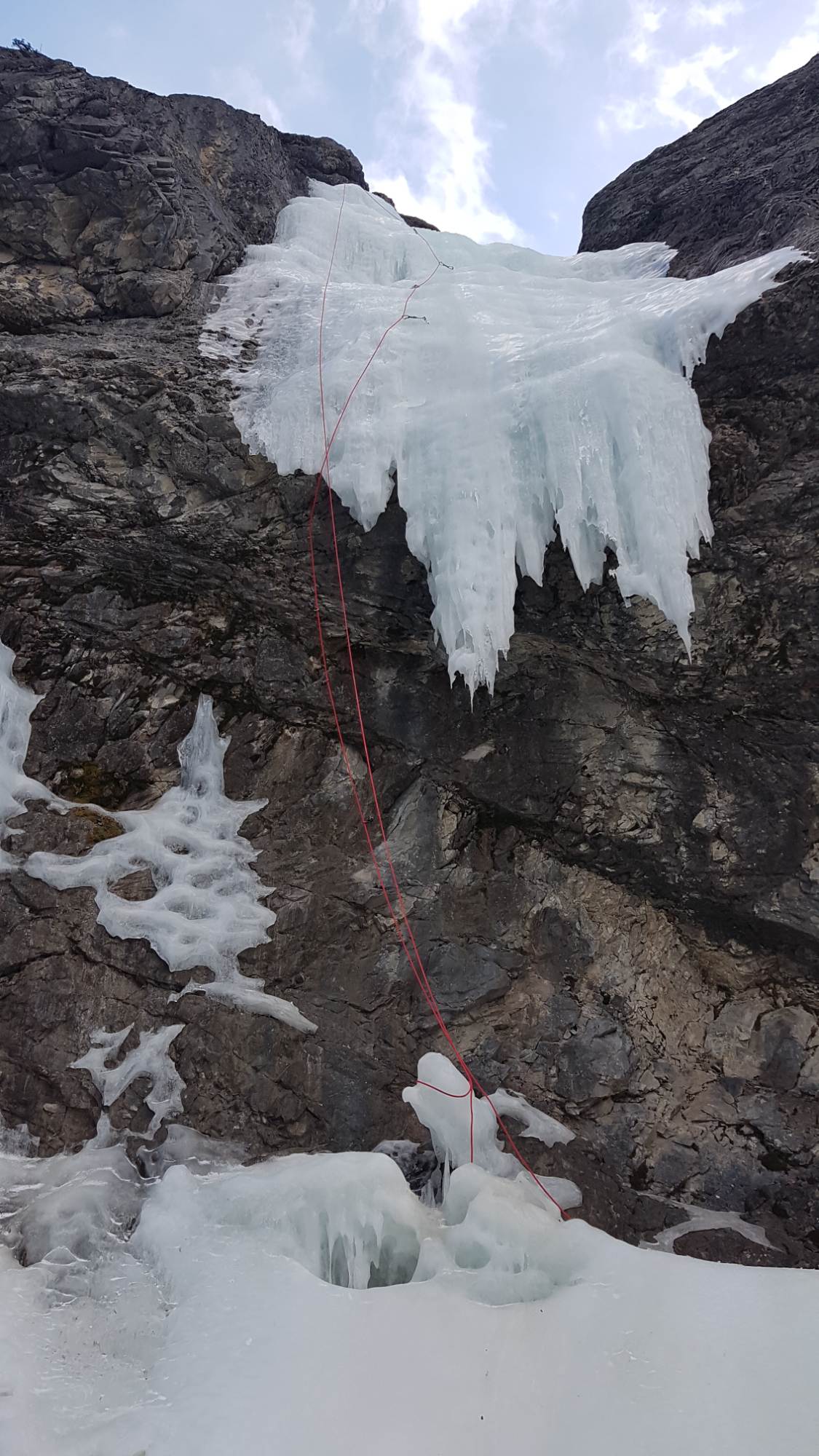
A 30m free standing curtain when fully formed. There is a dry-tooling route called Punani Tsunami (M7) up the back wall to gain the ice if the route is not formed.
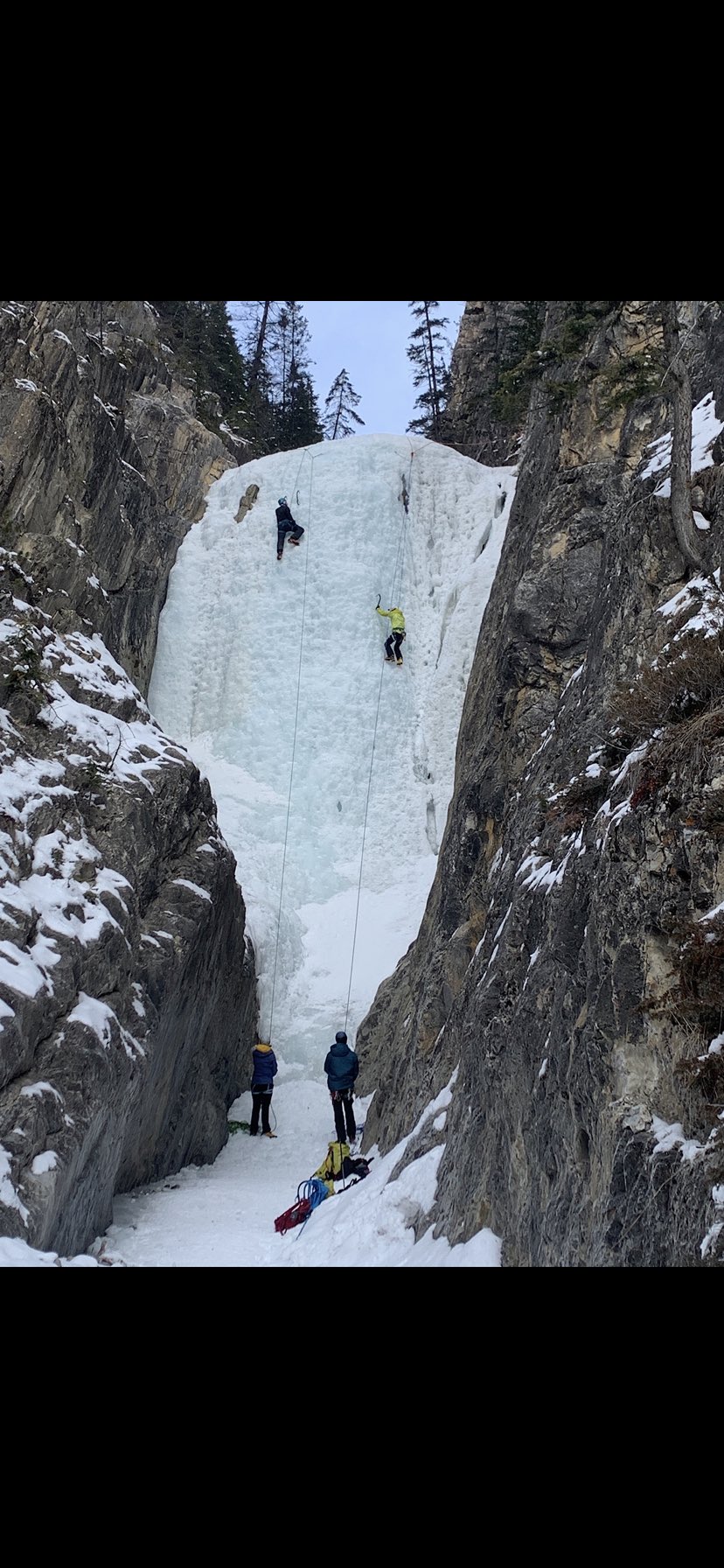
A very accessible and enjoyable climb close to Banff. A great route for its size and grade. 10m of easy ice leads to the main flow. Easier lines on the left, harder on the right. Don’t miss some of the more recent bolted dry-tooling lines on the cliff on the right before the climb!
A rarely formed 200 m ice gully high in upper Grotto Canyon, opposite Armadillo Buttress. Mostly low-angled snow and short steps culminate in a longer 45 m WI3 finish. South-facing aspect means rapid sun effect; hit it in a cold spell. First climbed in the 1975–76 winter by Doug Brown and Daniel Smart. Occasional mixed variations (e.g., Beach Bypass, about M4) have been climbed when the main line is too lean.
A dependable early-season WI3 on the right end of McGillivray Slabs above Lac des Arcs. Usually forms as parallel smears that funnel near the top; many variations make it a good venue for laps or a toprope session. First climbed in December 1980 by Allan Derbyshire and Darryl Kell. The McGillivray Slabs face north, which helps preserve the ice when they’re in.
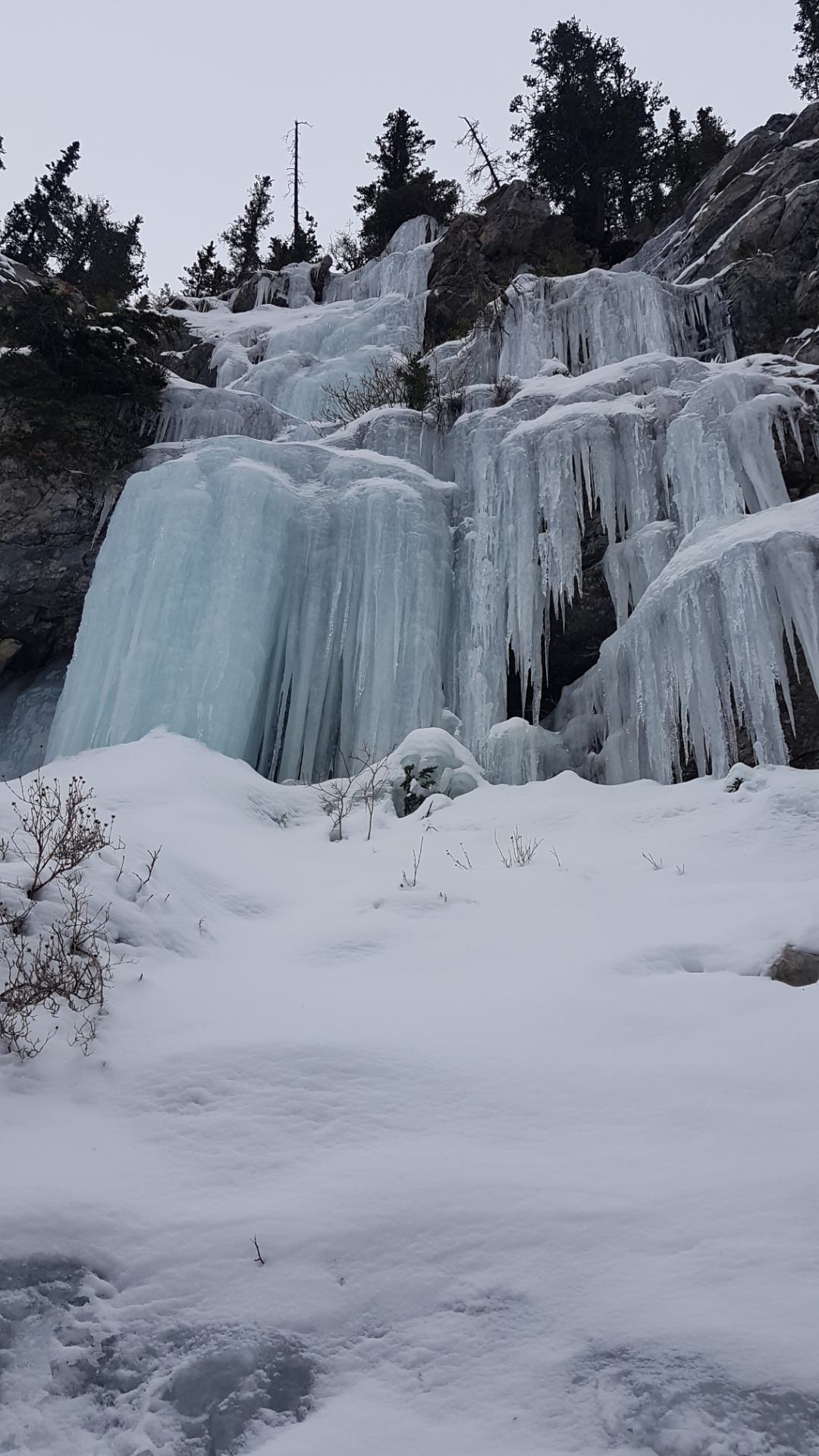
Climb a few meters of low angled ice up to a vertical short pillar. Tackle the pillar untill the angle eases off before steepening again to the top. AD is the rightmost flow on this wall. Another route "river bird " is a few meters to the left at a slightly easier wi3 grade. On the east side of the creek is third route "the N.I.P" just across from AD and is a short 8 meter pillar of wi2/3. These routes are usually very fat by march.
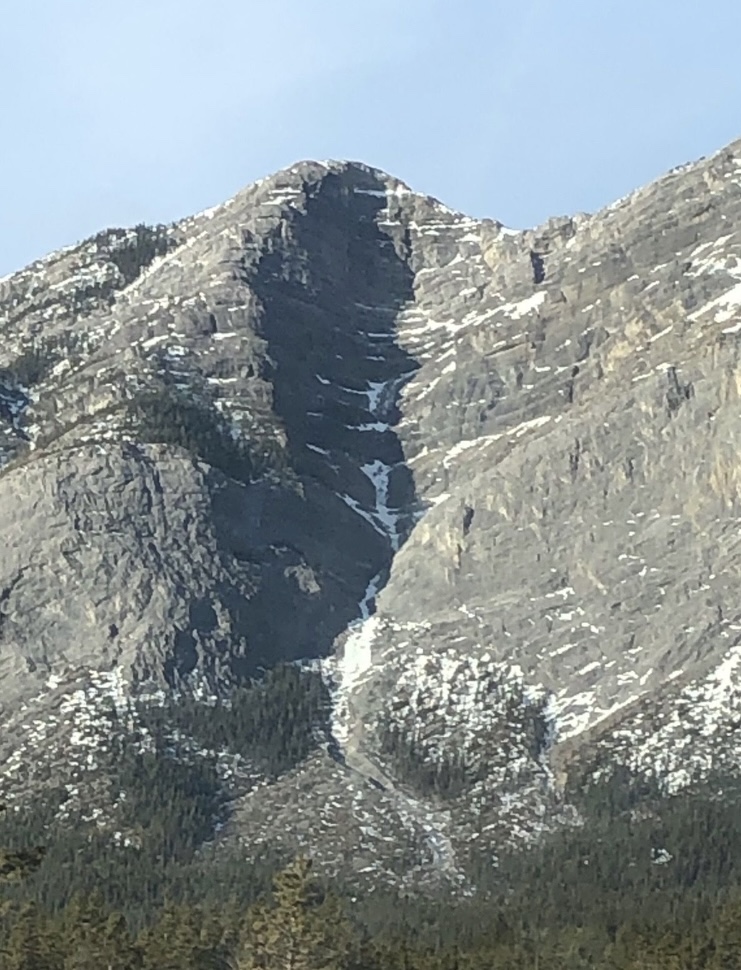
A long gully ice route on the southeast face of Goat Mountain that forms the lower (ice) portion of Coire Dubh Integrale. Mostly low-angle snow and ice with a short final step of good ice; an excellent venue to cover terrain at a moderate grade. First ascent recorded as December 1973 by Bug McKeith.
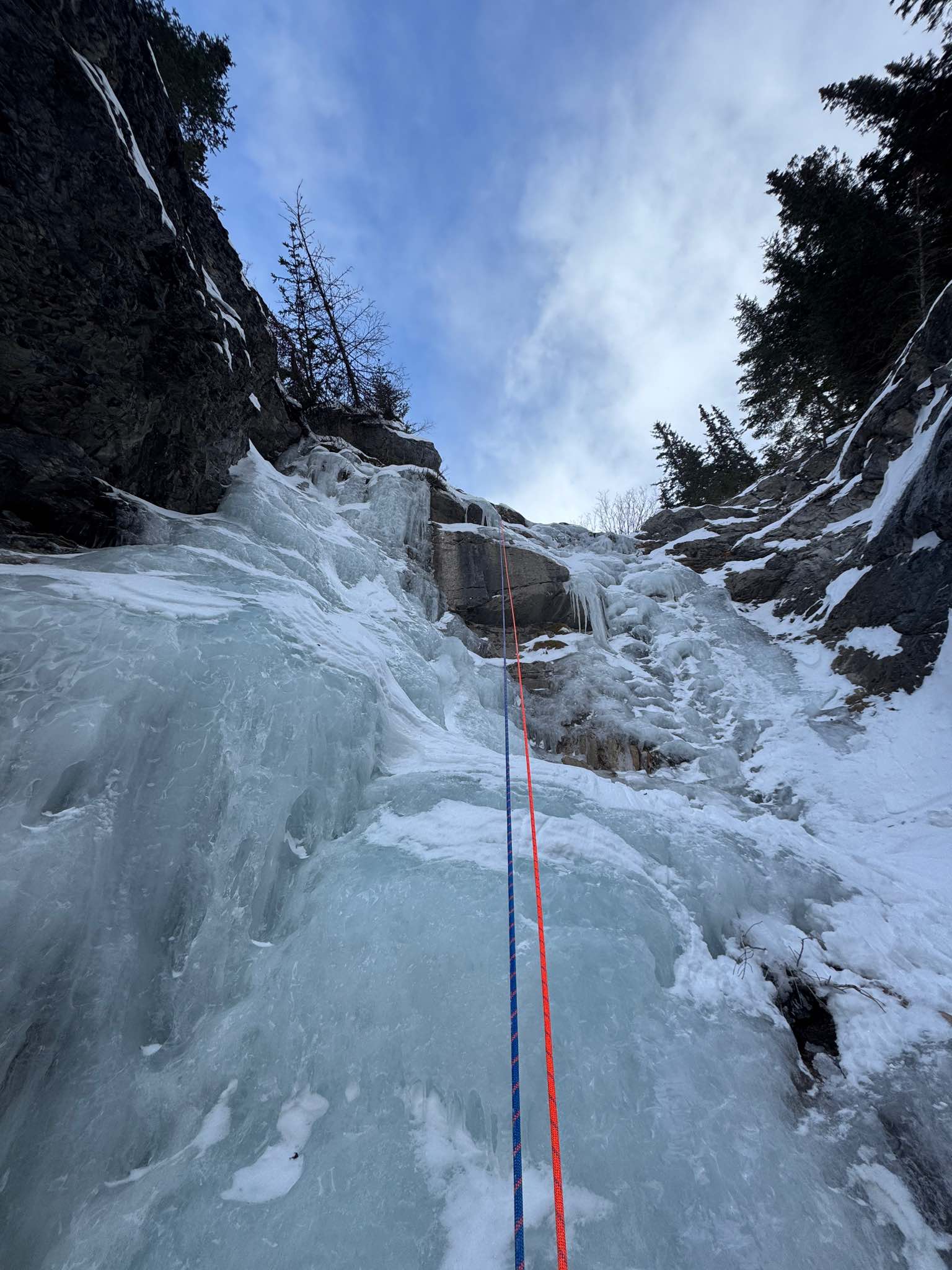
A three-pitch moderate ice climb tucked up a tributary of Cougar Creek behind Mount Lady Macdonald, offering mostly WI3 steps with a short easier finish. Expect a long approach but reliable early/mid-winter ice when conditions are good.
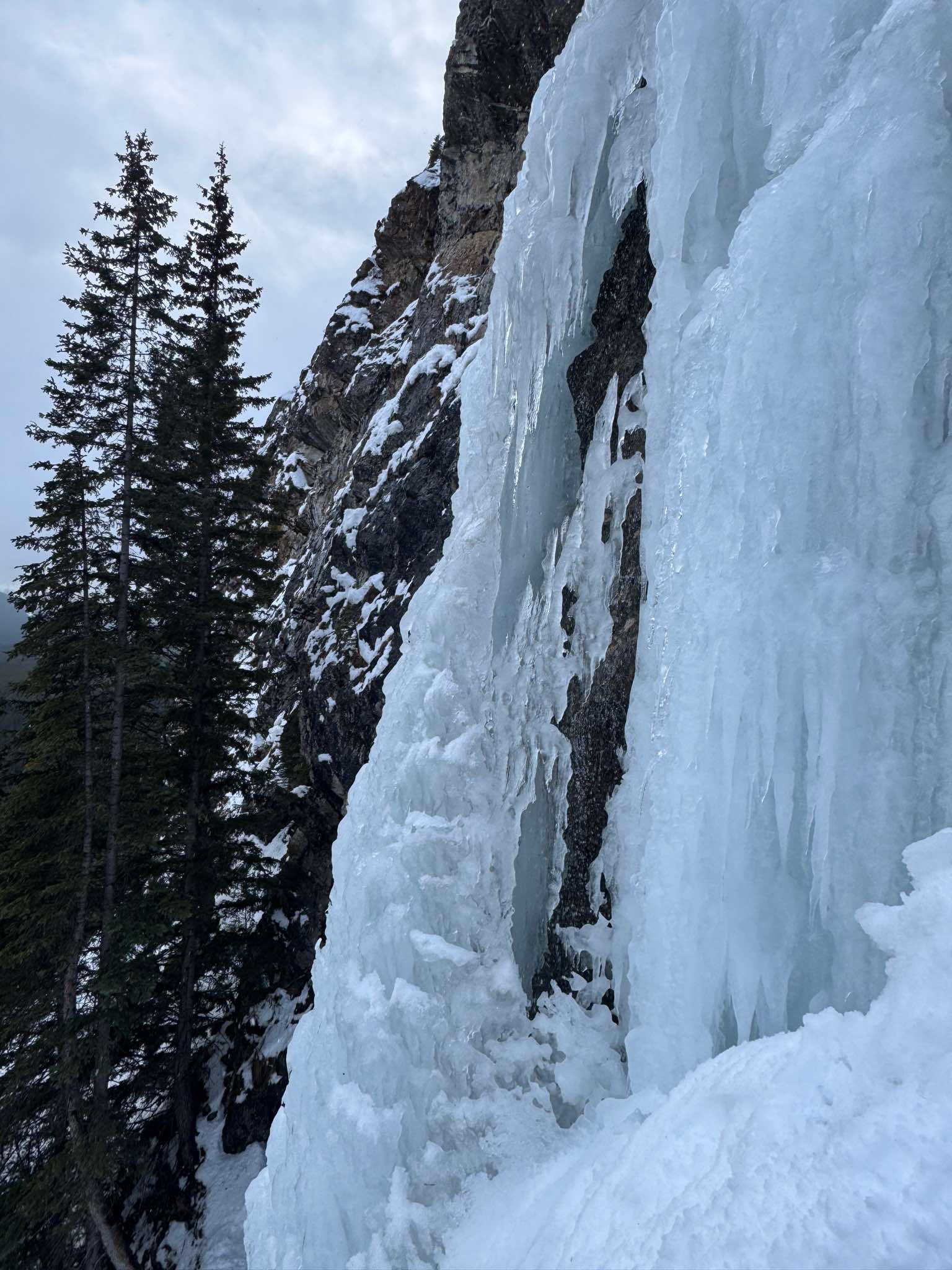
Very short and easy approach! Because of the rain and warm weather on December,2025. We just did pitch 1 only. The whole climbing should be listed in Ice, Snow, 750 ft (227 m), 3 pitches.
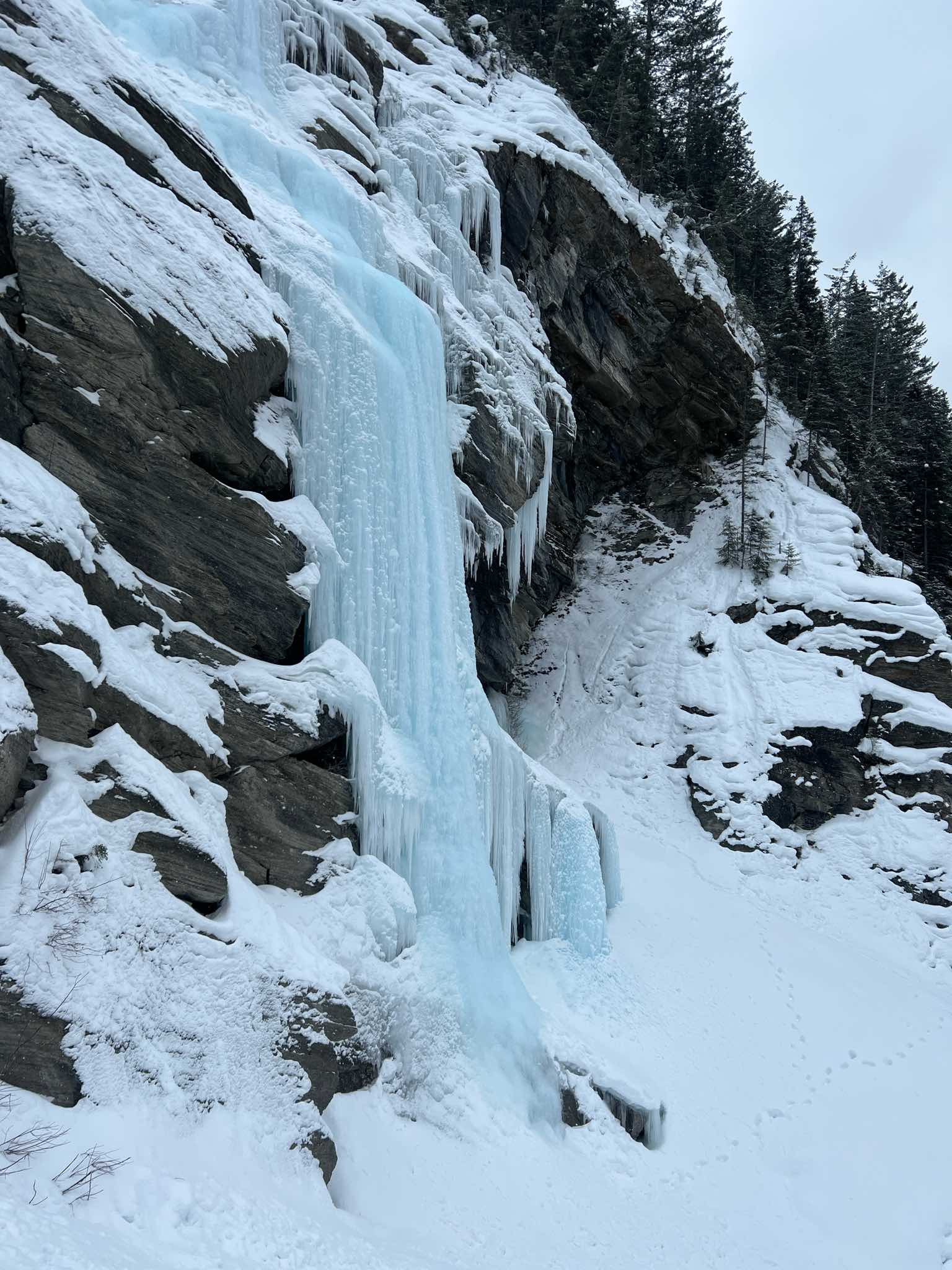
A Yoho classic on Mount Stephen just east of Field: a short, steep opening pitch followed by mellow rolling ice to treeline. Listed at 140 m, WI4, it’s one of the most commonly climbed routes in the park and sits in a significant avalanche path, so timing and conditions matter.
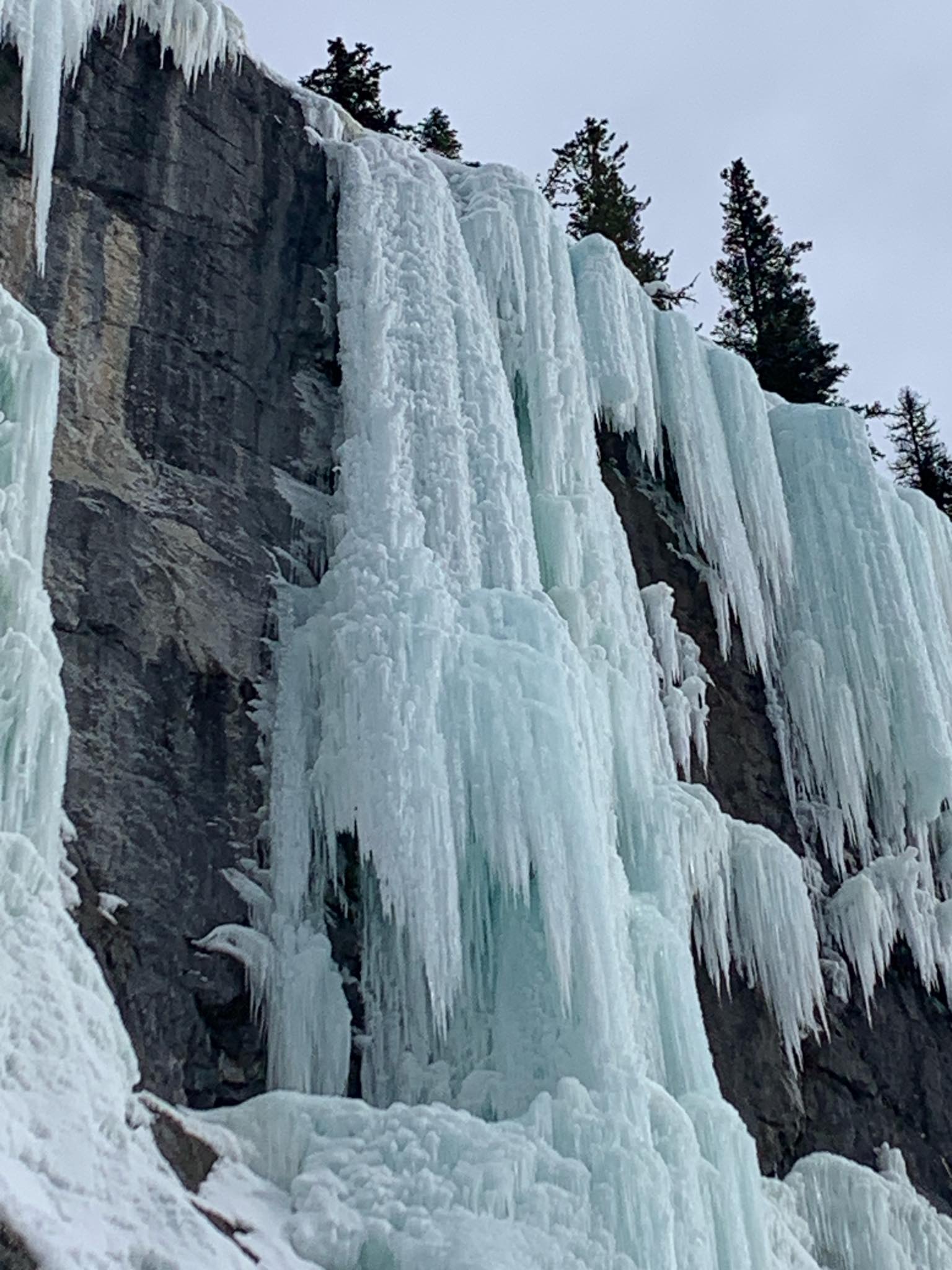
This route is one of many at “The Far Side”. Climb 100m of varying ice and snow to the base of the pillar. You can climb direct to the climb or start from the right and solo up to it. (See atattched pictures). Snowys Revenge is named after a popular cartoon dog. It is the 3rd pillar from the left. See atattched pictures.
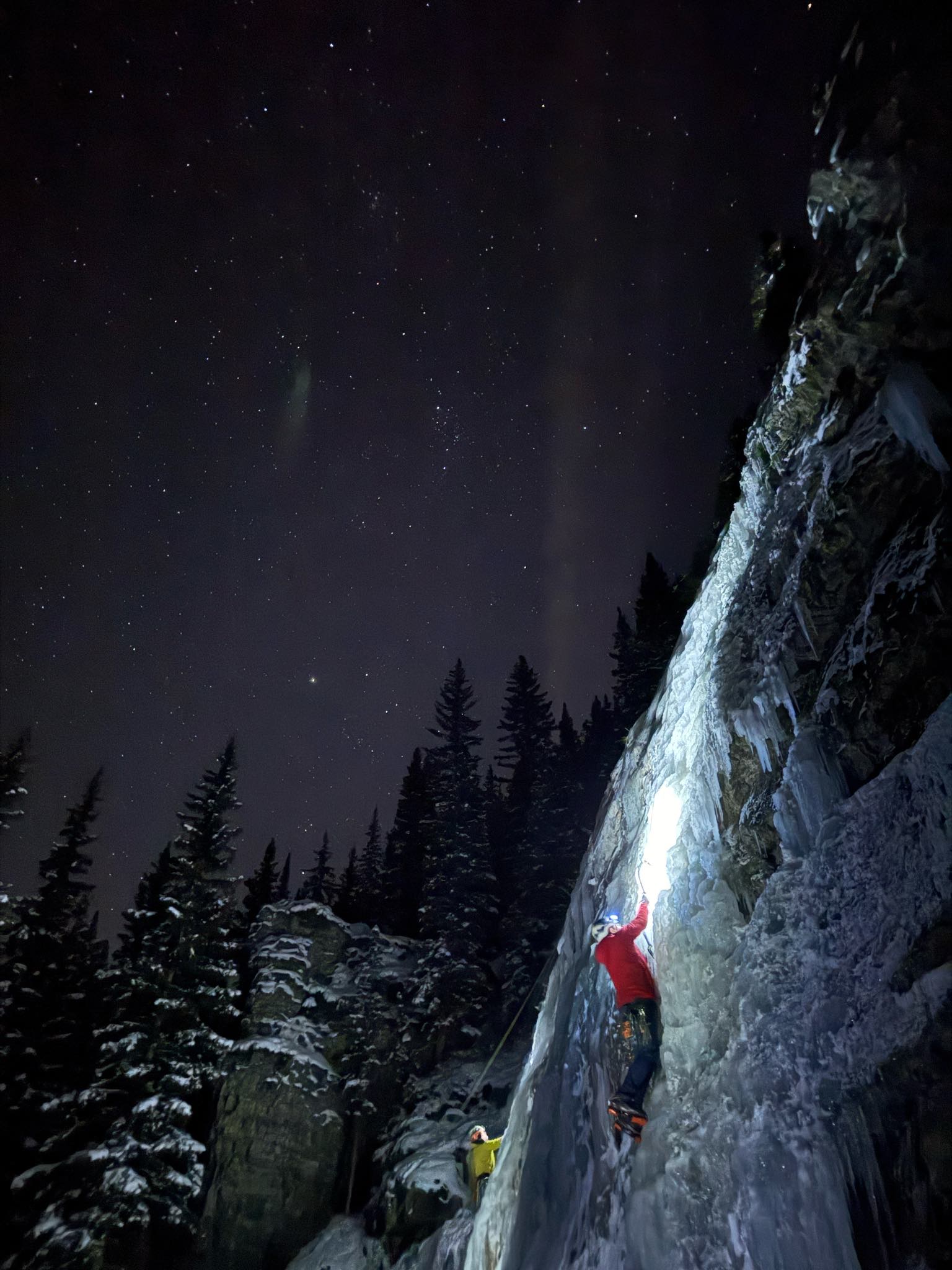
A short, single-pitch practice smear above Wedge Pond on Limestone Mountain near the Galatea Creek parking, typically forming as a 30 m WI3 flow. Descent is by rappel from a V-thread or a suitable tree.
A short, beginner-friendly ice venue in the Heart Creek canyon with rolling seeps and a steeper finishing step when formed. Expect roughly 45 m of climbing at WI2, with the upper step reaching WI3 in fat conditions. Easily combined with laps for practice.
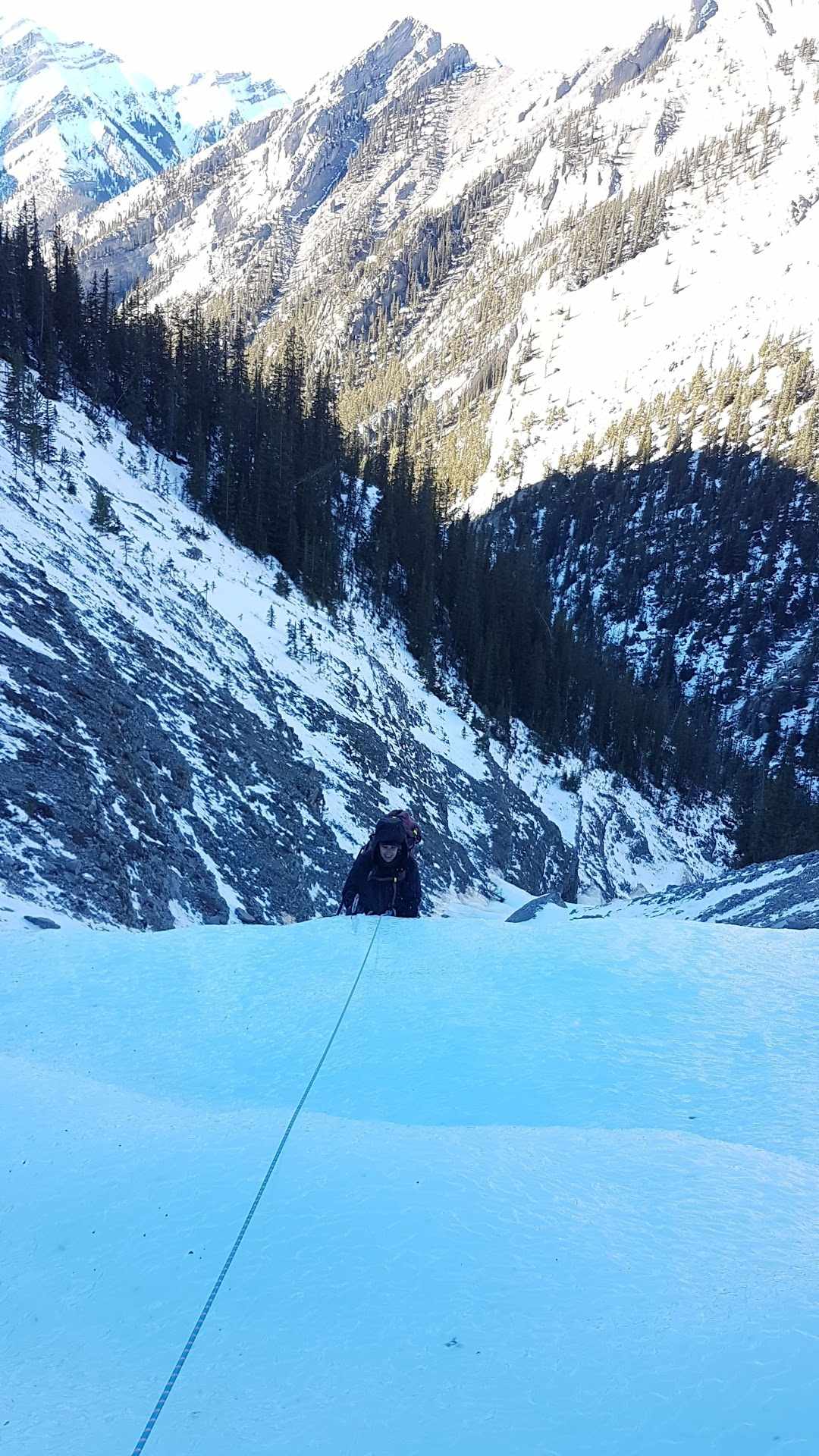
Fancy walking up 200 meters of Wi2- in a shallow gully feature. A route of little interest.
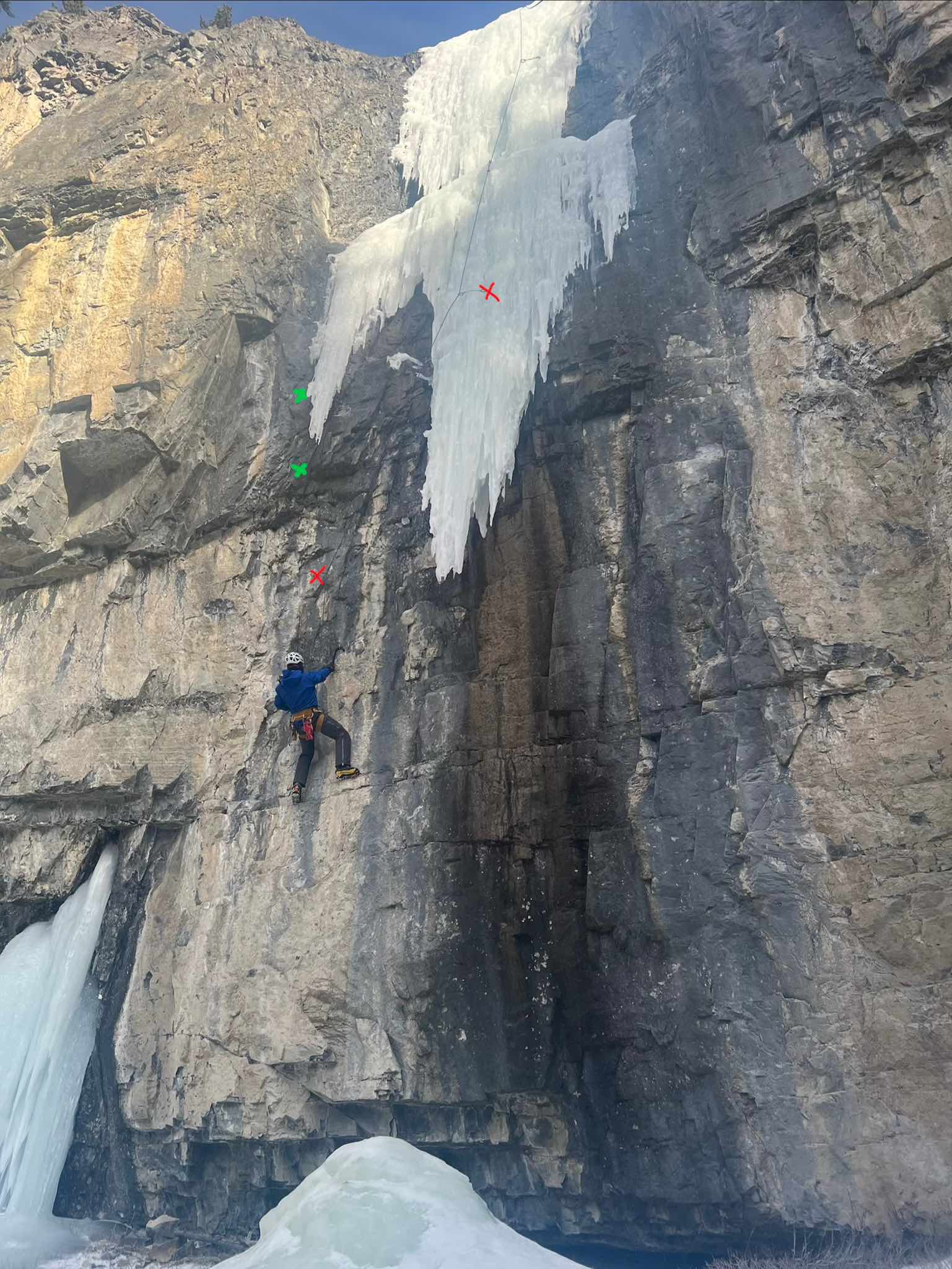
Bolted line on the left side of the eagle, quite fun climbing with a mix between insecure holds and buckets with ledges for feet. I cut right at the 6th bolt to gain the larger dagger (Jan 2026), climbing felt more like m6+ but quite runout beyond that bolt to the ice.
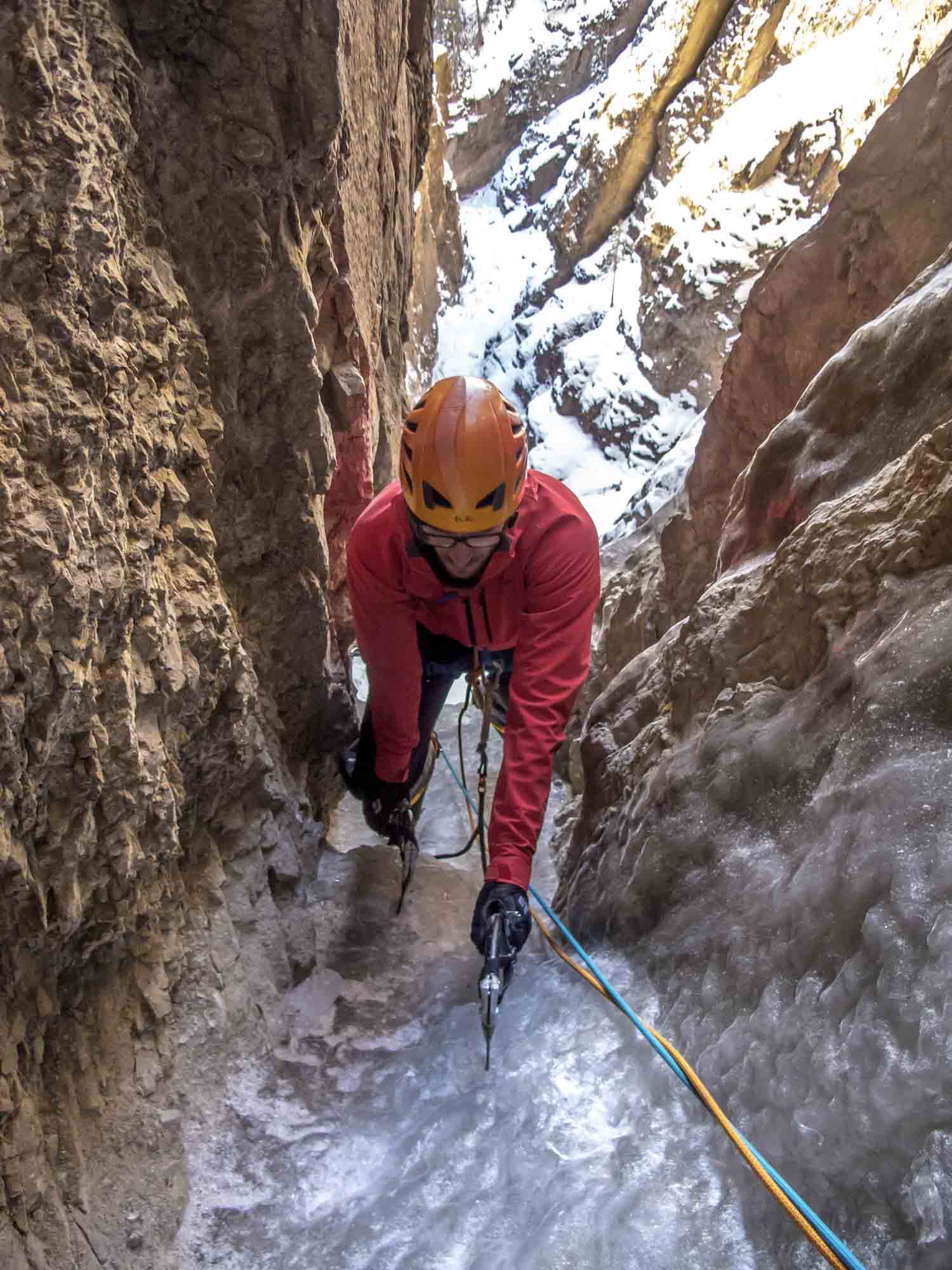
A short but classic two‑pitch mixed route immediately right of Whiteman Falls in the Opal Creek canyon. Climb a mixed right‑facing corner to steep rock and into the main cave, then finish by stemming between thin ice and rock features to a second cave; difficulty varies with how much ice forms before you commit onto it. Fun, well‑protected mixed climbing that’s become a local staple.
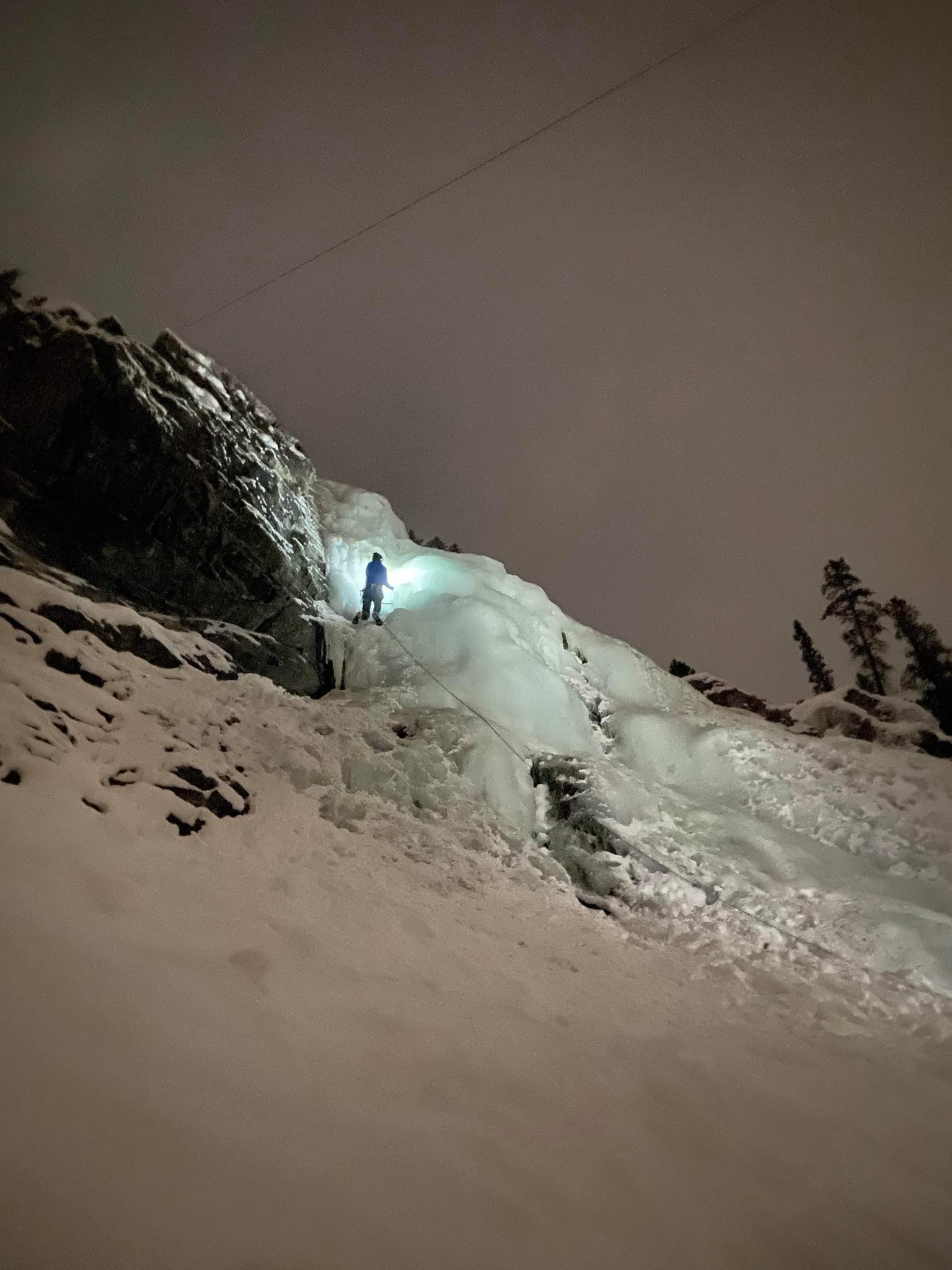
The mightly junkyards, easy access to easy climbing. Great place to practice technique, rope skills or get some after work laps. Broad curtains of ice ranging from WI2 to WI3, most areas can be accessed from the top to allow TR’ing without leading.
A short but fierce four-pitch testpiece on the Stanley Headwall, combining thin entry ice, a steep corner, mushroomed pillars and a finishing vertical tongue to a cave. Expect conditions to vary: the first two pitches may be rock/mixed up to about 5.8 when unformed or thin WI4 when iced; overall difficulty settles around WI6 with mixed to about M7 depending on build-out. Length ~145 m. First ascent in March 1992 by Claude Blazy, François Damilano and Philippe Pibarot.
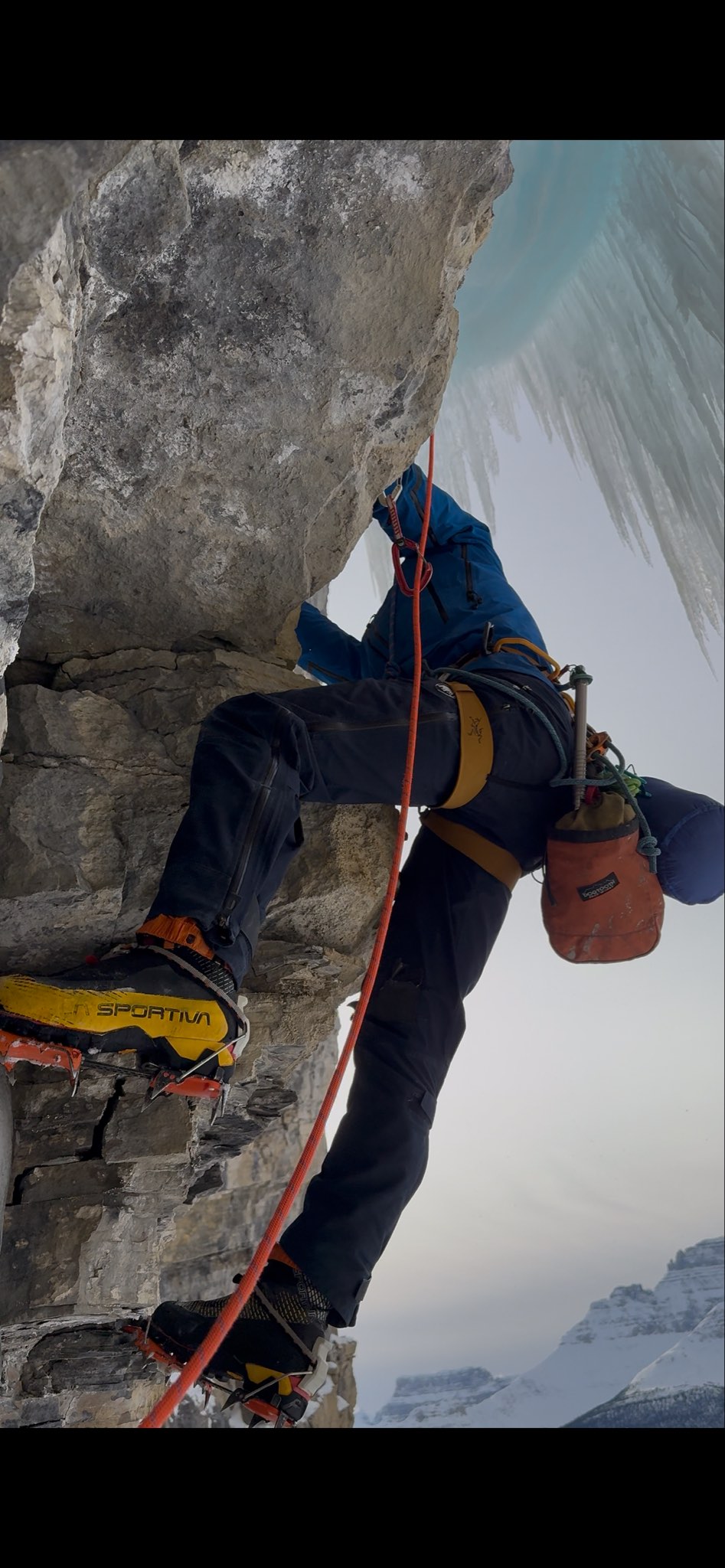
A 3 pitch mixed line sandwiched between the lower half of wilson and the upper climbs, suntori and living in paradise. A very cool climb in a cool setting, be sure to only venture in during stable avi windows. This route is in serious terrain Not a bad idea to take a wrench, many of the bolts were loose. I tightened some but not all of them
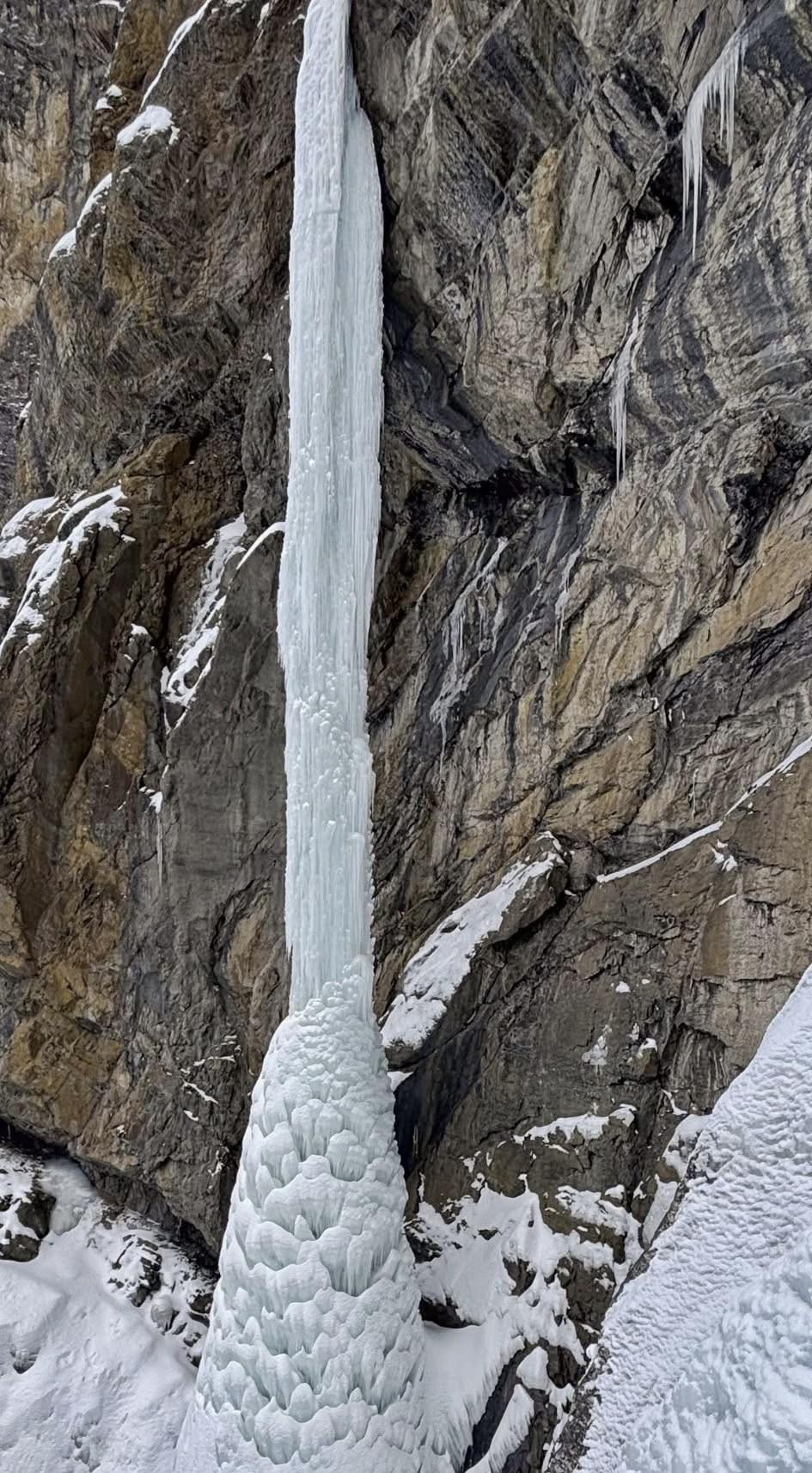
The pencil. Rarely formed, highly sought after.
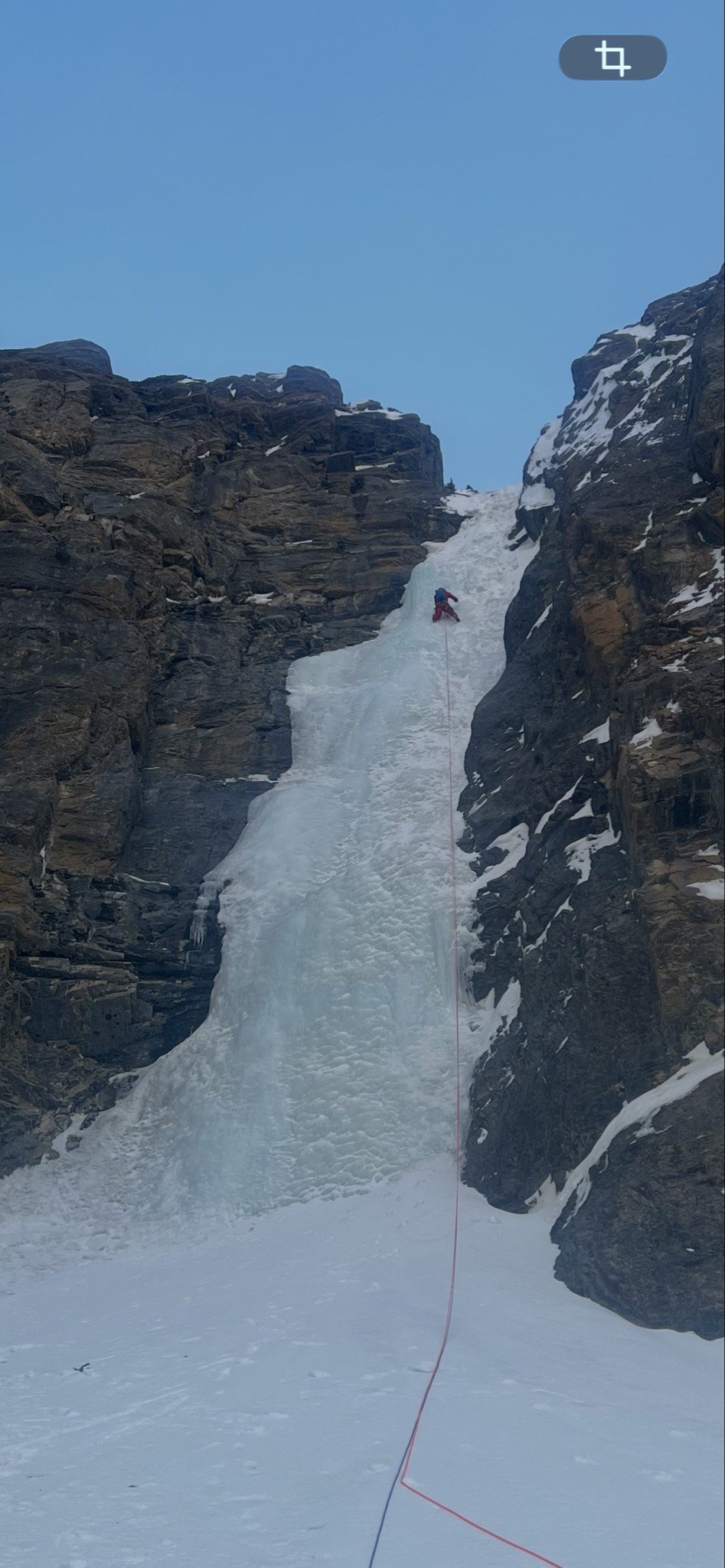
A series of short steps up a gully, the hardest pitch being a 30m WI3+ This route sits at the toe of a huge avalanche path, only consider this route in green brick conditions.
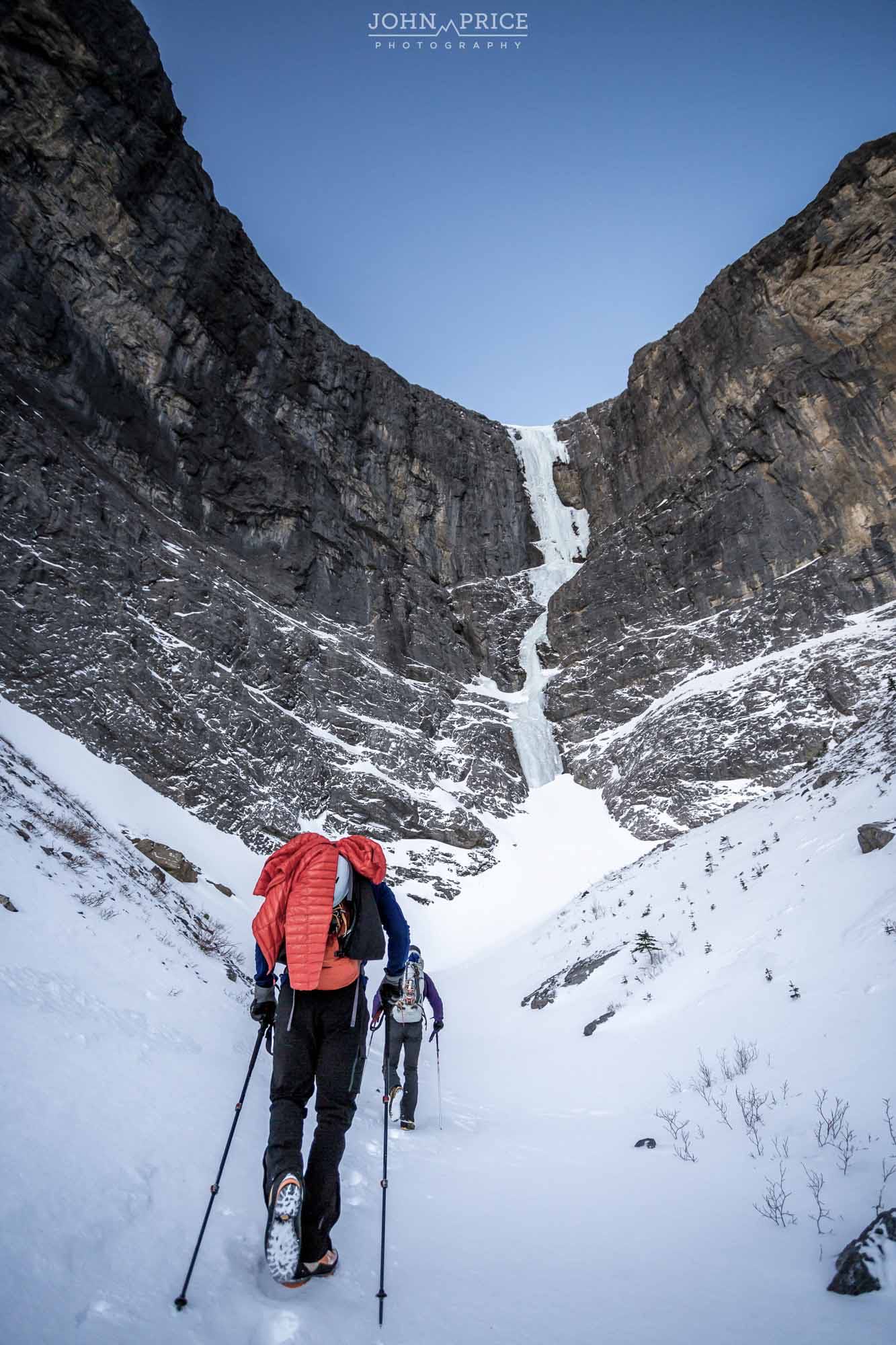
A 210 m, Grade IV, WI5 classic pouring into a steep limestone amphitheatre in the Johnson Creek drainage. Typically reliable each season though the first pitch can be thinner; the upper two pitches are long and sustained. First ascent in February 1983 by Kevin Doyle and Iain Stewart-Patterson.
A classic mini‑alpine link‑up on the north-facing drainage of Loder Peak, combining easy ice steps (to WI3), snow gullies, and a short 5.6–5.7 rock band, and finishing on the summit ridge of Loder Peak. Expect little to no direct sun in winter and often windy conditions on the ridge. First climbed by Bugs McKeith in December 1973.
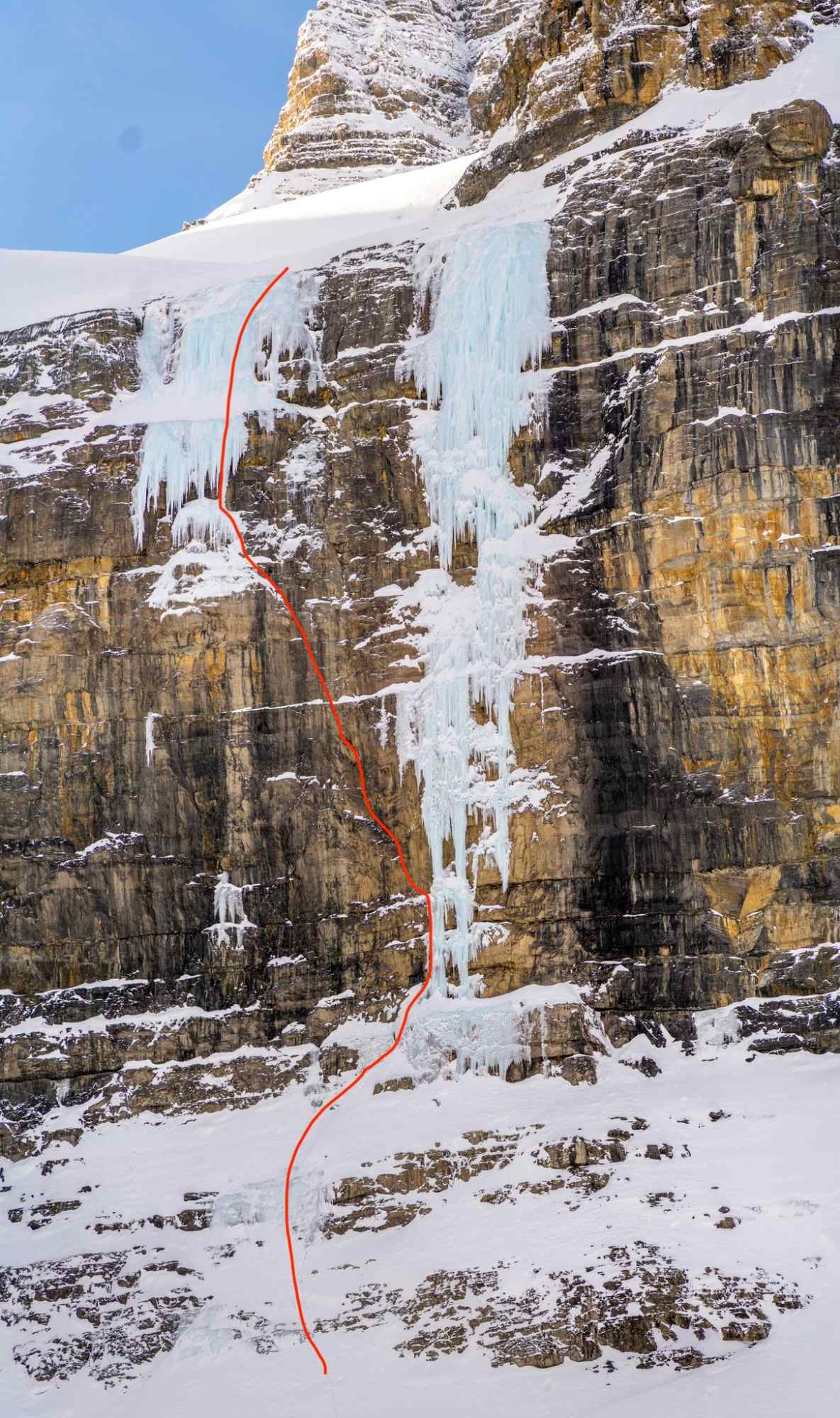
Scratchy mixed climbing, often with good torques but poor feet.
A short but serious, dead‑vertical pillar in Grotto Canyon. Despite only ~15 m of climbing, the ice is often thin, chandeliered early season, and can become pitted/overhung with traffic; ground‑fall accidents have occurred here. Once a rope is in place it’s a top‑rope magnet. A bolted mixed line, Mental Jewelry (M6+), climbs the right rock wall to join the ice. First climbed in the 1975–76 season by Cyril Shokoples and partner.
An extremely rare, short, free‑standing pillar in Grotto Canyon, forming in the corner immediately right of Hers. It was documented as a one‑off, freak water flow and has not been known to re‑form since; expect it to be absent in most seasons. 15 m of steep ice at roughly WI4 when present.
A short mixed variation that starts from the mid-height ledge of Grotto Falls: climb the first WI2 step to the ledge, then traverse right and follow cracks (about 5.8) past a fixed piton to a tree. Total length about 50 m. Described as II, 5.8, WI2 in the local guide.
A short, bolted mixed line on the right side of the His pillar in Grotto Canyon. It climbs rock past five bolts to reach the ice, then finishes on a short ice step. Modern consensus lists it around M5, while the older Rockies guidebook recorded it as M6+.
A short bolted mixed line immediately left of Hers in Grotto Canyon; climb drytooling past bolts, then step right onto Hers to finish at the shared bolted anchor. Listed locally as “Sketch n Sniff.”
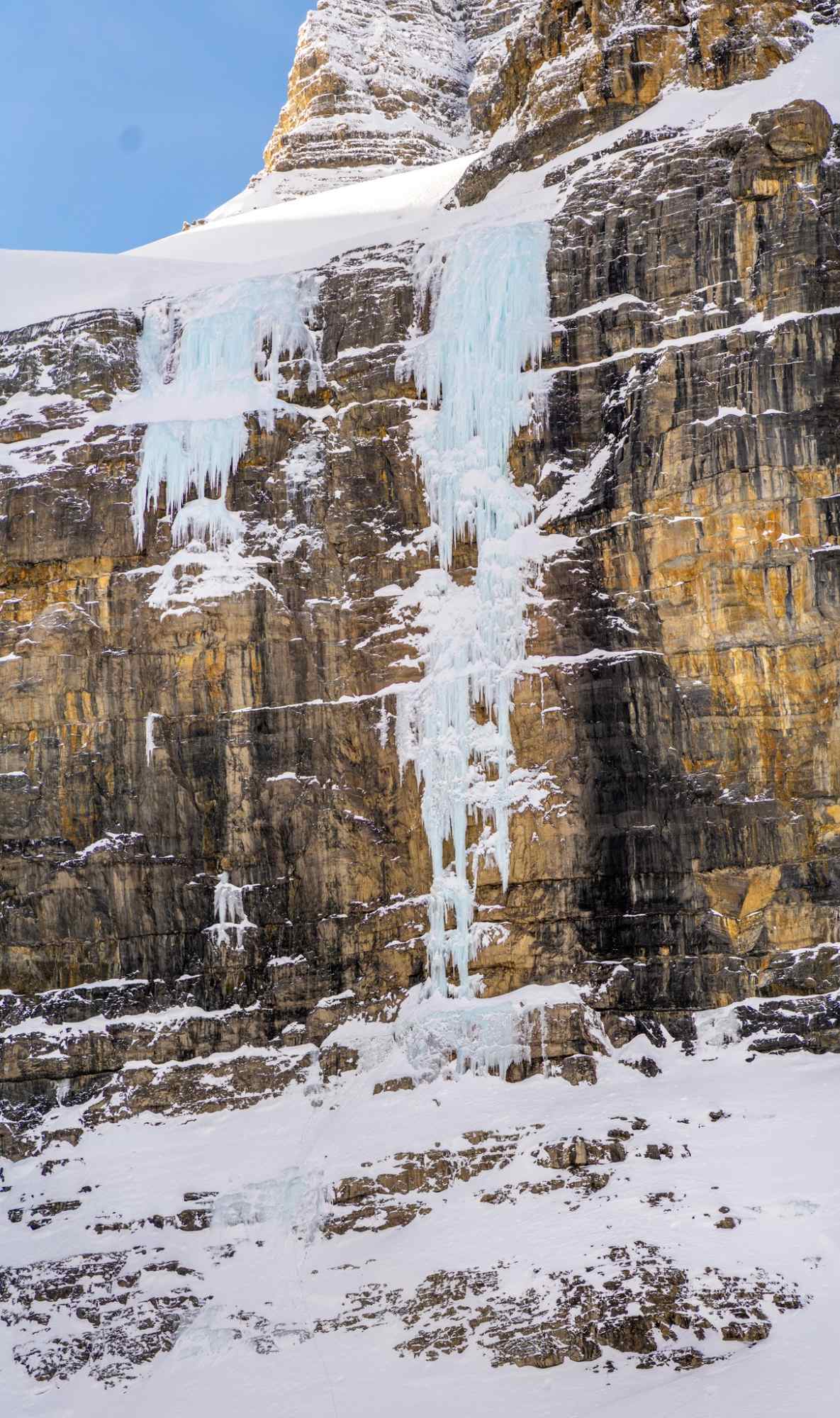
If Nemesis had an extra pitch... it still wouldn't be this cool!
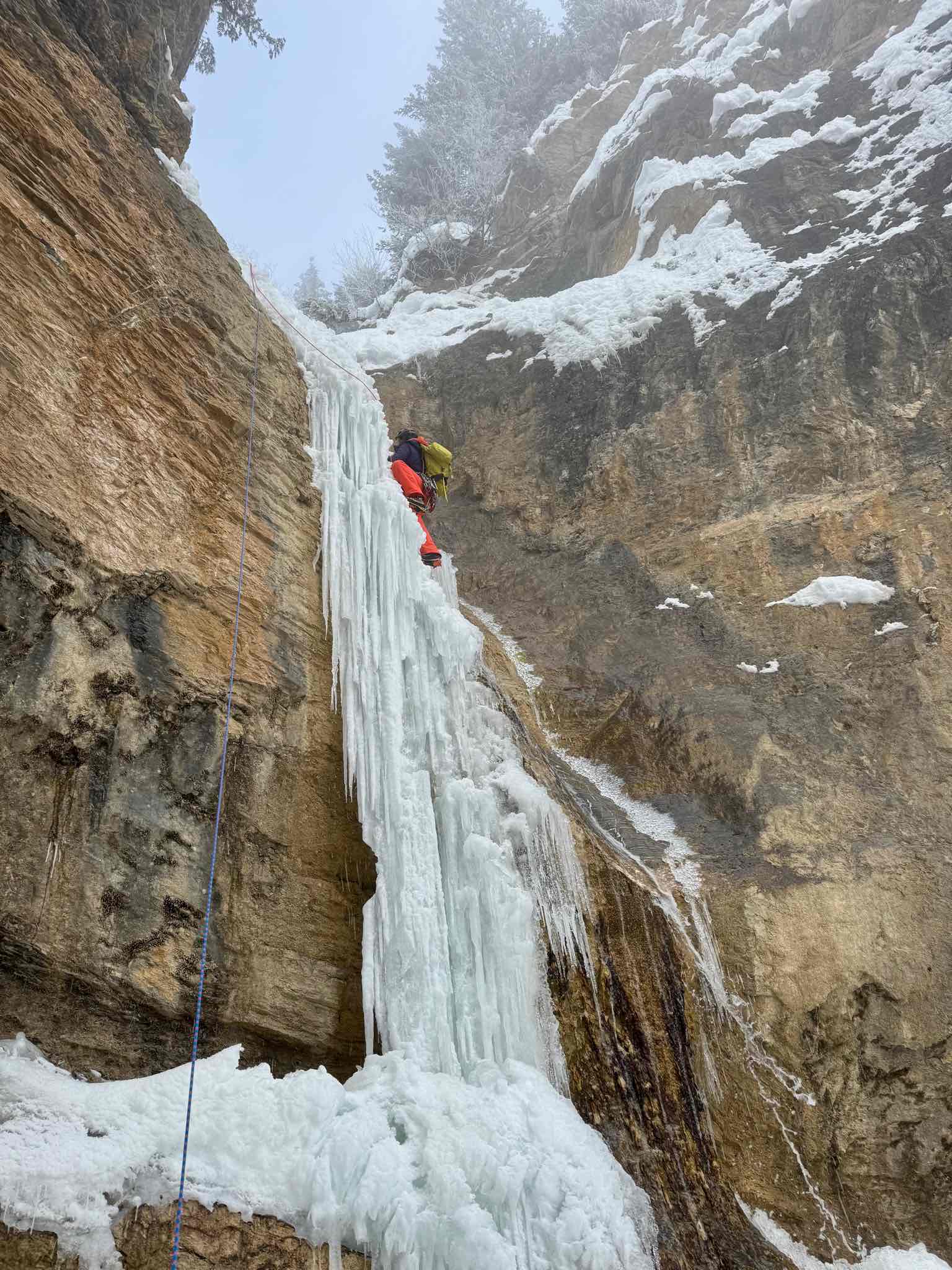
“Ladies First - WI4” Short little canyon ramble consisting of 3 pitches of ice. There definitely more up higher, seems like a line pushes far into the alpine but is broken up by more walking than we could be bothered to do. I think some cold weather would make this route fairly enjoyable. Long walk for not alot of climbing though
No overview yet.
Shaded, north-facing ice in the Mt. Dennis “Beer Routes” above Field. When thin it can be hard to spot or snow-covered; when fat it offers worthwhile moderate climbing. If conditions look lean or the ice suspect, consider Guinness Gully instead. First ascent: Carlos Buhler and partner, winter 1979–80.
Mixed route reported at approximately M7 WI5. No definitive public description located in Josephson’s Waterfall Ice (2000) and no dedicated entry in Avalanche Canada’s Ice Climbing Atlas as of October 30, 2025.
A single long mixed pitch used to gain the ice of Pilsner Pillar on the north-facing Beer Climbs wall of Mount Dennis above Field. Commonly reported at M7 WI5 and about 50 m in length. Several mixed starts exist for Pilsner; this is the most traveled. “No sun” conditions on adjacent Guinness Gully highlight the wall’s cold, shady aspect.
Historic mixed route in the Canadian Rockies, attributed to Gery Unterasinger (1993). Publicly available topo/beta appears scarce; Josephson’s Waterfall Ice (2000) notes that many modern mixed routes from this era are omitted and refers climbers to mixed-specific resources, which helps explain the lack of guidebook detail for lines like this. Unterasinger is documented as a prolific Rockies developer, including modern routes on the Stanley Headwall, underscoring his long-standing role in this style. In difficulty and character, Sapporo’s stated grade aligns with the early‑1990s Rockies mixed benchmark exemplified by Mixed Master.
A short, steep sport‑mixed line on the Pilsner mixed wall among Field’s Beer Climbs at Mount Dennis. Local reports noted fresh hardware updates in 2024, and the wall sits within the popular Beer Climbs corridor. Expect condition‑dependent ice smears and a bolted finish.
An iconic free‑standing pillar on Mount Dennis above Field, B.C., and the easternmost of the Beer Climbs. The climb is ~215 m in total, with the celebrated 40 m pillar forming the WI6 crux; many teams rappel after this first pitch, but up to four easier pitches continue above in the gully. Expect highly variable three‑dimensional ice and mushrooms on the pillar, and serious avalanche exposure in the drainage. First climbed in 1974; the first free ascent was in 1978.
A historic 250 m Grade V WI4 waterfall ice climb on the east wall of the Yoho Valley, widely regarded as a Rockies classic. The first ascent was completed in January 1974 by Jack Firth, Bugs McKeith, John Lauchlan, and Rob Wood; Duncan Ferguson and Dave Wright made the first free ascent in 1977, and Lauchlan later soloed the route. High water volume behind the ice makes the crux shield extremely serious when thin.
M6 & 5.9 WI3-6 It’s a rock climbing crag also, so make sure to climb respectfully https://www.summitpost.org/wad-valley-climbs/363035
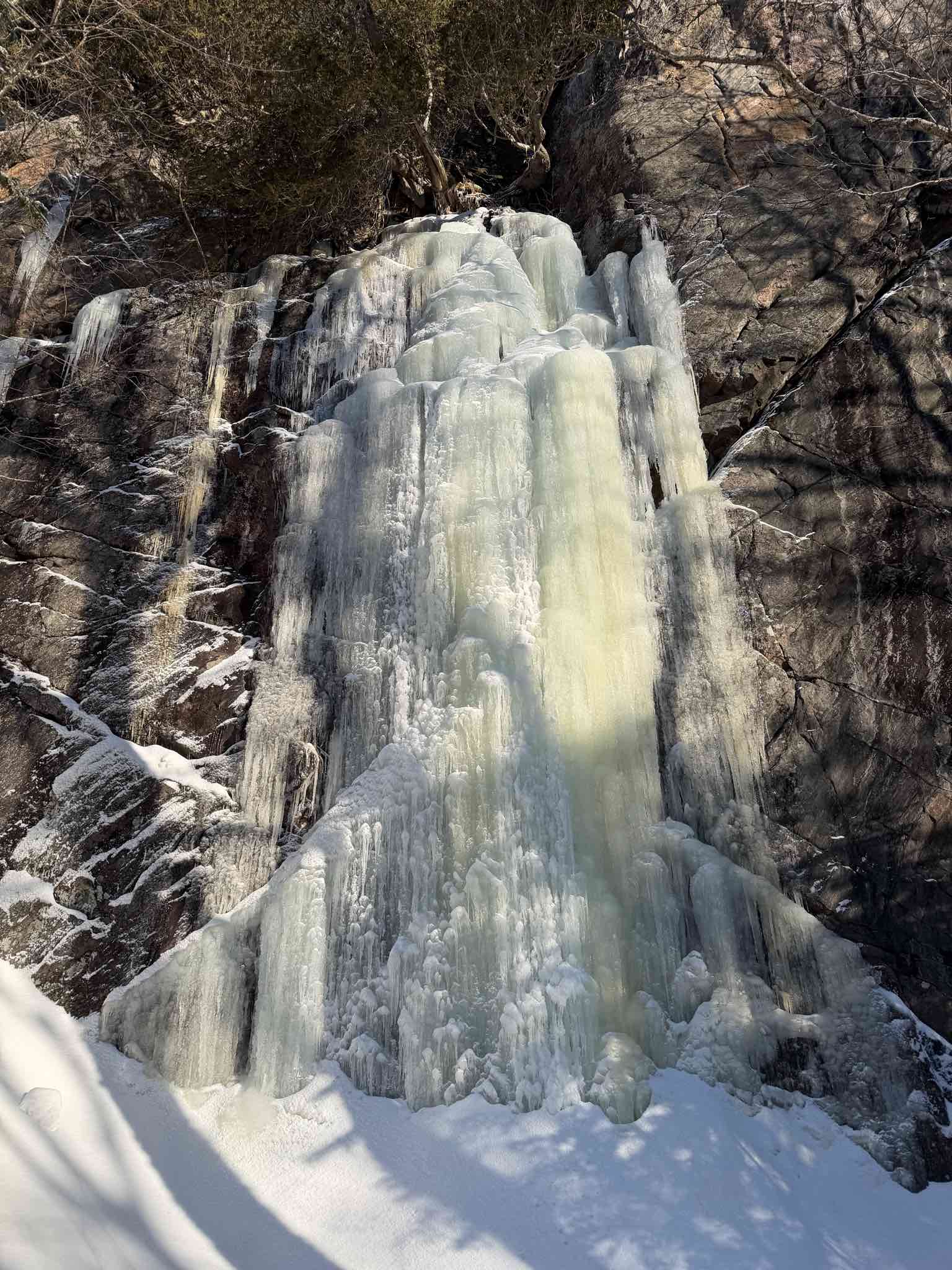
This is the kind line of Panama Wall. The biggest most obvious flow along the cliff line. TR accessible but it will be adventurous to find from the top to set the TR.
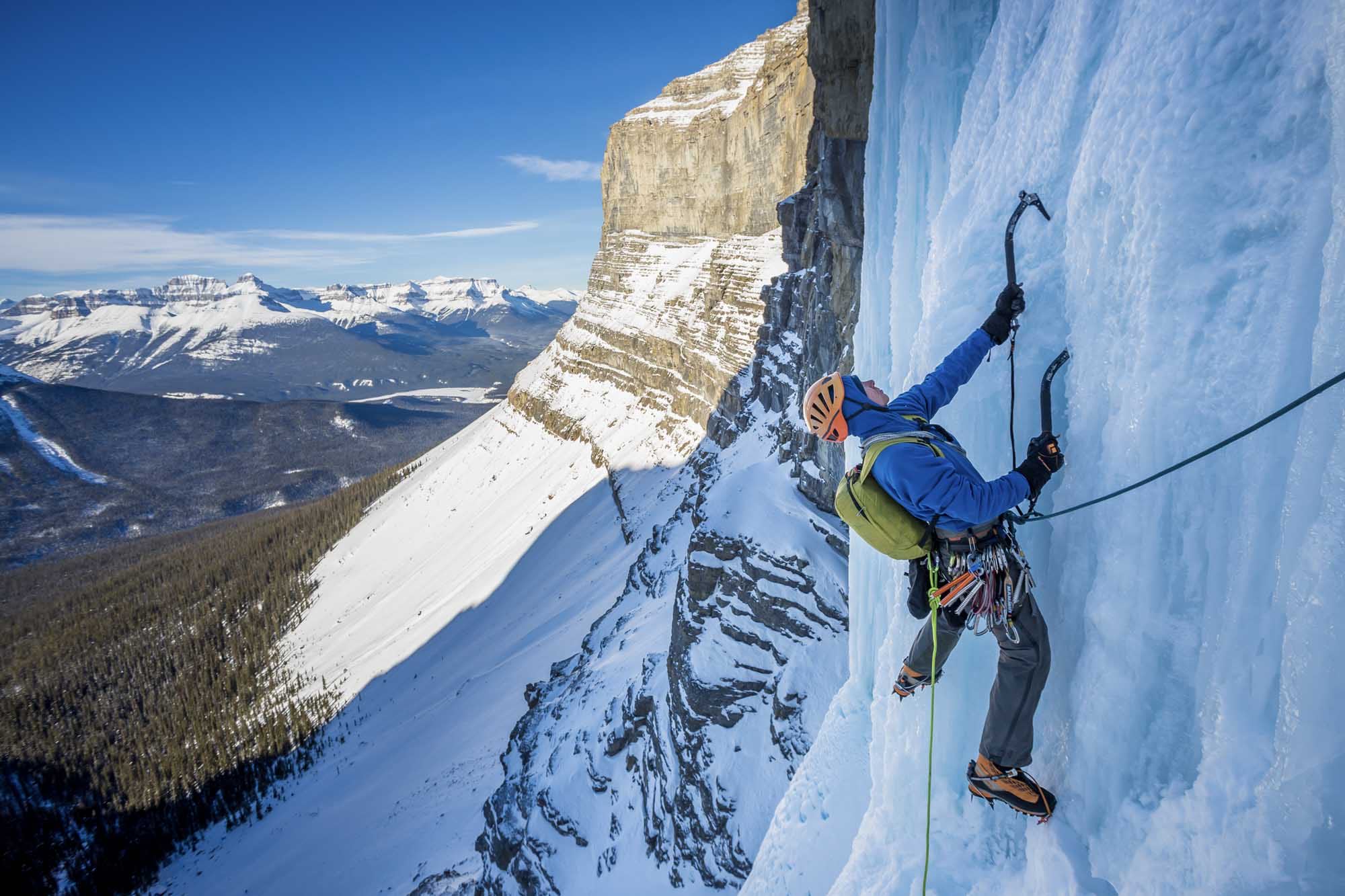
A long, aesthetic multi‑pitch waterfall on the west side of Mount Murchison’s amphitheatre, typically forming early and offering varied lines that build to a sustained final curtain. Commonly climbed at WI4/4+, with parties either soloing or leading a short WI2 step to reach the main flow. Expect colder temps in the amphitheatre and constantly changing ice features. First ascent: Trevor Jones and Tom Whittaker, 1997. The route is one of the Parkway classics with relatively low overhead hazard; the primary exposure is the final approach slope from climber’s right. Older guidebook descriptions note an easy final 20 m step above the last curtain and a fixed rappel anchor out right below it.
A long and sustained link-up on Cirrus Mountain’s Weeping Wall combining Lower Weeping Wall (typically via Central Pillar or Right-Hand) with the Upper Weeping Wall’s striking Weeping Pillar. Expect roughly 350 m of climbing with two crux WI6 pitches on the upper tier and classic WI5/5+ climbing below.
Steep, gymnastic drytooling through a roof to an icicle curtain in the amphitheatre behind the first pitch of Ice Nine on Mount Wilson. A modern sport‑style outing on excellent limestone; commonly referenced at M8+.
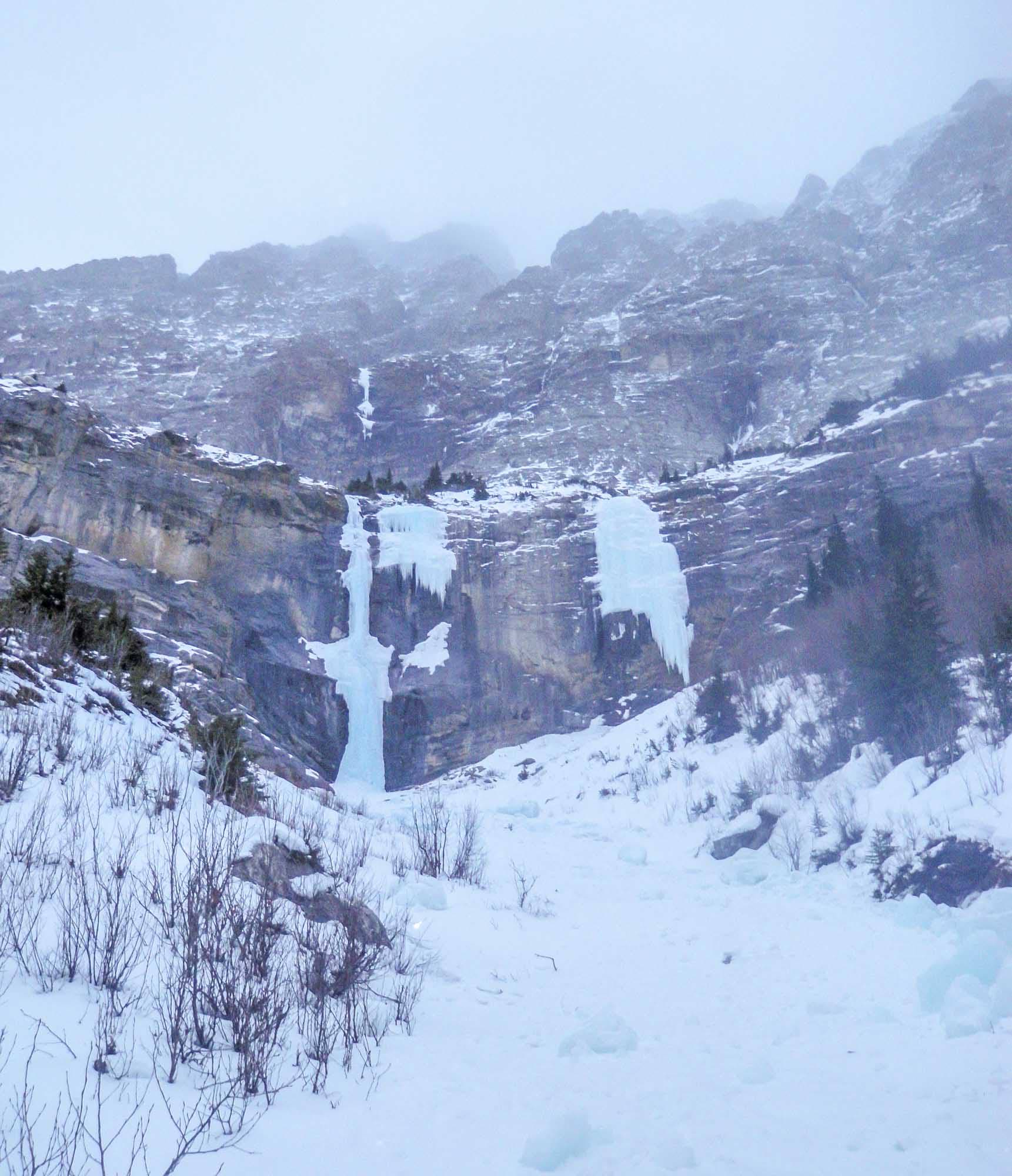
A striking two-pitch pillar just south of Rampart Creek Hostel. Often chandeliered and technical when thin, yet occasionally forms thick and plastic; historically it has not been consistently in every year.
A fierce and committing testpiece: the right-hand of two narrow pillars high in the Tabernac Bowl above Oh Le Tabernac. About 80 m in two pitches of sustained, technical, sometimes overhanging ice; generally harder and more finicky than Whoa Whoa Capitaine, and it rarely forms well. First ascent by Barry Blanchard and Kevin Doyle, January 1992. Often referenced at WI6+, but graded here as WI6 to match the database scale.
No overview yet.
A 225 m, big-mountain waterfall ice test-piece high in the north bowl of Mount Patterson, characterized by thin, hollow and snow-covered ice with sustained, modern-style climbing and little respite. In lean conditions sections approach WI7; first and fourth pitches are typically the stiffest. First ascent: April 1987 by Jeff Marshall and Larry Ostrander.
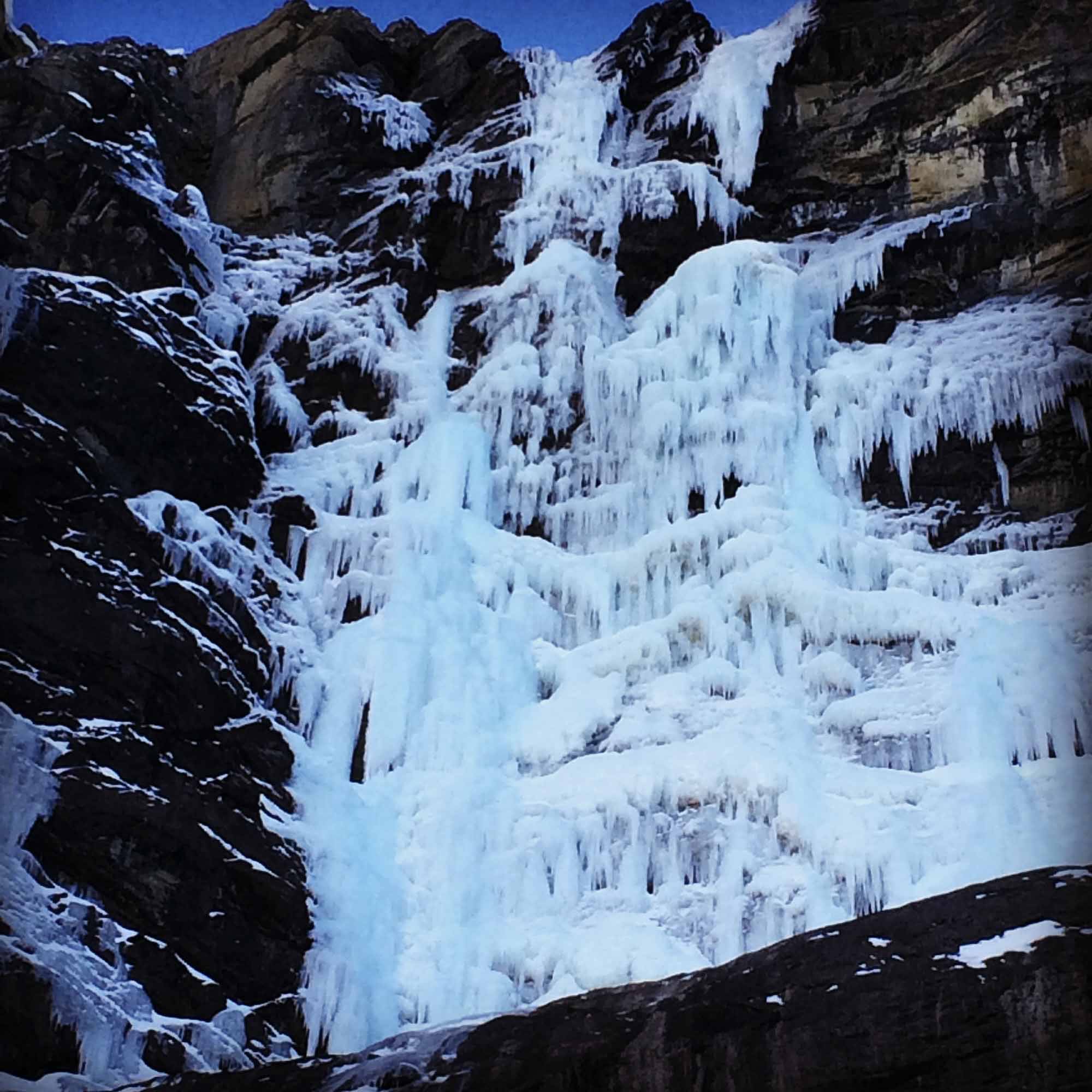
A rare-forming, late-blooming pillar route immediately right of Murchison Falls on Mount Murchison. When complete, it offers sustained, technical ice to a spectacular topout; only the final pitch is usually visible from the road. 160 m, Grade IV, WI6. Virtual Reality typically involves steep free-hanging features and can climb quite seriously when thin.
Wild mixed-and-ice line in Kicking Horse Canyon near Golden, BC. Three lower mixed pitches (now partially bolted) lead to a spectacular, well-protected roof-traverse crux and a final steep WI5 exit. First ascent by Jim Gudjonson and Sean Isaac in February 2000. In December 2013, Jon Simms and Mike Mason equipped the first three pitches with bolts/anchors to improve access when the lower ice is lean. Expect variable ice formation; the crux roof is M7+ when dry, with a short transfer to ice. Sources: Mountain Project route description and pitch breakdown; Gripped route profile and equipping note.
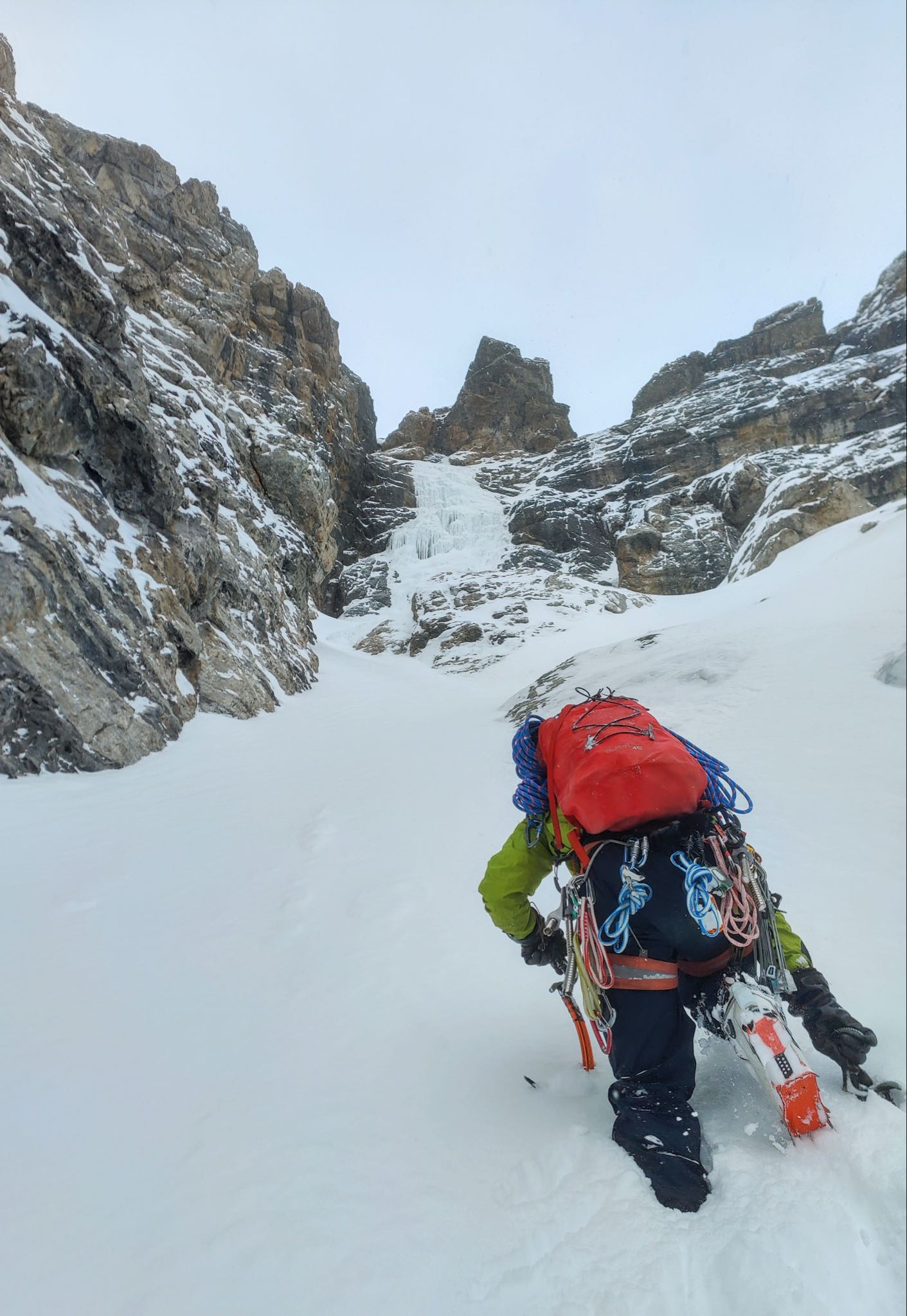
The major central gully on Protection Mountain. Possibility for the dagger on P1 to touch in a good year.
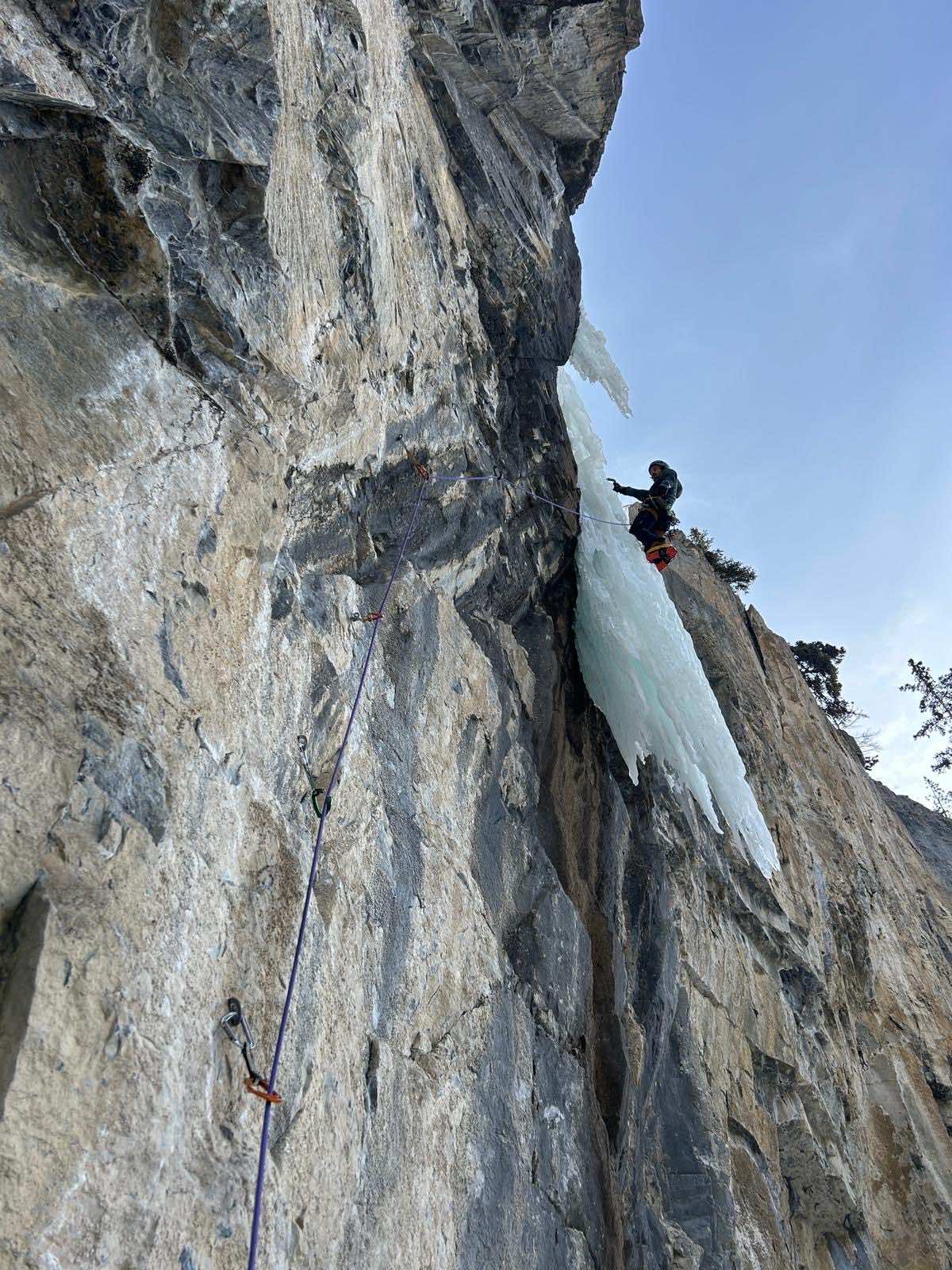
A beautiful, sustained single‑pitch pillar tucked at the back of Valley of the Birds, aptly shaped like an eagle with a cone (tail) and flared “wings” mid‑height. A historic Frank Campbell testpiece.
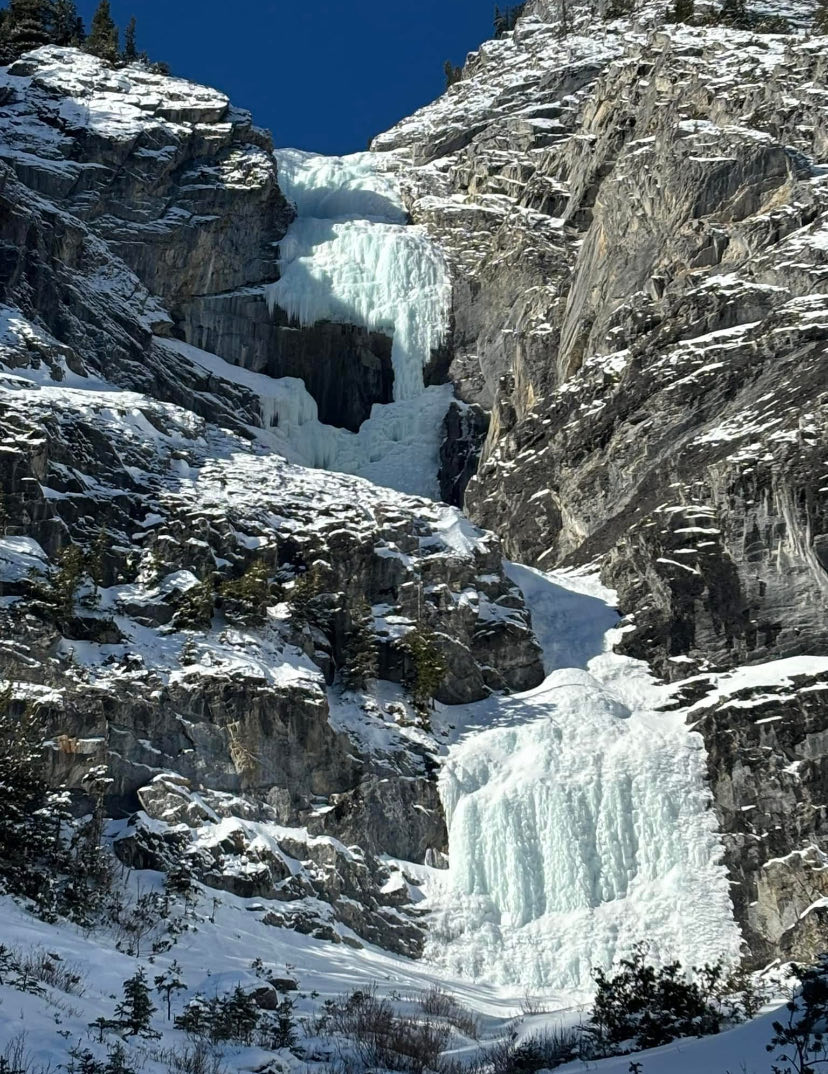
WI5 - IV - 170m Class 3 Located on the east side of Sulphur Mountain, the is climb is a stellar WI5 that forms consistently and reasonably early in the season. The approach can be quite long and difficult if there is lot’s of snow. Be very avalanche aware as you are climbing in a full on avvy zone. This climb is one of the Banff areas’s classic WI5s and should not be missed when in condition. Avalanche gear is recommended - see Parks Canada’s ATES online overview for this climb.
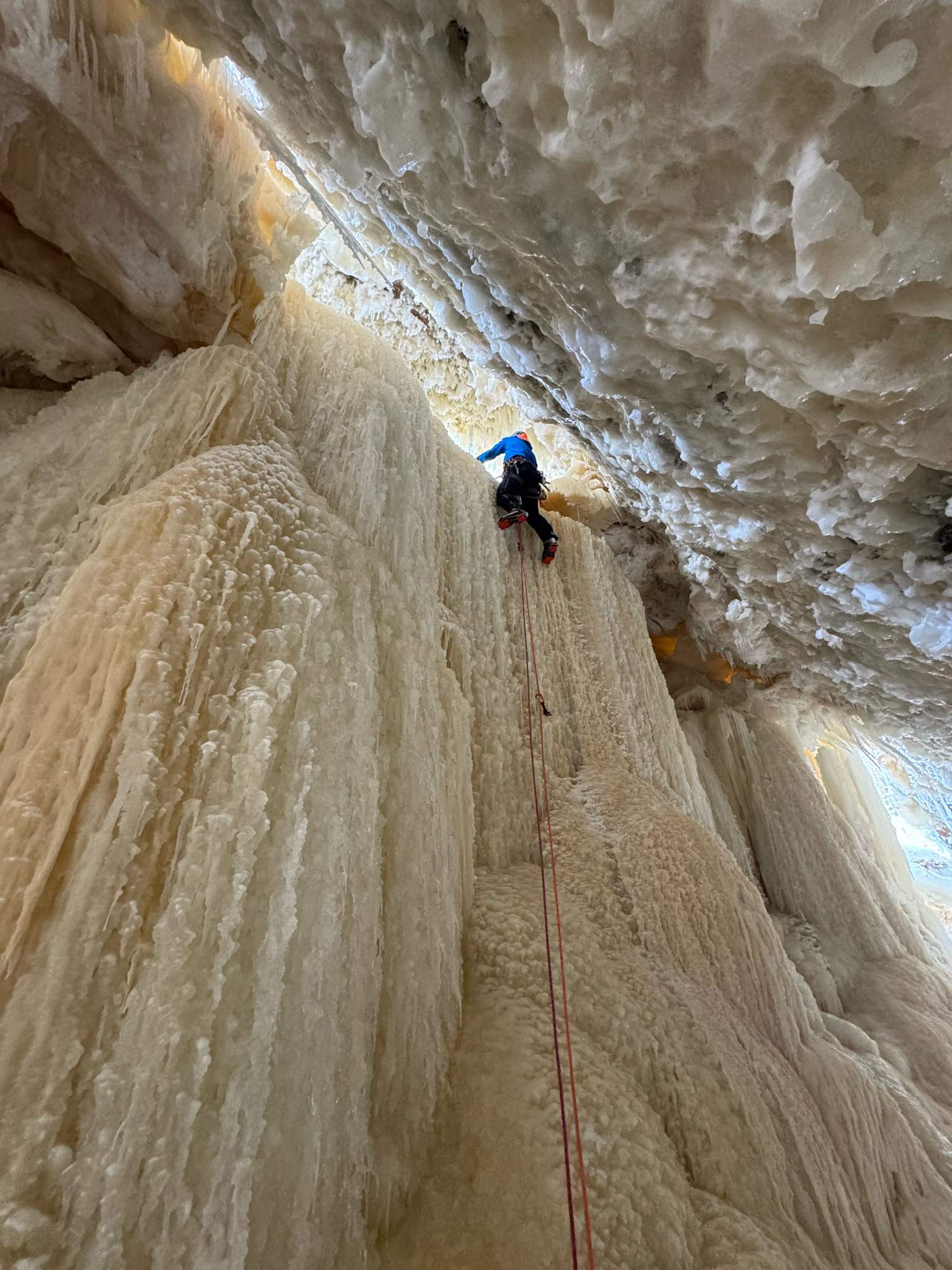
Beautiful climb in a remote area that does not see ascents very frequently. Forms very different year to year but is commonly very good solid ice.
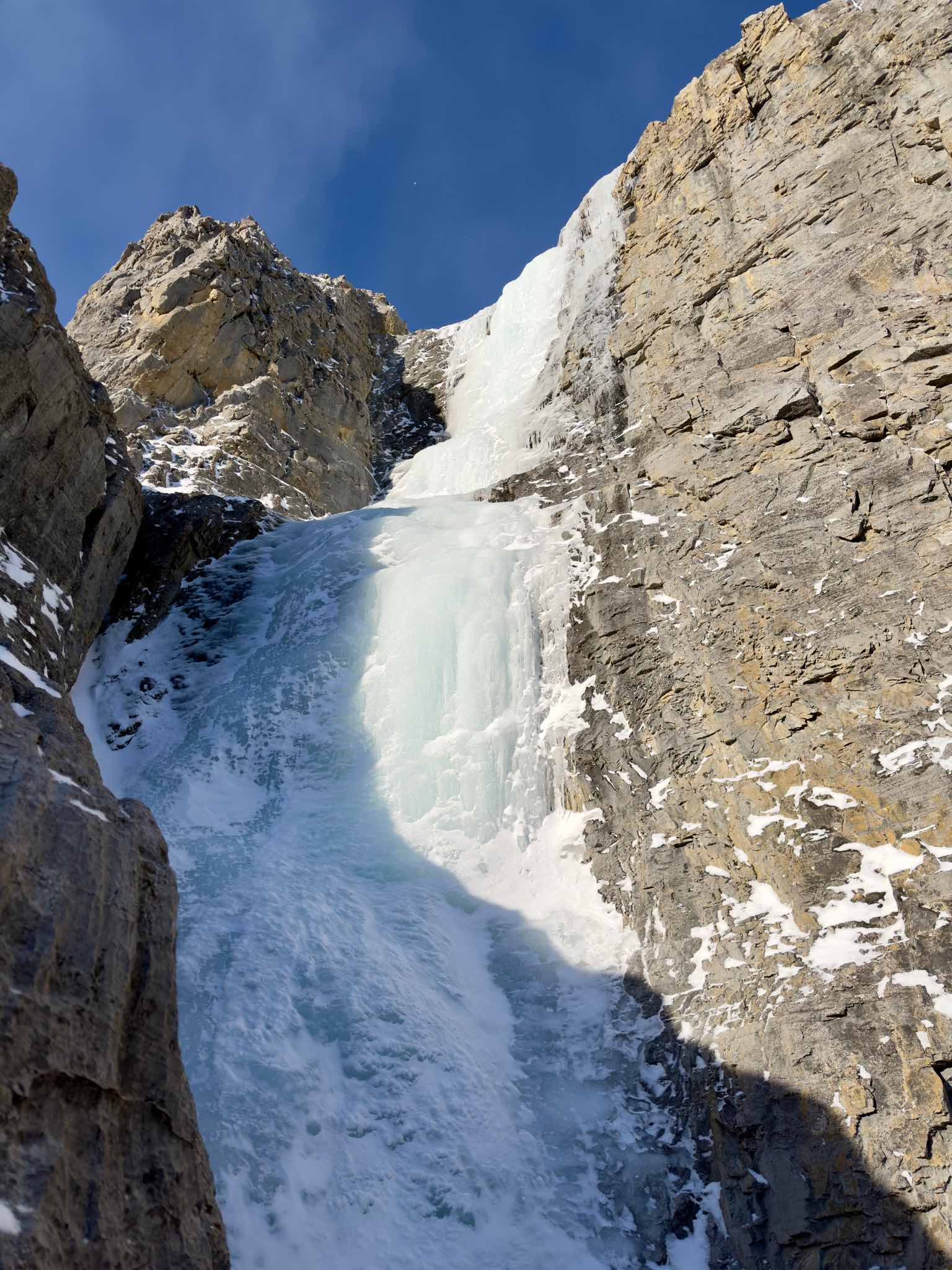
First pitch is easy grade WI 2-3. We made an ice anchor in the cave left of the pillar. Pillar is approx 15m of steep ice.
An obscure WI5 offering great early season climbing. WI5 - III - 85m
WI5 - V - 170m Class 3 3 pitches Skis, snowshoes, or walking. All methods have been used at different times of the season. Be aware of the avalanche slope further up just before the main valley plateau where the climbs are located. Long approach. 3.5 to 5 hours. FA: A. Gariepy, M. Audibert, H. Slowinski, G. Lacelle.
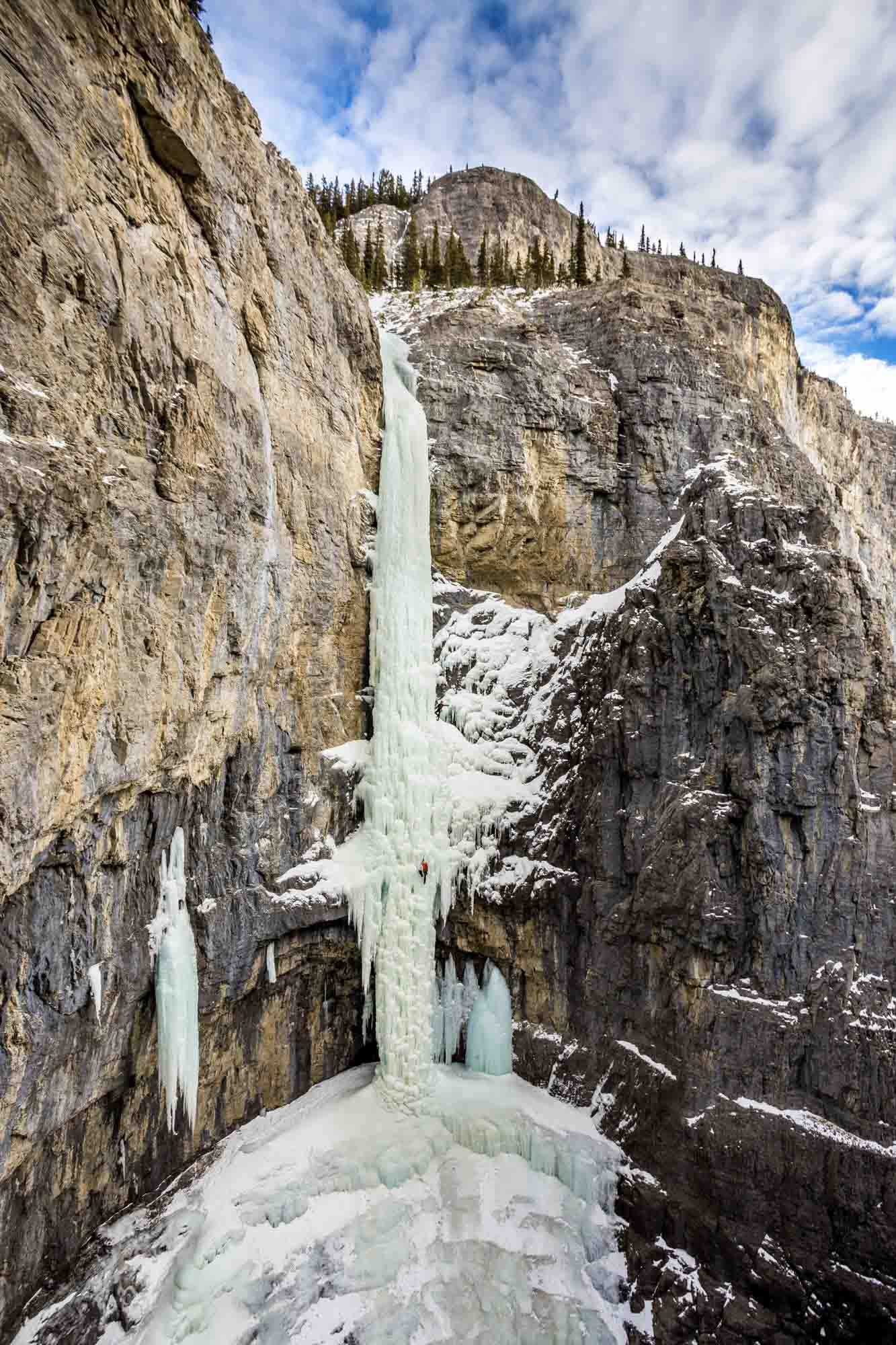
A spectacular two-pitch testpiece tucked into the far-right corner of the Recital Hall above Aquarius. The top pitch forms most seasons, while the lower pillar is often broken; when complete, the route gives 75 m of sustained, steep ice at WI6. First climbed in January 1992 by Joe Josephson and Brad Wrobleski.
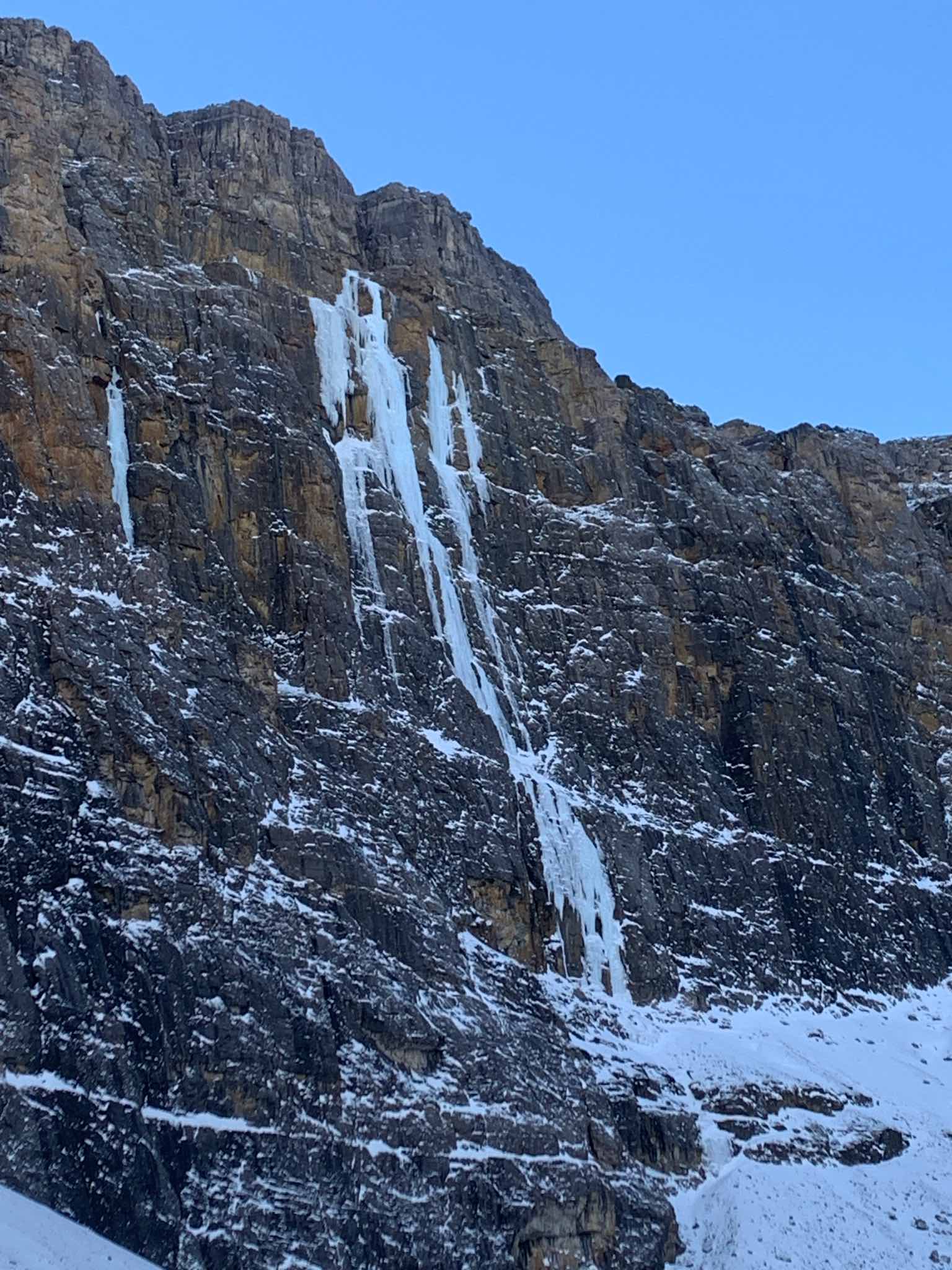
A long, remote outing in the back of Protection Valley linking the first pitch of Mon Ami to a hidden main fall, with a crux of very steep, brittle ice followed by a big finishing pillar. First climbed in March 1997 and commonly given WI6 for the main fall; total length about 250 m. The route is rarely crowded but has seen occasional traffic in good early-season conditions.
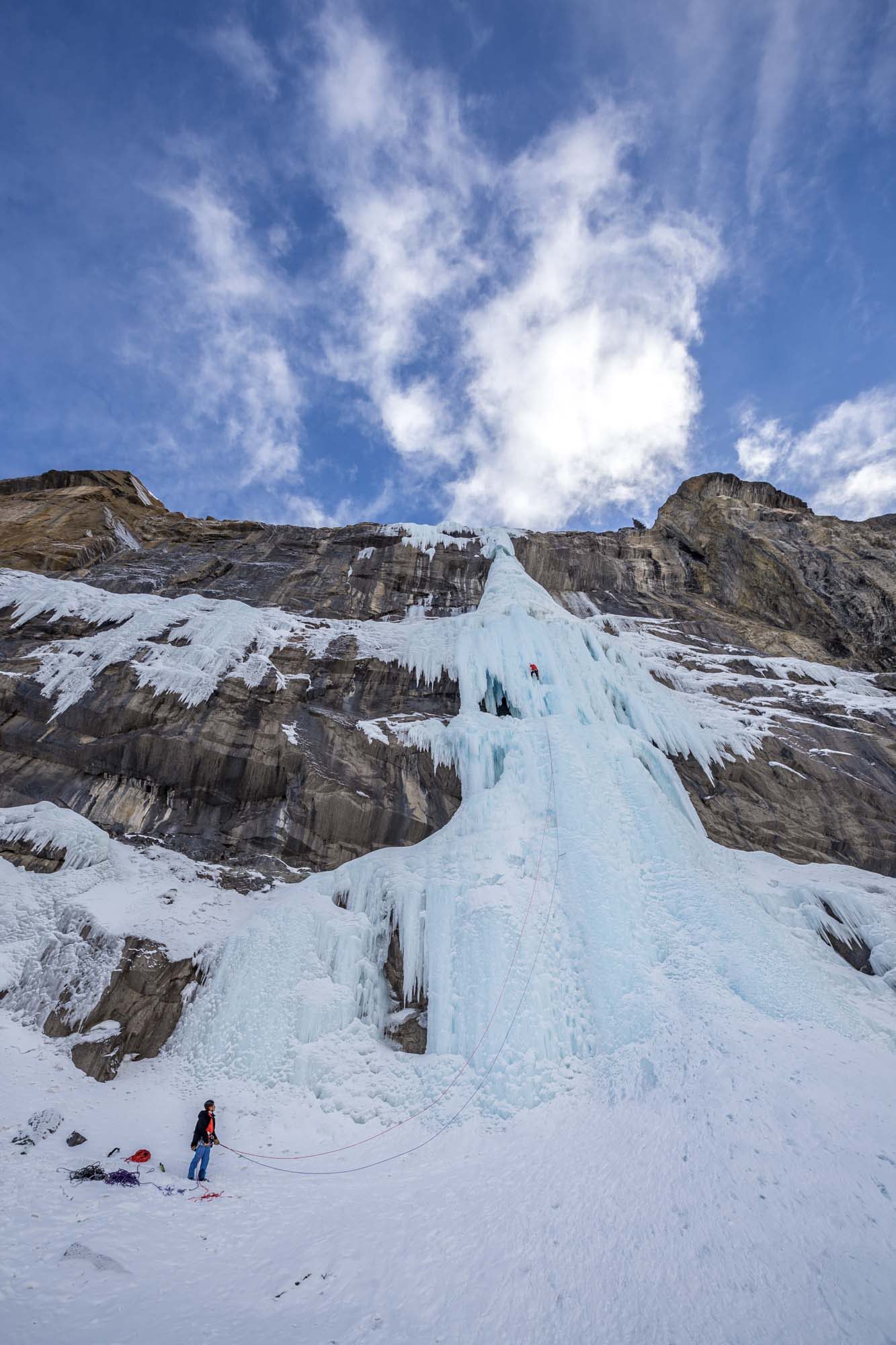
A modern Canadian Rockies testpiece of twin steep pillars connected by funky, sometimes overhanging mushrooms. Often cited as one of the scariest-looking routes around; in fat years its reputation eases, but the climbing remains consistently vertical to overhanging, especially on the upper pitch. Located on the east side of the Icefields Parkway at Tangle Ridge, a few kilometres north of Tangle Creek.
Second climb found in the canyon on the left side as you head up
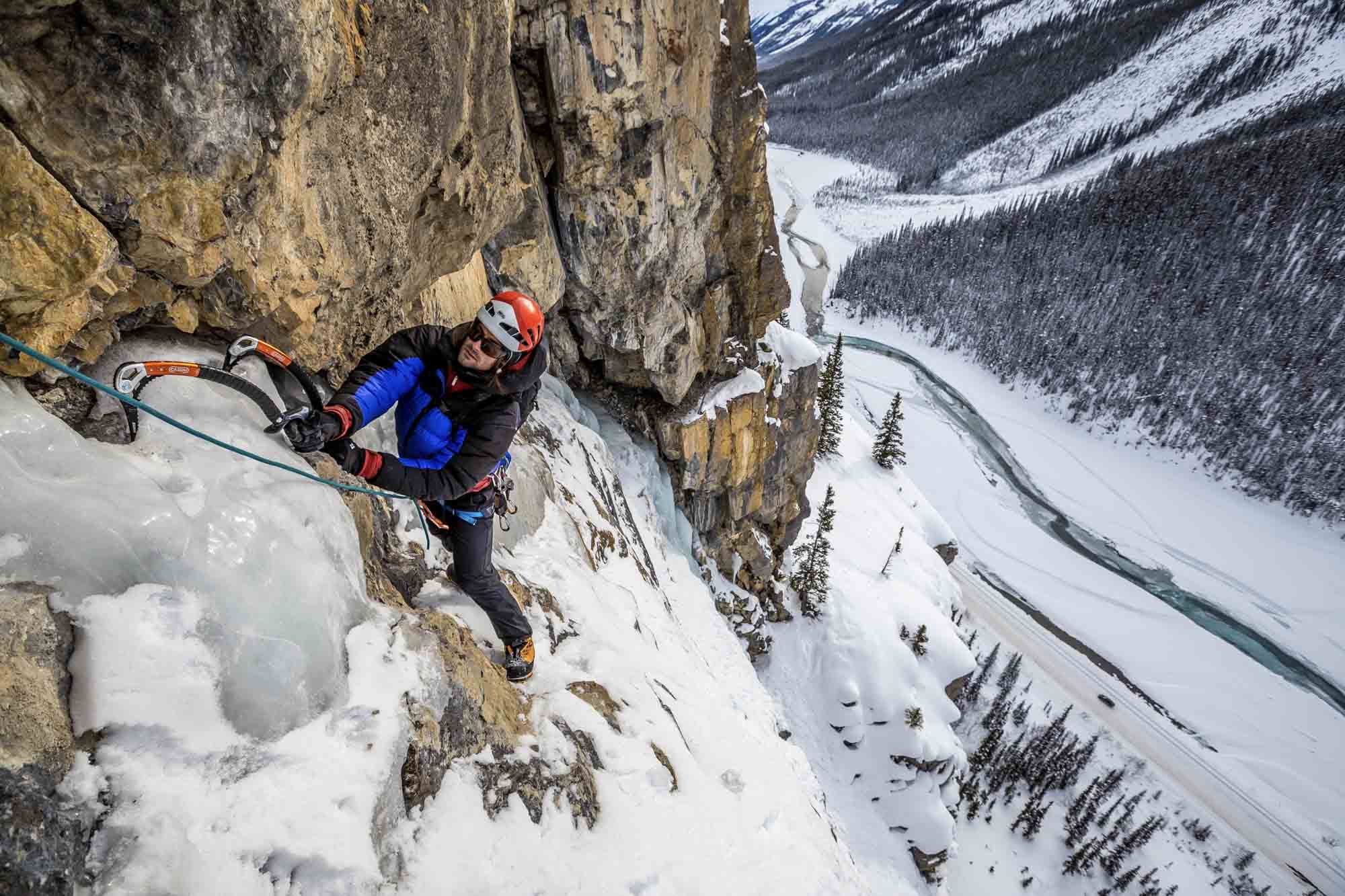
A highly recommended mixed line in the first significant gully ~200 m left of the Weeping Wall, offering Scottish‑style gully climbing that builds to a thin, steep ice crux. Commonly broken into 6–7 pitches depending on conditions and belay choices. First climbed in December 1991 by Joe Buszowski and Troy Kirwan. The Weeping Wall area faces southwest, which influences conditions and sun exposure.
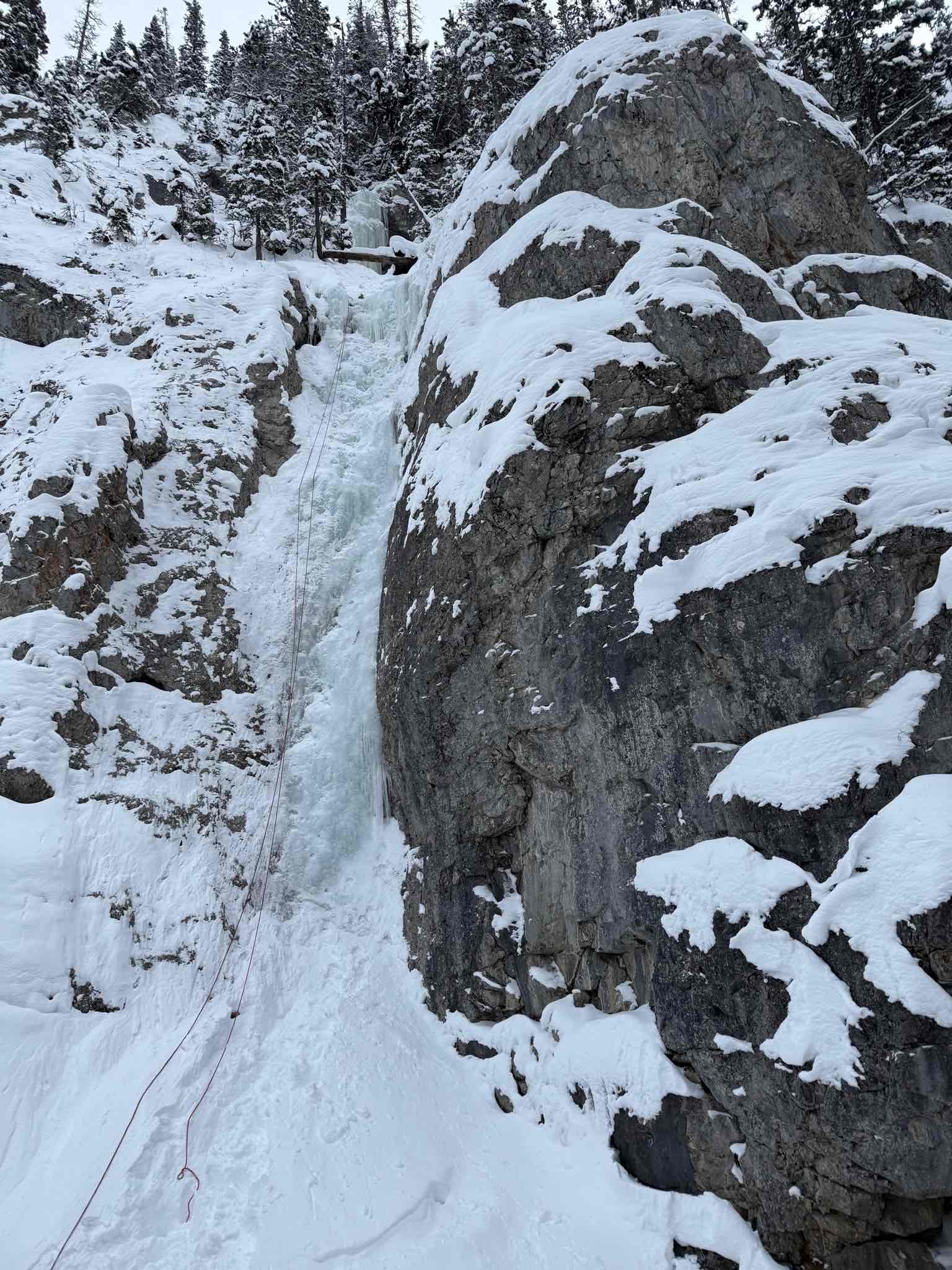
4 flows in the north side of the creek ranging from WI2 to WI3-3+. The second flow from the right into the cave has a very short thin start. 1st and last routes are the longest.
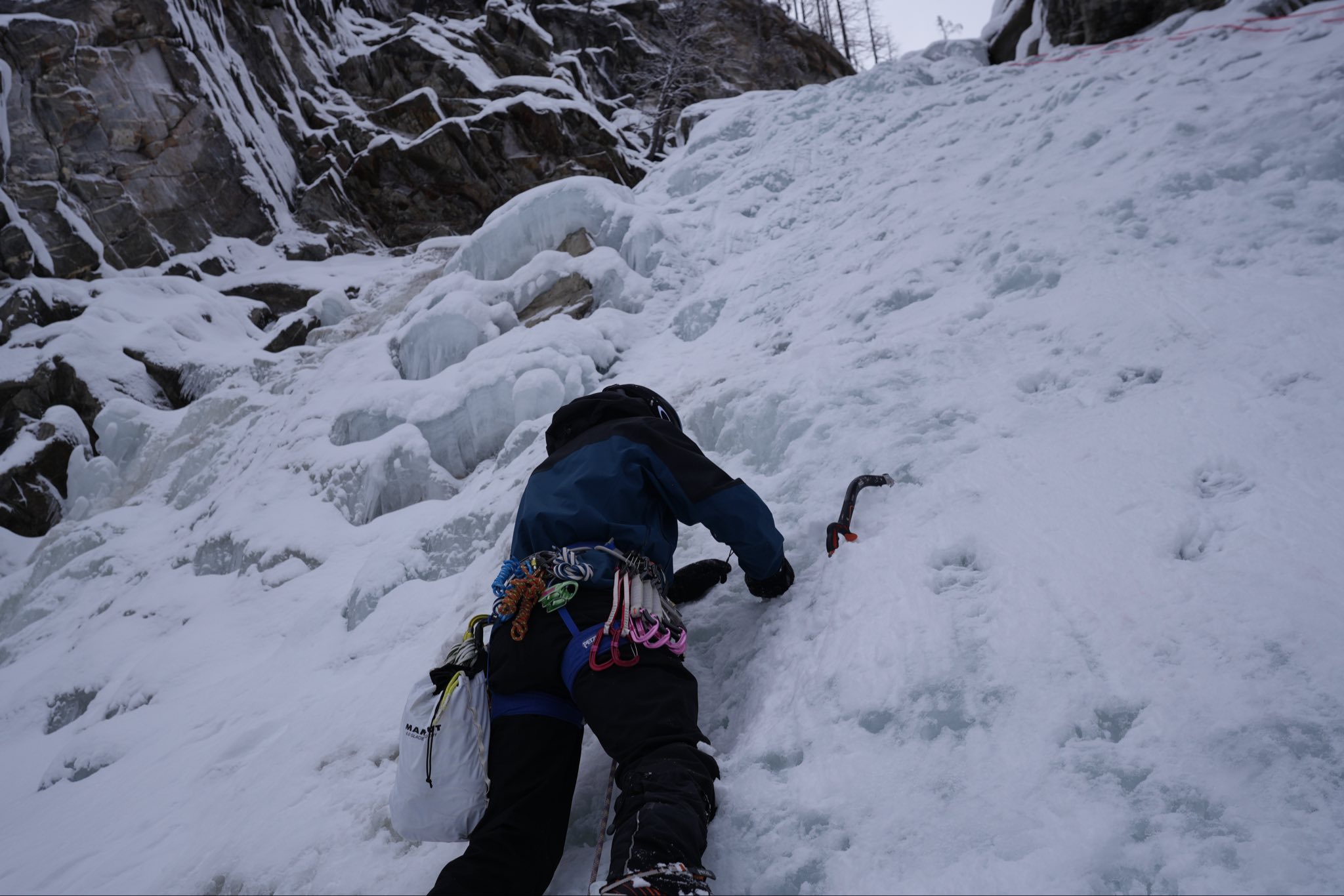
2 pitches of ice flow that go at WI2-3, there is a walk in the middle, it is 2 separate climbs
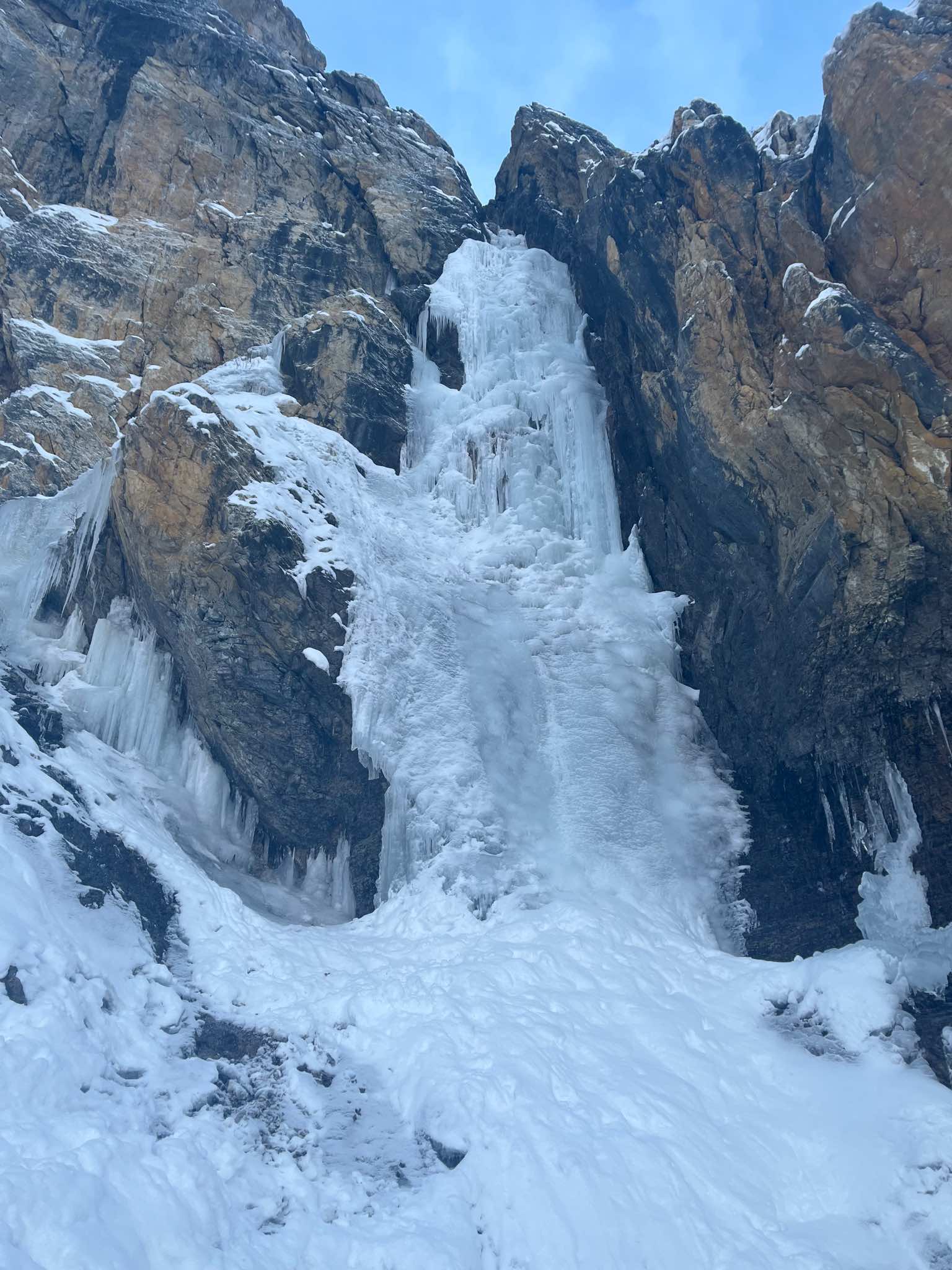
A fine 2-3 pitch outing.
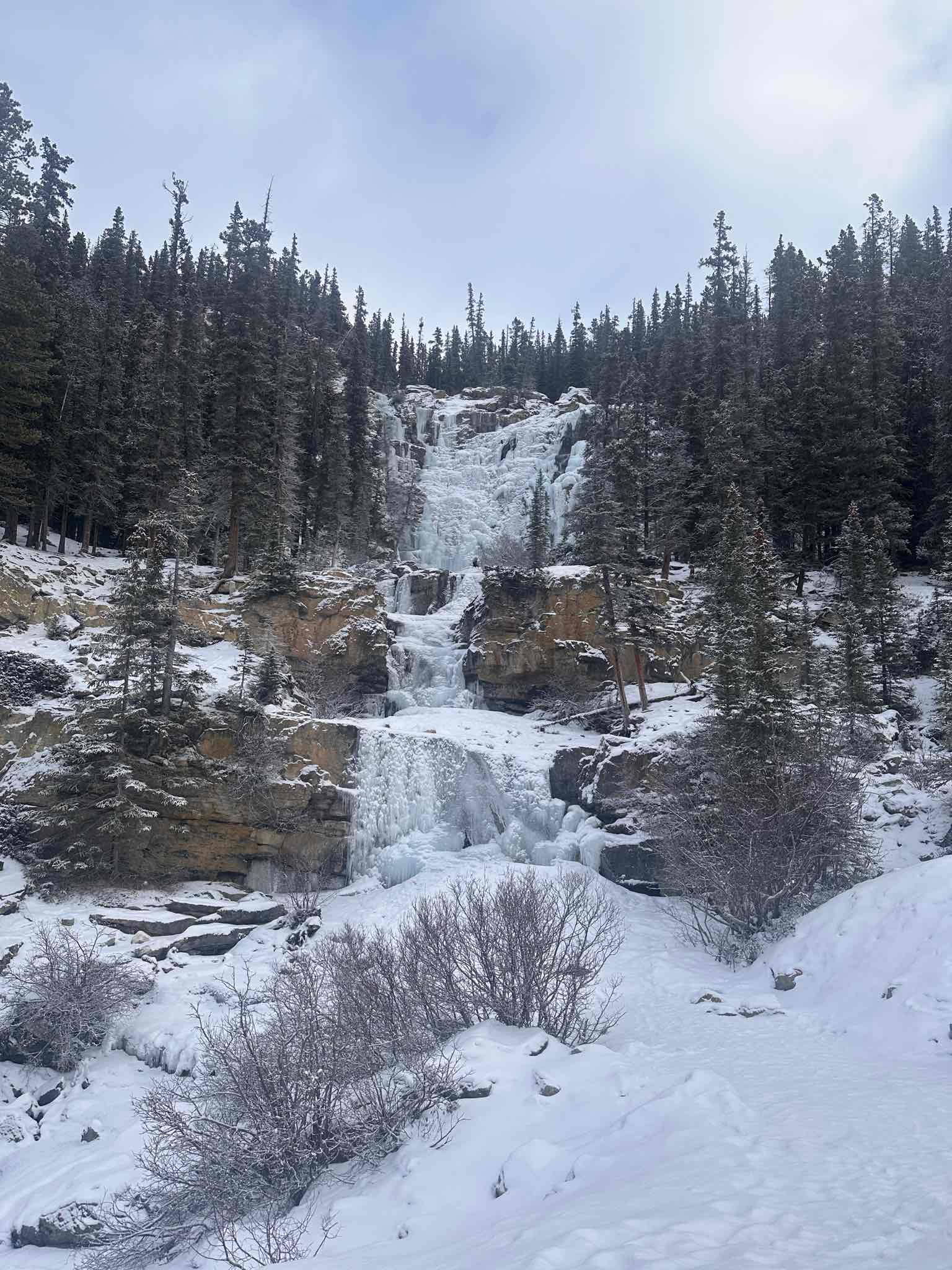
Some easy water to climb in tree line, ATES Class1 From Parks Can: Tangle Falls are located on the north side of Tangle Hill, 7.4 km north of the Icefields Centre along the Icefields Parkway. Park in the ploughed area close to the outhouses.
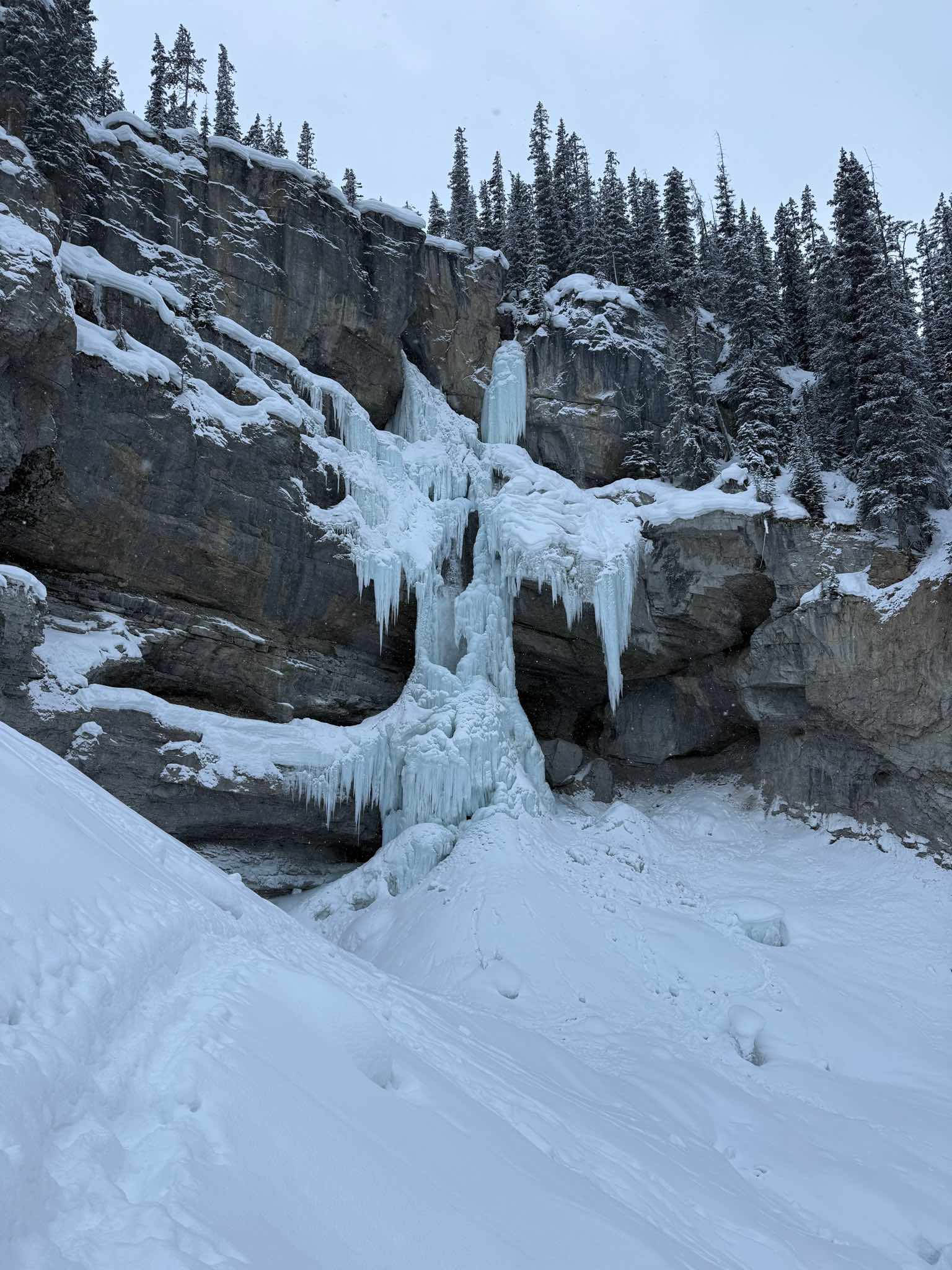
60m WI3-4 From Parks Can: Park in the ploughed viewpoint to Bridal Veil Falls on the Big Bend Hill along the Icefields Parkway. The top of the climb can be accessed from below by following an often snow covered summer trail through the timber below the south end of the parking area. Although there is no avalanche danger on the route, to access the climb from below you will be exposed to some steep avalanche prone slopes. To avoid these entirely you can rappel from the top of the climb to the base of the route. The climb is usually done as 2 pitches with the first pitch starting from inside ‘The Cineplex’ cave, home to ‘The Game’ and ‘Musashi’ (two of the best and hardest modern mixed sport routes in the world). The exit pitch is through a cool Scottish gully like feature. Be aware that there are some deep narrow limestone slots between the top of the climb and the parking area, often completely hidden by snow.
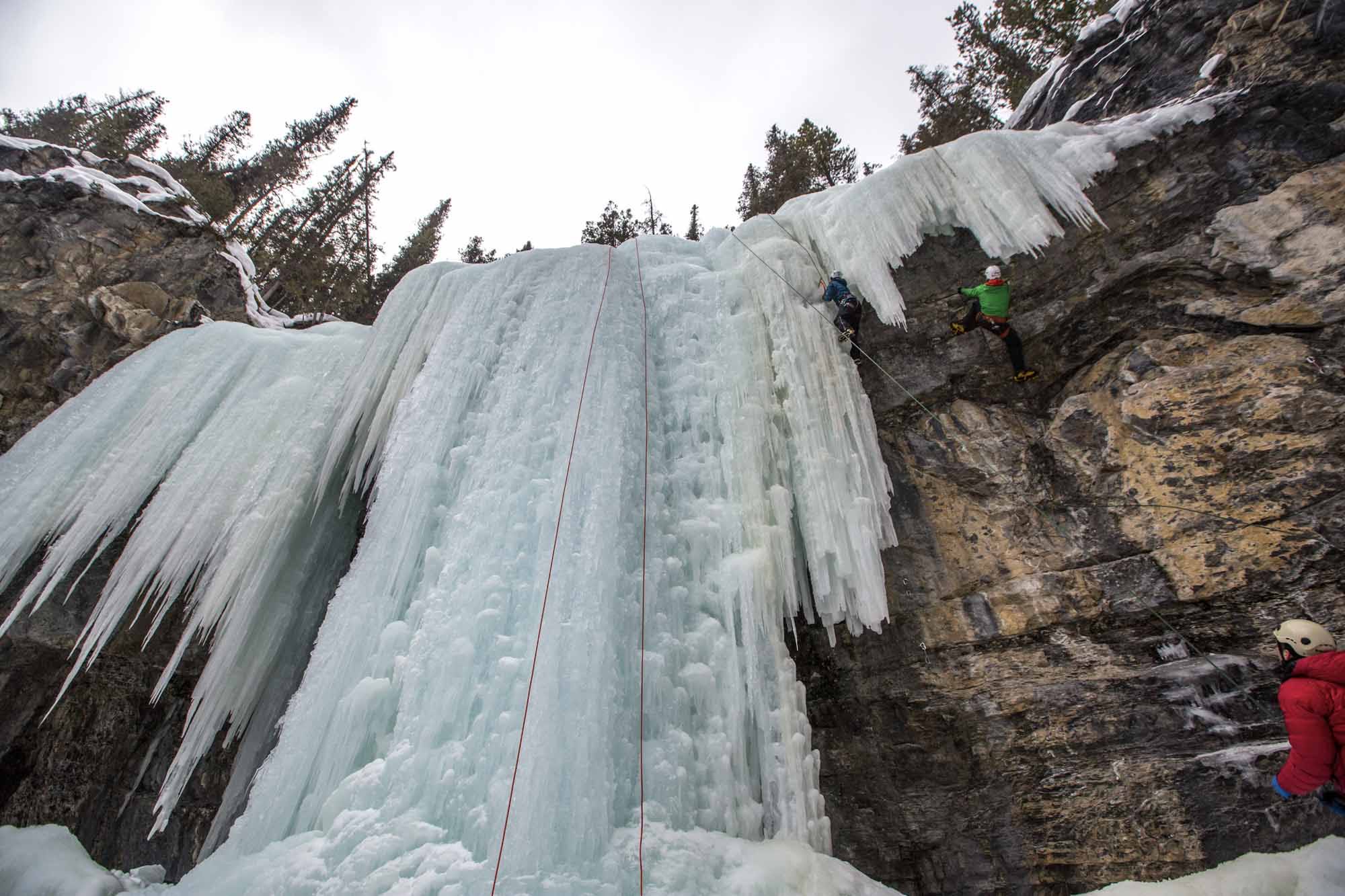
A short, steep curtain at the mouth of the Bear Spirit drainage on the east side of Mount Cory. Typically forms fat and is climbed around WI4 today, though historical descriptions note WI3–4+ depending on build. First ascent by Cory Ogle in December 1995. The broader Bear Spirit crag is popular for top‑roping when conditions allow.
The Replicant is the slender, ephemeral pillar immediately right of The Terminator on the Trophy Wall of Mount Rundle above Banff. When formed it offers three sustained pitches of steep ice for roughly 145 m, typically around WI6 in difficulty, finishing on excellent, more featured ice. First climbed in January 1994, it forms sporadically and is known to appear suddenly in mid to late winter. The wall is on the north face and sees little to no sun.
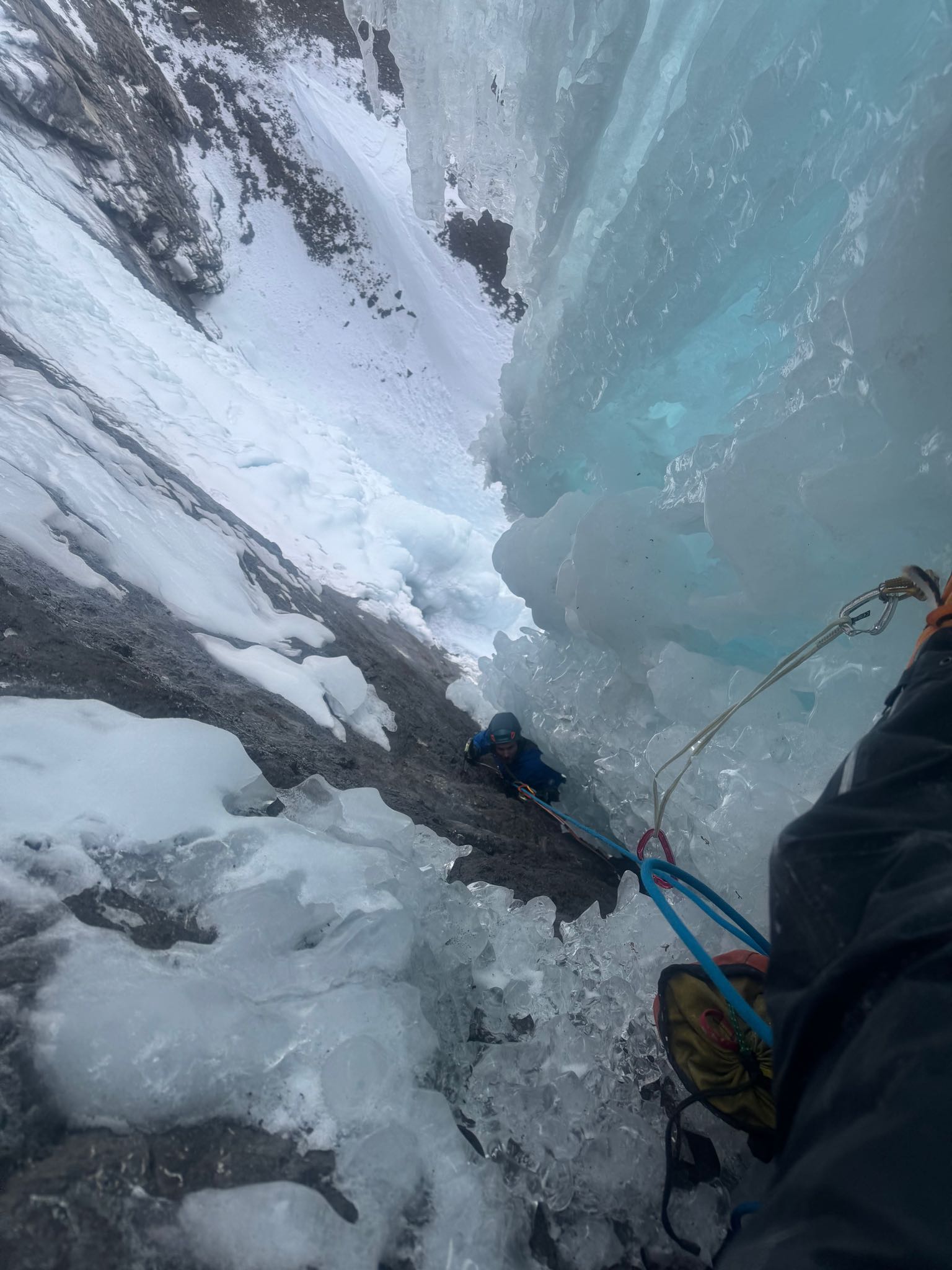
A modern Rockies mixed classic on the east face of Orient Point above the Ghost. The line links two steep, bolted mixed cruxes with outrageous curtains and pillars for about 195 m over five pitches. Originally reported around WI7 M7+ in early guidebooks, current consensus is roughly WI6 M8. First ascent: December 1998 by Kefira Allen, Eric Dumerac, Sean Isaac and Dave Thomson.
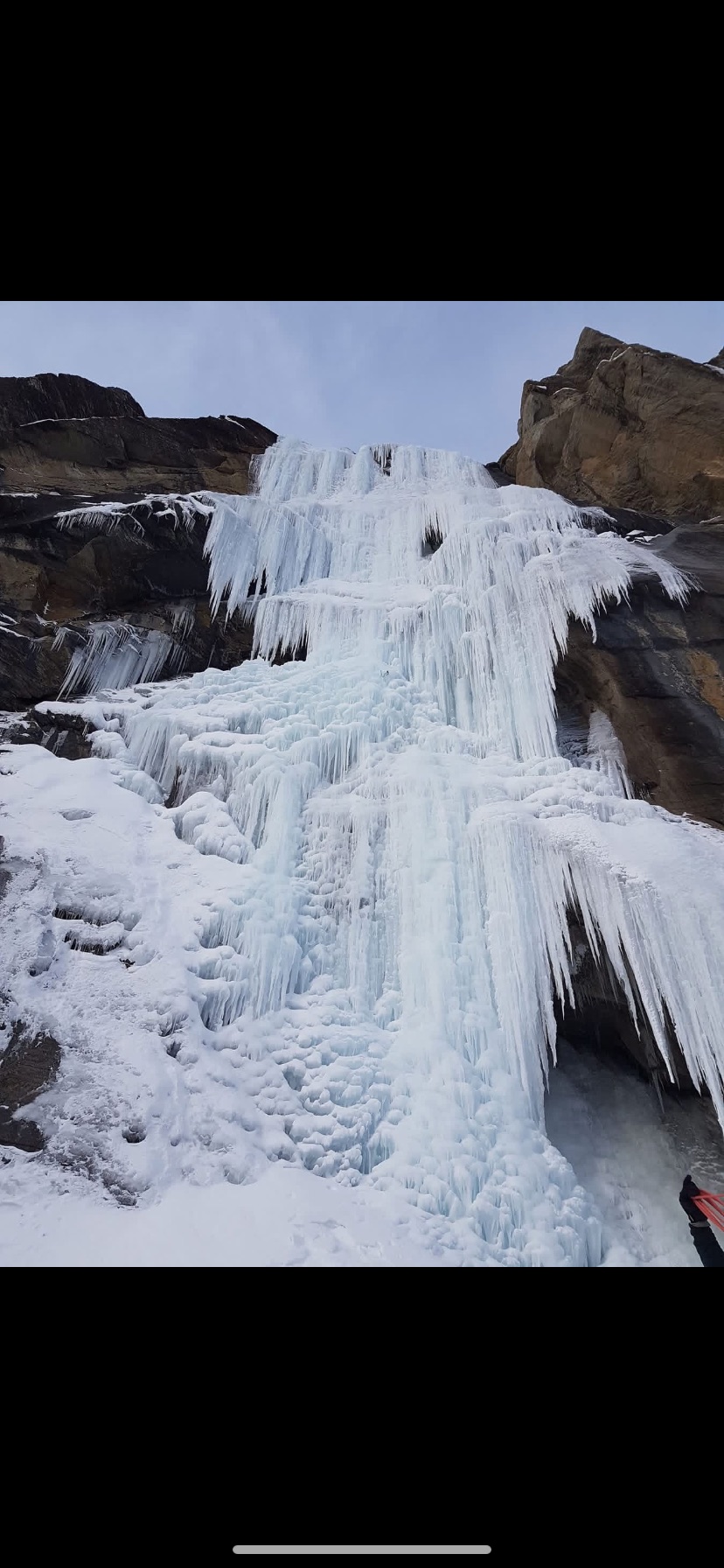
This curtain is the obvious tiered curtain close to the road and visible from the trans-canada hwy. A classic moderate for the Field area. This climb and others in the area have vast amounts of avalanche chutes feeding them. Always be in the know on current avalanche conditions and plan your day accordingly. Although a moderate climb, do not underestimate the seriousness of the terrain you are in. FA: 1974 FFA: Albi Sole & partner Dec. 1977.
20m line of WI2/WI3 ice that normally forms early to mid November. Flow has two lines when fully in and is a great spot for beginner. Beware of the avalanche risk associated with climbing here.
Ice and mixed in a roundabout 15 minutes north of Vernon
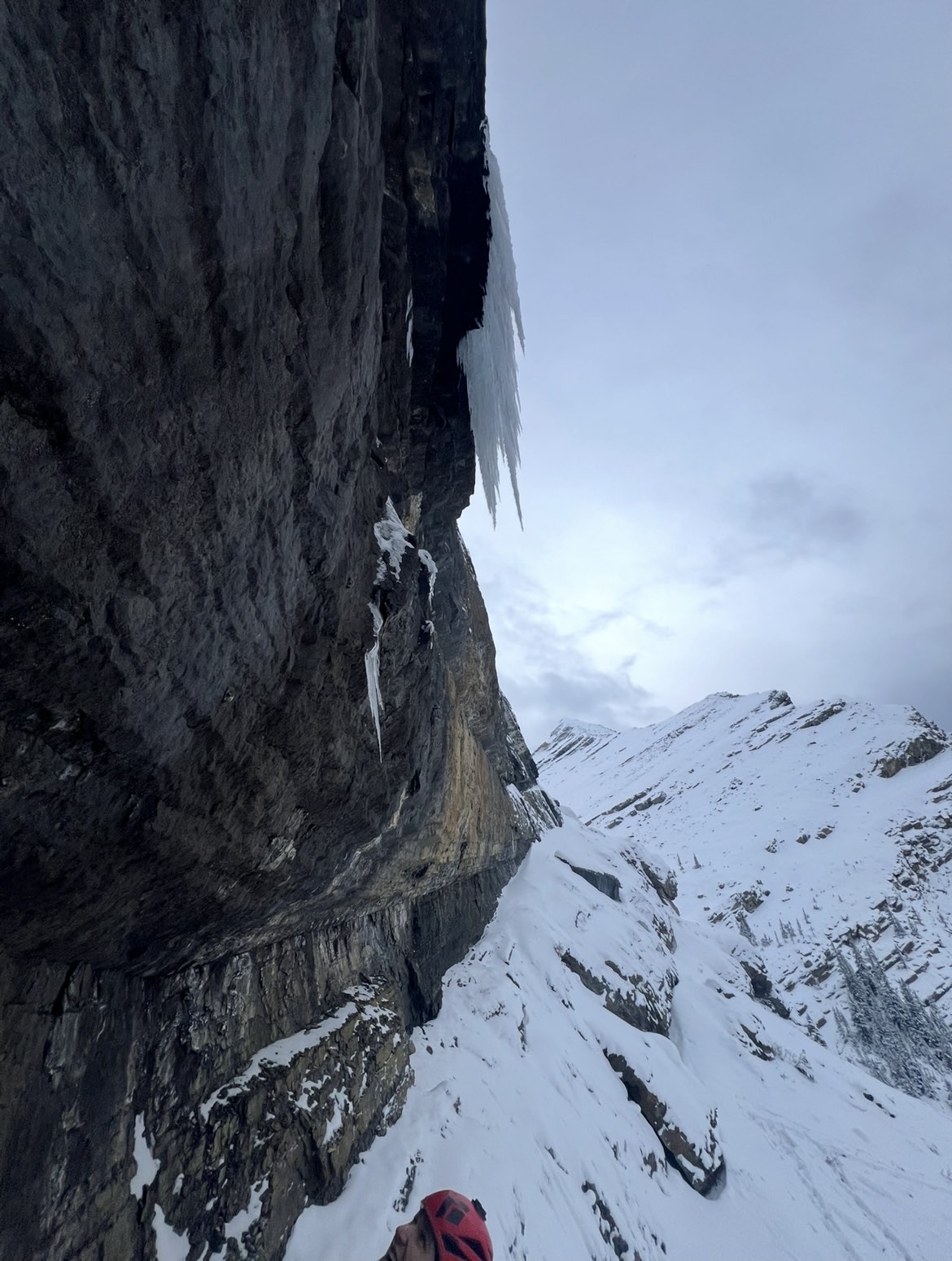
A two-pitch mixed route featuring steep rock to a WI5 ice pillar and sculpted ice on the upper pitch.
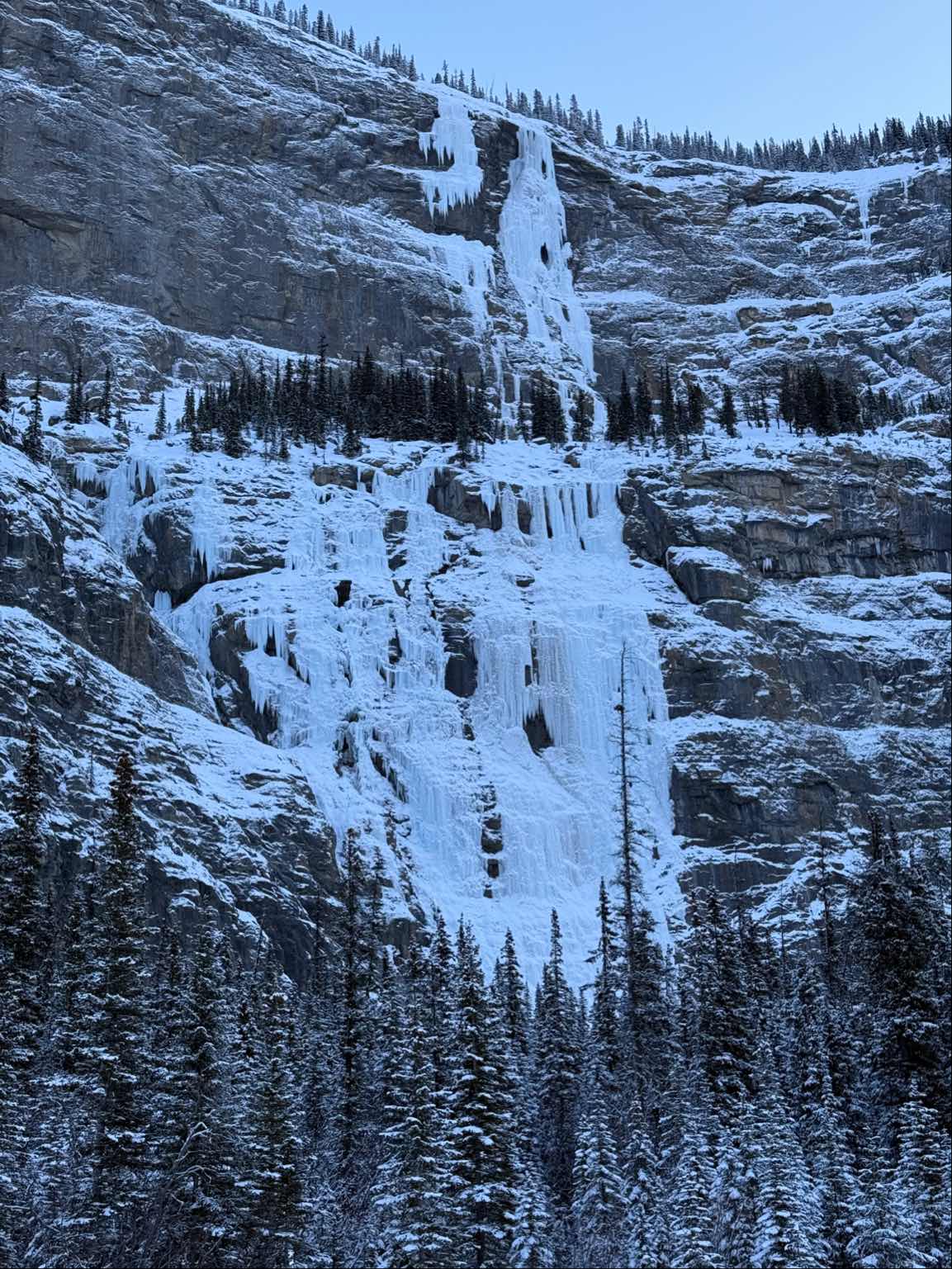
The Weeping Wall is a broad, south‑facing roadside ice cliff on the Icefields Parkway offering multiple parallel lines from WI3 to WI6 on the lower tier with harder routes above. This entry describes a representative ascent of the Lower Weeping Wall via the classic Right‑Hand line (III WI5, ~180 m), with notes on common descent infrastructure shared by the wall. The wall sees plentiful sun but remains a reliable mid‑winter venue with low avalanche exposure compared to nearby objectives.
An outstanding route and a very sought after ascent when the route forms. Fantastic exposure, steep climbing and comfortable belays given the position of the route. First climbed in 1985 by Craig Reason and Jay Smith on the north face of Mount Rundle; long considered the wall’s benchmark line.
Left-hand of the two high-tier “beer” falls perched above the top of Guinness Gully on Mount Dennis. Typically formed and reliable, it gives an excellent two-pitch outing of about 90 m on quality ice: a lower-angled shield leading to a long, steeper crux pitch. Expect notable avalanche exposure on the approach and at the route.
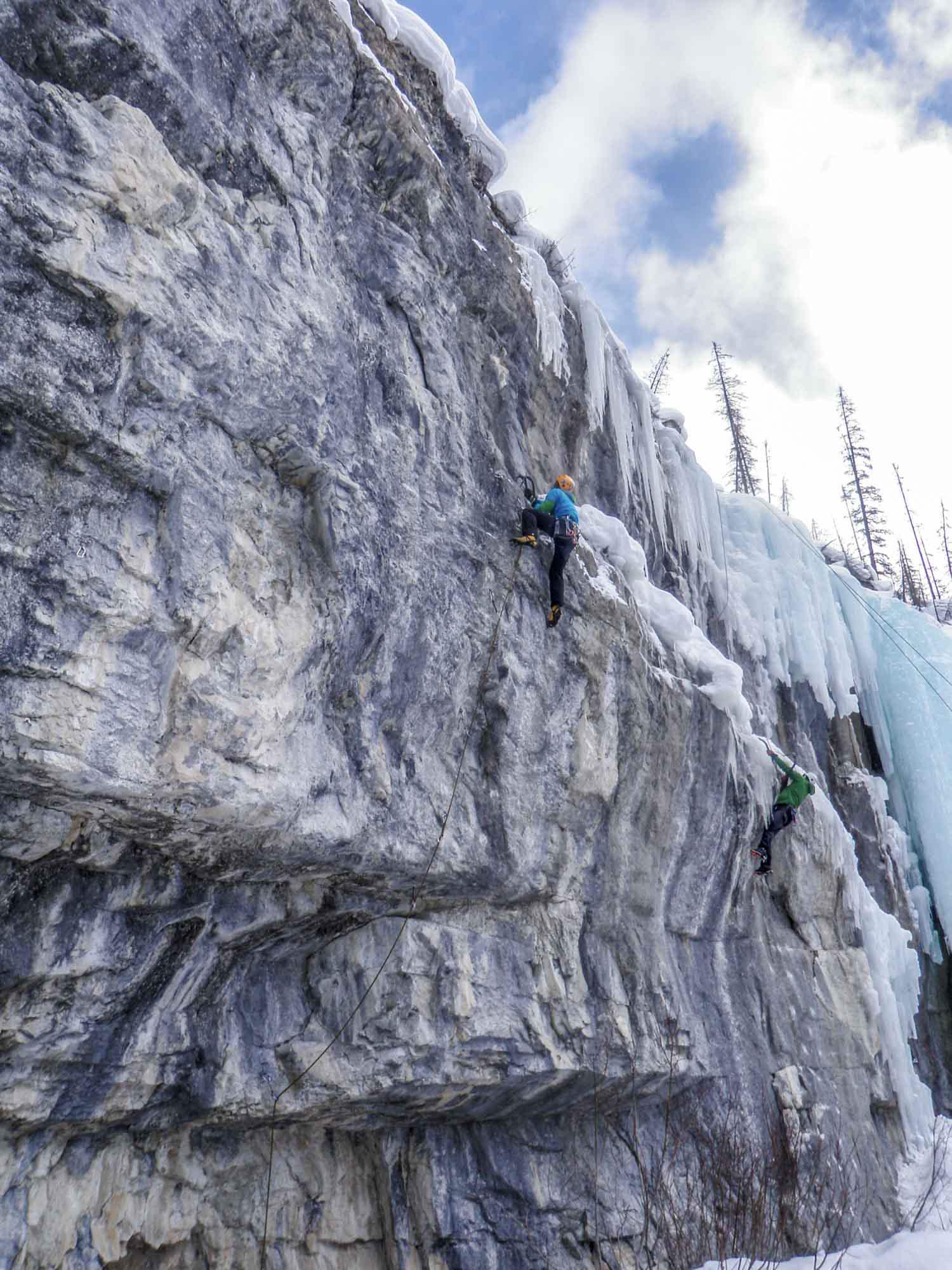
Mainly a full dry tooled route with very little ice. The crux is the roof at the start but the climbing is sustained with the exception of a rest at 2/3 height.
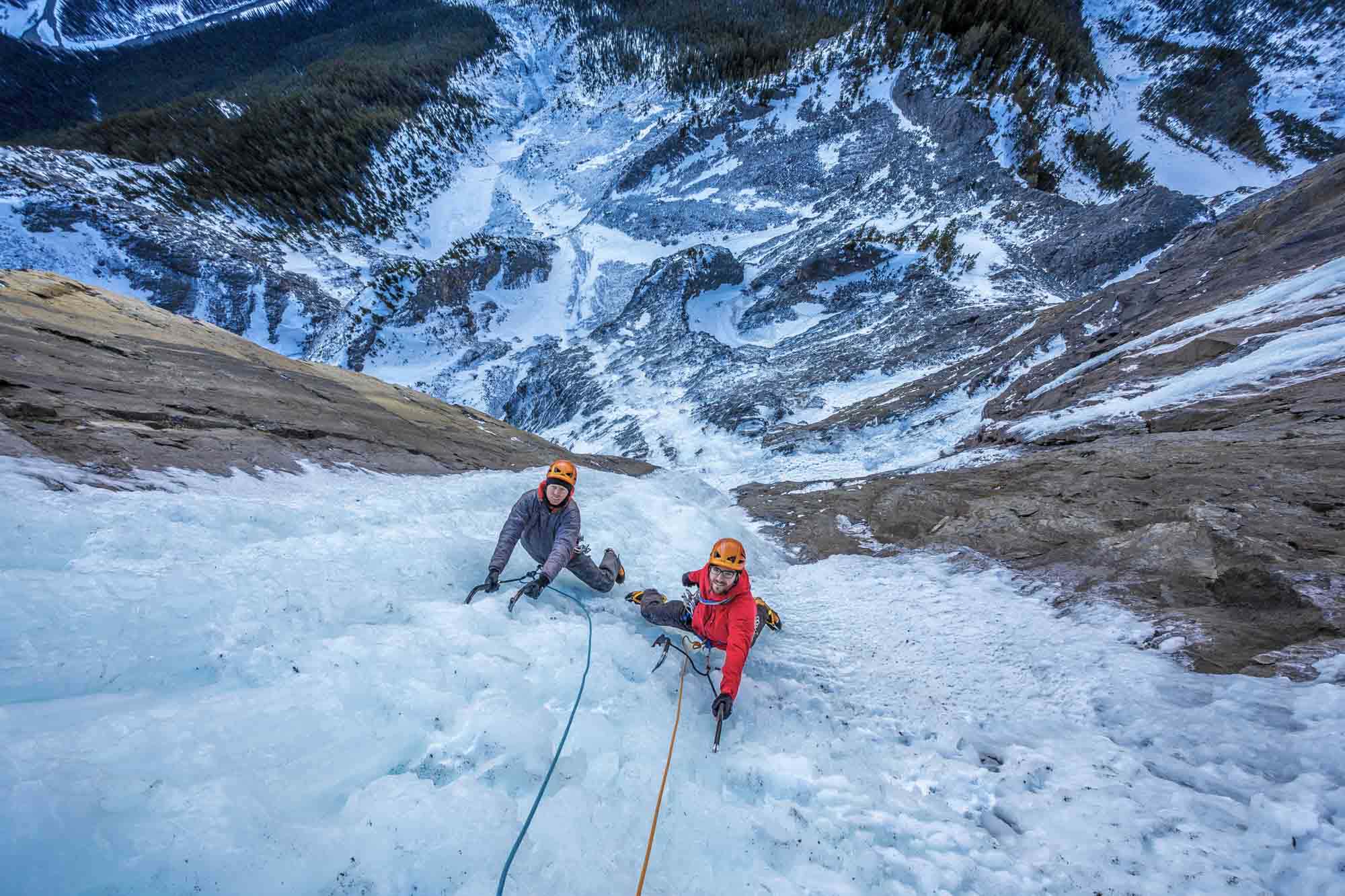
The rightmost line on Banff’s Trophy Wall, Sea of Vapours is a serious, condition-dependent testpiece. In its thinnest state (first ascent), it was graded WI7+ R, with solid belays but virtually no protection on lead; in fatter years it settles to sustained WI5/6. The wall is north-facing and cold, and the route has formed in many different configurations over the years—sometimes even to the ground. FA in February 1993 by Bruce Hendricks and Joe Josephson.
Usually an iced‑up rock route on the right side of the Moonlight/Snowline wall in Evan‑Thomas Creek; in fat years it can form as continuous ice. Historically given an R rating; more recently reported as retro‑bolted, though parties commonly build anchors on ice. Two long pitches.
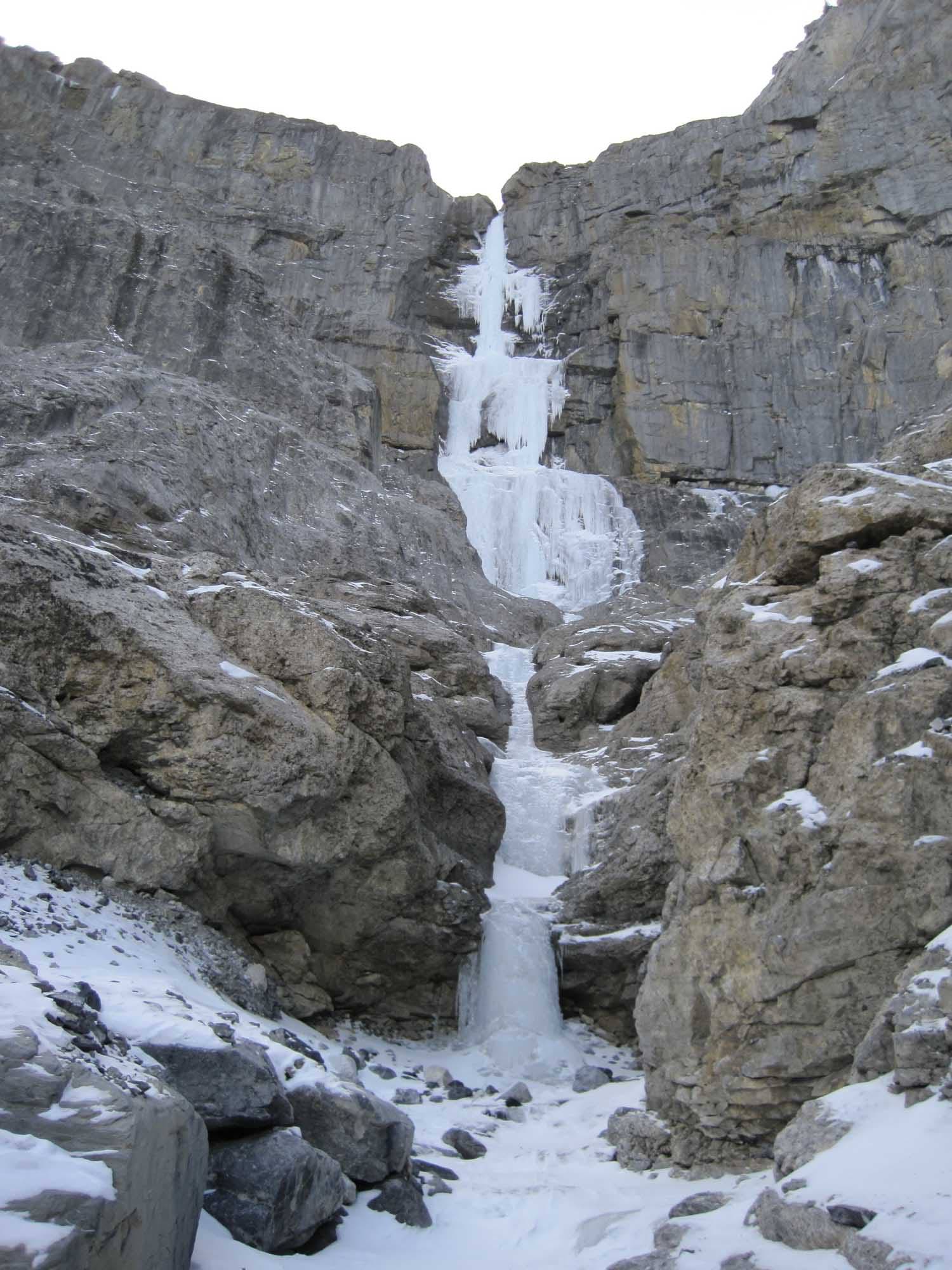
A striking two-pitch sheet-and-pillar tucked beneath one of the largest avalanche bowls in the Bow Valley; many locals have also called it Under the Volcano. Clearly visible from Highway 1 in the next gully left (east) of Professor Falls, it’s an early-season objective when the bowl above is lean.
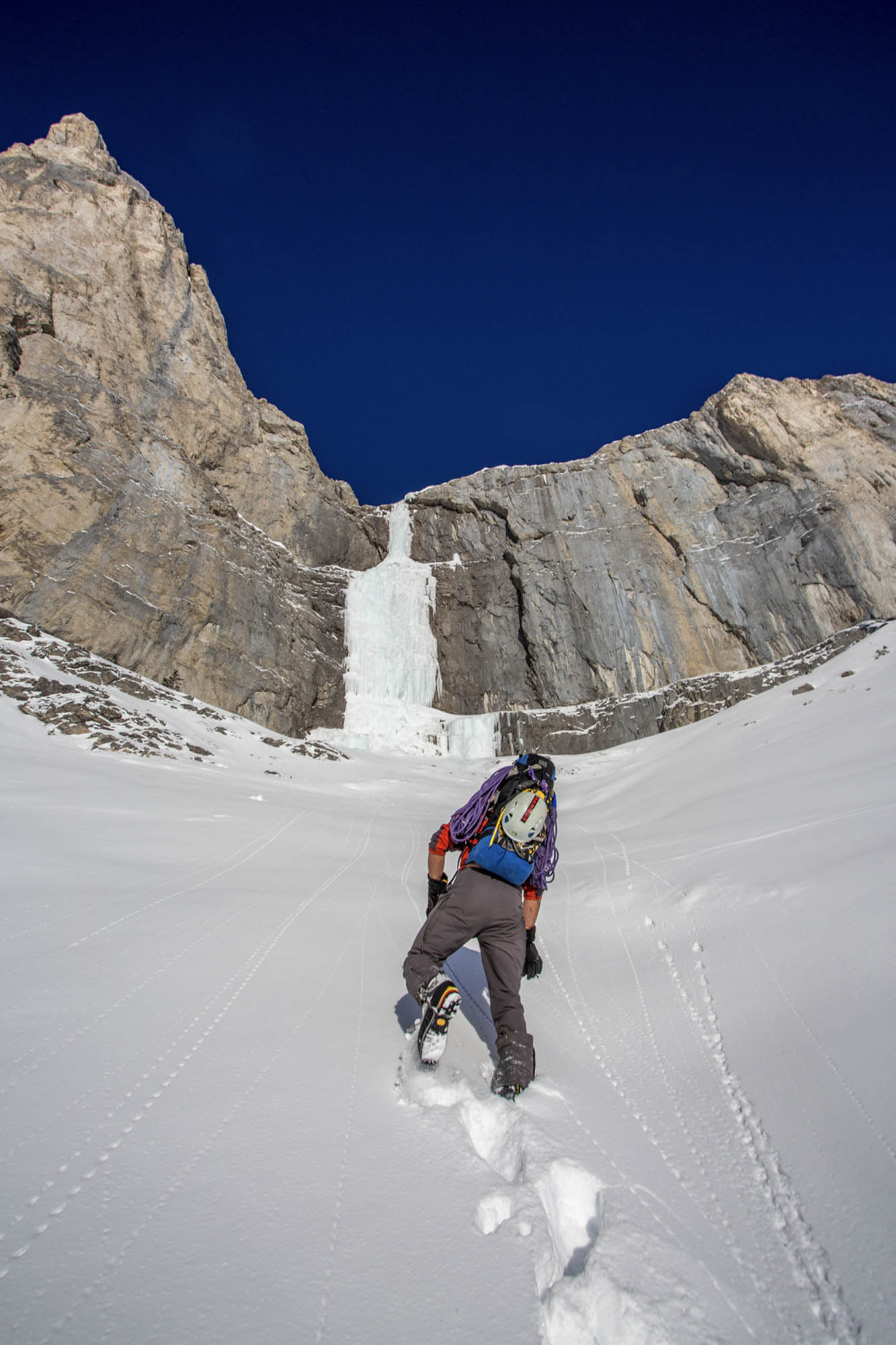
A sunny two-pitch waterfall in a beautiful setting below the Mount Kidd bowl, visible from Highway 40. Despite its moderate grade, it sits beneath a large avalanche bowl—choose conditions carefully. First ascent: January 1982 by Barry Blanchard and Iain Stewart-Patterson.
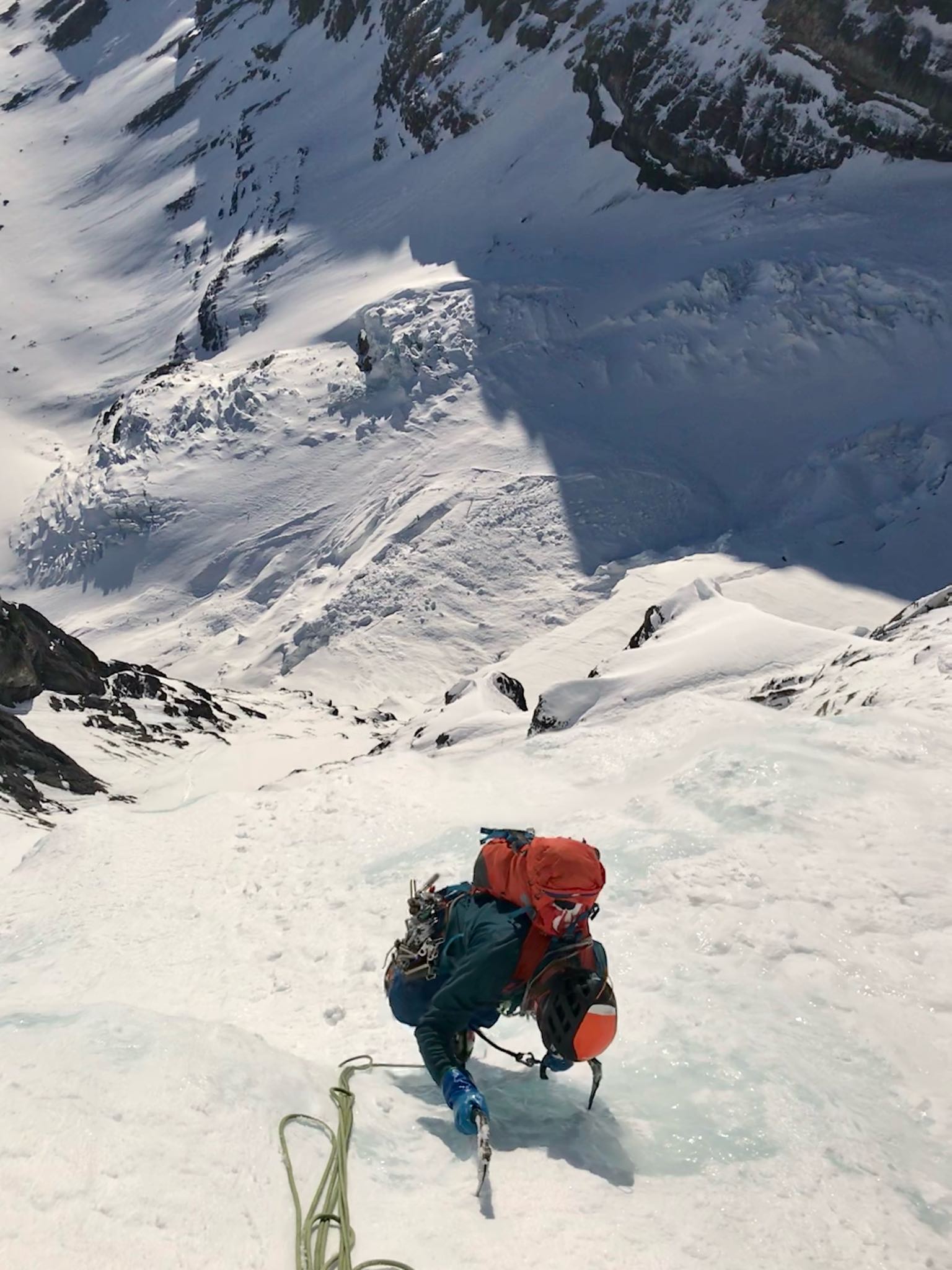
Perhaps one of the most iconic pure water ice routes in the Canadian Rockies. Some 900m of gain from shrund to cornice. First pitch at the grade then lots of low angle, often deep snow in mid winter. Final section is 3-5 pitches of pretty consistent grade 4/4+. Punch the last 80m snow slope and deal with the cornice. Right on the arete with the north face is probably the easiest but you can opt for a more direct finish if you’d prefer to have any semblance of pro for the final sting in the tail.